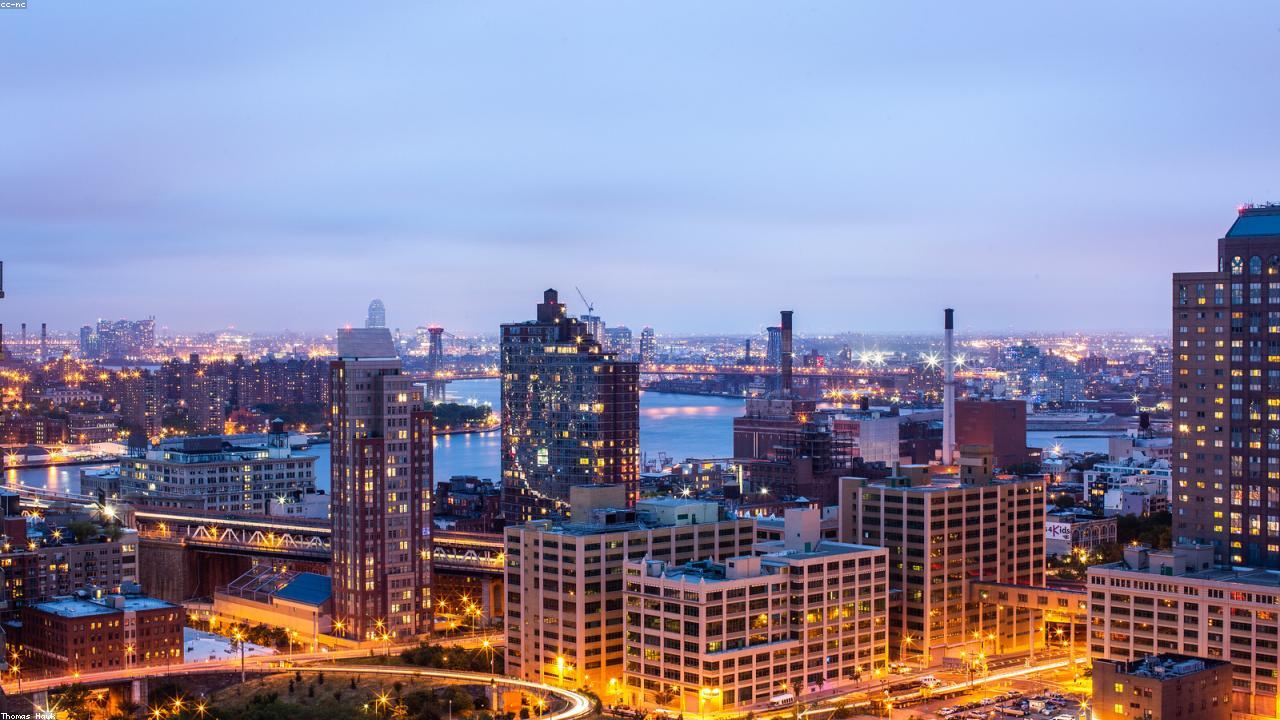
Photo: Ščenza
New York, United States · North America
New York City, slowly: the case for staying put in one neighbourhood
Most first-time visitors to New York spend three days running between the Empire State Building, Times Square, the Statue of Liberty, and a Broadway show. The better trip picks one neighbourhood per day and walks it until you have a coffee place by Thursday.

By Ščenza
· updated · 5 min read
It’s 6:47 a.m. on a Saturday on Bedford Avenue in Williamsburg and the queue for the bagel place — Black Seed — is already a dozen people deep. Half are locals in workout clothes who walked over. Half are still wearing last night’s clothes. The coffee place across the street has just unlocked the doors. Someone is walking a vast white Pyrenees. This is the New York I keep coming back for, and it’s not, primarily, in Manhattan.
Why I keep coming back
I’ve been to New York probably forty times since 1999. My relationship to the city has gone through the standard New York-tourist phases. Initially, the Manhattan icon-chasing. Then, the slightly performative Brooklyn discovery. Now, in the third decade, the recognition that the city is, deeply and consistently, a city of neighbourhoods, and that the visitor who tries to do everything will achieve nothing.
The city has changed enormously in the past twenty years — gentrification has reshaped Brooklyn and Queens; the post-Covid recovery has been uneven; rents have climbed beyond reason — and remained recognisably itself. The diner is still the diner. The deli is still the deli. The bagel still requires no less than a minute and a half of waiting.
Where to base yourself
The Lower East Side for the central neighbourhood-walking access; gritty, food-rich, walkable to most of Manhattan.
Williamsburg or Greenpoint (Brooklyn) for the contemporary Brooklyn experience.
Crown Heights or Fort Greene (Brooklyn) for a slightly more residential, less hipster-saturated Brooklyn.
The West Village or Chelsea for the classic Manhattan elegant-walking-neighbourhood.
Avoid Times Square as a base unless your trip is two nights and primarily for a Broadway show.
What to actually do
Walk the High Line. The elevated park on the former rail line; 2.4 km from the Whitney Museum south to Hudson Yards. Best at 8 a.m. or after dusk.
Spend an afternoon at the Met. Don’t try to do the whole thing. Pick three sections: the European paintings, the medieval cloisters, the Egyptian Temple of Dendur. Allow three hours.
Eat at a deli. Katz’s on East Houston is the famous one (pastrami sandwich; cash; tip the ticket-taker who slices for you); 2nd Avenue Deli is the slightly less crowded alternative.
Take the Staten Island Ferry. Free, 25 minutes each way; passes the Statue of Liberty. The best harbour view of Manhattan without the cost of a tour boat.
Walk one bridge. The Brooklyn Bridge is famous and crowded; the Williamsburg or Manhattan Bridge is the locals’ choice. Walk from Dumbo into Manhattan at sunset.
Go to a small show. Off-Broadway theatre, a jazz club at Smalls or the Village Vanguard, the Lincoln Center chamber series, the Met Opera (standing-room is US$25–35). The cultural depth of the city is the highest in the Western Hemisphere; use it.
Run or walk the Central Park loop. 9.7 km around the reservoir, the bridle path, and the loop road. Best at dawn.
Visit one museum per day, deeply. The Whitney, MoMA, the Frick (now reopened in its restored mansion), the Cooper Hewitt, the Met Cloisters in Fort Tryon Park.
Where to eat
Russ & Daughters (Lower East Side) — Smoked-fish appetising counter, since 1914. Joe’s Pizza (Carmine St) — The classic slice; cash, eat standing. Xi’an Famous Foods (multiple) — Hand-pulled Chinese noodles with cumin lamb. Lilia (Williamsburg) — Pasta; reservations elusive. Estela (Nolita) — Modern New York small-plates. Roberta’s (Bushwick) — Pizza, the new-Brooklyn template; the brunch is the move. Le Bernardin — French seafood, three Michelin stars; reserve months out. Levain Bakery — Their cookies are absurd; expect to queue. Coffee at Sey Coffee (Brooklyn) or La Cabra (Lower East Side).
When to come
Mid-April to mid-June, or September to November. Pleasant temperatures, the city in its best moods.
July and August are hot, humid, and many New Yorkers leave the city; museums are quieter but the heat is real.
December has the Christmas-tree, ice-rink, holiday-window-display set piece — touristy and atmospheric.
Practical notes
- Visa: ESTA for most Western passports (Visa Waiver Program); apply online before flying.
- Money: Card universally. Cash for tips at delis and in some bars.
- Transport: The subway is the best way to move around; the MTA card has been replaced by contactless tap-in (OMNY). One ride is currently US$2.90. Yellow cabs and Uber for late nights or specific cross-town moves.
- Tipping: 20% standard at restaurants; US$1–2 per drink at bars; US$1 per bag at hotels.
- The walking: A New York day involves more walking than most people anticipate. 10–15 km in a day is normal. Wear shoes.
- The subway map: The express vs local distinction is the single confusing point for first-time visitors. The yellow and red lines have express services skipping local stops; the green and blue lines mostly don’t. Look at the map before boarding.
A final thought
New York is the city I have written about most often in this collection and felt most ambivalent about in the writing. The city is, depending on how you look at it, the great American success story or a long slow crisis of housing affordability and public-services strain. Both are true. The neighbourhoods that gave the city its character through the second half of the 20th century — the bohemian Village, the Italian East Village, the working-class Lower East Side — have been almost entirely repriced by capital. The pizza, somehow, has hung on.
The gift the city gives the visitor, in 2026 as in 1999, is its density of small specific things. The pastrami sandwich at Katz’s. The 9 p.m. show at the Vanguard. The bagel at Black Seed. The 6 a.m. walk along the East River. The afternoon in front of one Vermeer at the Frick. The Greek diner on the corner that serves a perfect cup of coffee and a grilled cheese for twelve dollars and has done so for thirty years.
Pick a neighbourhood. Walk it twice. Eat at a deli. Take a bus once just to ride it. Stay longer than three days. The city has more than you can possibly process; the strategy is to process less of it, more carefully.
If you only have a few days
8 ideal things to do in New York
The Staten Island Ferry at dusk
Whitehall Terminal, Lower ManhattanLate afternoon; ride out and come straight back
Twenty-five minutes each way, no fare since 1997, and it passes close enough to the Statue of Liberty to make the harbour cruises look like a practical joke played on tourists. Stand at the stern going out for the skyline receding, and at the bow coming back for it arriving. You do have to get off at St George and rejoin the queue for the return, and that inconvenience is the entire price of the thing.
The Met Cloisters in Fort Tryon Park
Washington Heights, the top of ManhattanWeekday morning; the A train takes about forty minutes
Rockefeller money bought the stones of four French monastic cloisters, shipped them across, and assembled them into a museum on a bluff over the Hudson in 1938 — which sounds like vandalism and turned out to be a rescue. Inside: the Unicorn Tapestries, a medieval herb garden, and essentially nobody, because it is an hour from midtown. The quietest hour I have ever had in New York, and I have looked hard for competitors.
The Lower East Side Tenement Museum
97 and 103 Orchard StreetBook one specific apartment tour rather than a general ticket
Orchard Street has two surviving tenement buildings, restored apartment by apartment, each room holding one family's story — a German dressmaker, a Sicilian household in the Depression, Holocaust survivors, a Puerto Rican family in the seventies. You go through in small groups. The rooms are the size of my first flat in Munich and housed seven people, and the guide will not let you walk out with a comfortable feeling about it.
Green-Wood Cemetery
Sunset Park, BrooklynA clear morning; go in at the Gothic gate
Four hundred and seventy-eight acres of hills, ponds and Victorian funerary excess, opened in 1838, back when a cemetery was where a city went on a Sunday afternoon. Basquiat and Leonard Bernstein are here, along with nine unsuccessful presidential candidates, which is a niche. A colony of monk parakeets nests in the spires of the main gate — escaped from a shipment decades ago, never left — and they are astonishingly loud for a graveyard.
A late set at the Village Vanguard
Seventh Avenue South, Greenwich VillageWeeknight; take the second set, not the first
Wedge-shaped basement room, open since 1935, the oldest working jazz club in the city, with a low ceiling that is the reason all those live recordings sound the way they do. No talking, no phones, no exceptions. I watched a man removed for the first of those, quickly and without any drama at all, and the band did not stop playing or even appear to notice.
The Coney Island boardwalk and the Wonder Wheel
Southern Brooklyn, end of the D, F, N and QWarm months; the rides close for the winter
Deno's Wonder Wheel has been turning since 1920 and carries two kinds of car: eight bolted to the rim and sixteen that slide inward along curved rails and swing outward as the wheel comes over the top. Take a sliding one. It is a hundred-year-old machine doing something no modern insurer would sign off, and the boardwalk afterwards — an hour on the subway from Manhattan, and then the Atlantic — is the best cheap day in the city.
The North Woods and the Ravine, upper Central Park
Between 97th and 110th StreetsAutumn morning, midweek
Everyone walks the bottom third of Central Park. The northern end has ninety acres of engineered woodland with a stream called the Loch running diagonally through it, two small waterfalls, and Huddlestone Arch, a bridge whose boulders are held in place by nothing but their own weight — no mortar anywhere in it. You can stand under there and hear no traffic, in a park that takes tens of millions of visitors a year. It feels like a filing error.
The whispering gallery at Grand Central Terminal
Dining concourse, outside the Oyster BarOff-peak, or you will be whispering into a rush hour
Under the tiled arches on the lower level, two people standing in diagonally opposite corners and facing the wall can talk at a murmur while everybody in between hears nothing whatsoever. It has worked like this since 1913, purely because of the way the vaults are shaped. I tried it with a stranger who had also read about it, we each said something idiotic into a corner, and then we shook hands like colleagues and went our separate ways.
From a Split boy’s notebook
The Split lens
What reminded me of home
City of immigrants where every block has multiple traditions stacked on each other. The Lower East Side's layered Jewish-Chinese-Latino-foodie identity is structurally what our older Lučac neighbourhood was when the small Italian, Bosnian, and Roma communities all overlapped before the property boom. Both cities are good at multi-tradition density when allowed.
What Split could borrow
New York reclaimed an abandoned freight rail line as the High Line — the most-visited piece of urban infrastructure built in the past twenty years. Our old narrow-gauge railway between Split and Sinj is partially in ruins and partially used as informal hiking paths. Reclaiming the right-of-way as a proper walking-and-cycling corridor would be transformative.
Who can take you
Tour operators & guides to try
A short, opinionated starter list — just my humble opinion. Verify before booking.
Context Travelspecialistwww.contexttravel.com →
Context Travel's New York walks are particularly strong on architecture — the Greenwich Village walk, the High Line, the Lower East Side immigration history. Six-person cap, working academics or specialists. Caveat: New York genuinely rewards self-guided walking, more than most cities; reserve Context for the depth-on-a-specific-theme days rather than as a general orientation.
Take Walksspecialistwww.takewalks.com →
Take Walks runs the more accessible NYC walking-tour format — the Statue of Liberty / Ellis Island morning, the Museum of Modern Art priority entry, the Broadway-behind-the-scenes evening. Group size 12–18, professional guides. Caveat: their food tours in Greenwich Village and Brooklyn are fine but not as deep as the New York-specific operators (Foods of NY Tours is the long-running specialist if you want a deeper food walk).
If you liked this, try these
New Orleans, United States
New Orleans: the city that runs on jazz, gumbo, and the slow Mississippi
March 26, 2022
Lisbon, Portugal
Lisbon, the city I came back to live in
February 14, 2025

Mexico City, Mexico
Mexico City: the high-altitude metropolis that took a decade to be discovered
November 30, 2023