Photo: Ščenza
Amsterdam, Netherlands · Europe
Amsterdam beyond the canals: the city the Dutch live in
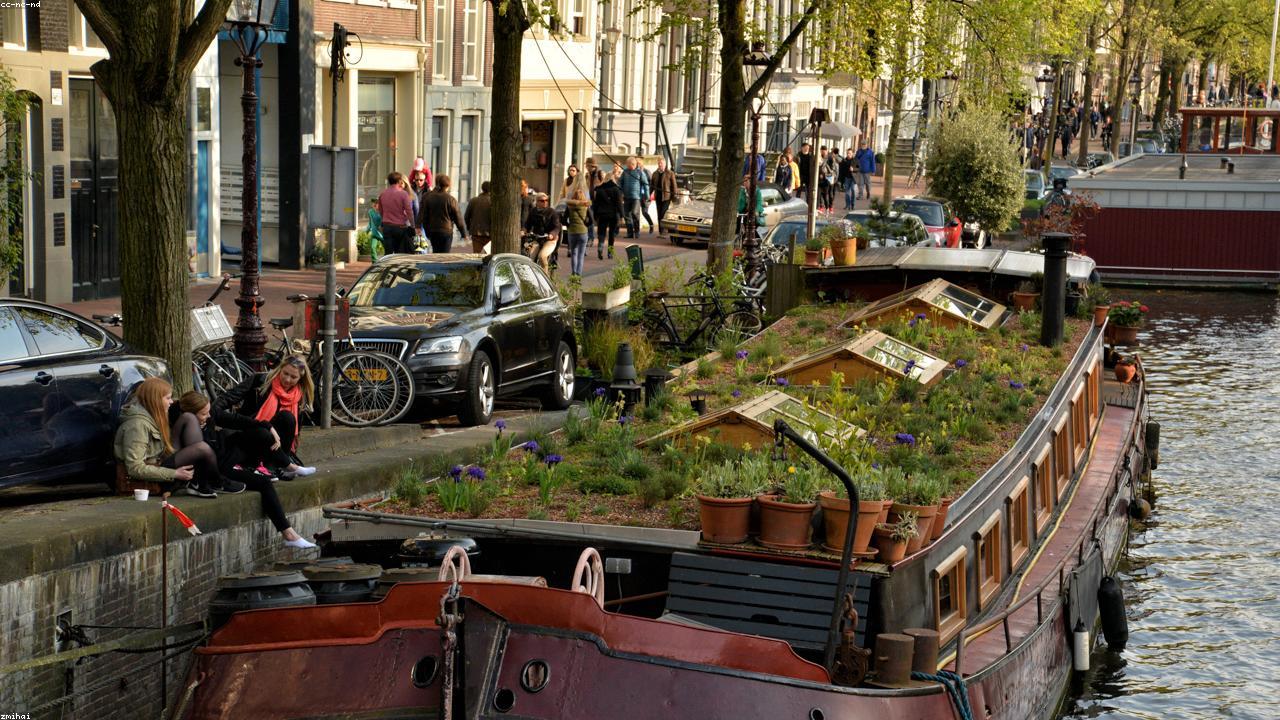
The Amsterdam tourists see is roughly a triangle: Dam Square, the Red Light District, the Anne Frank House. The Amsterdam the Dutch see is a calm, low-rise, water-laced city of seventy-five distinct neighbourhoods, half of them on islands, almost none of them on the postcard.
By Ščenza
· updated · 5 min read
It’s a Tuesday morning in November, raining steadily, and a man in a long coat is cycling past me on the Prinsengracht with a small bouquet of yellow tulips wedged into the handlebar basket and a baguette under one arm. He’s not in a hurry. The rain doesn’t seem to register. The bicycle is the same bicycle he probably had thirty years ago. This is what I keep coming back for. Not the canal houses. The mood.
Why I keep coming back
Amsterdam was the first European city I lived in, briefly, in 2006 — a sublet in De Pijp, three months, working on what was supposed to be my first book and what eventually became my first abandoned manuscript. The city did the manuscript a favour by absorbing my attention. I have been back at least once a year since.
The Dutch have a particular gift for the not-quite-perfect — for getting infrastructure 90% right rather than 100%, for cycling that is universally practical rather than performative, for design that knows itself but doesn’t shout. The cities reflect this. Amsterdam is not beautiful in the Italian sense. It is beautiful in the way a well-made wooden chair is beautiful, which is to say the beauty improves the longer you sit in it.
Where to base yourself
De Pijp, south of the centre. The Albert Cuyp market on weekdays, terraces facing the morning sun, the Heineken Brewery (which you can skip), and a Metro stop that connects you to everywhere. The most liveable neighbourhood for a visitor.
The Jordaan for the classic Amsterdam canal feel without the worst of the centre. Smaller streets, antiques shops, brown cafés that have been serving the same locals since the 1970s. The Westerkerk bells from the Anne Frank House tower carry.
Oud-West if you want a hipper, younger, slightly cheaper version. The cafés are good, the Vondelpark is at your back door.
Amsterdam-Noord if you want to stay across the water, on the formerly industrial north bank, accessed by a free ferry that runs every five minutes. Quieter, more architectural, and very contemporary Dutch.
Avoid: anywhere east of the Dam between the Old Church and the Centraal Station, which is the Red Light District perimeter and noisy from 10 p.m. onwards.
What to actually do
Spend half a day at the Rijksmuseum. Not the whole day — half. Go straight to the Gallery of Honour. Stand in front of The Night Watch for as long as you can stand. Then go and find the small Vermeer rooms, where The Milkmaid is. The rest of the museum is, frankly, optional. Half a day, properly done, is enough.
Go to the Stedelijk afterwards. The modern museum next door is consistently underestimated. Its De Stijl rooms — Mondrian, Rietveld, the original red-blue-yellow chair — are some of the most influential rooms in 20th-century art. The crowds are a third of the Van Gogh next door.
Rent a bicycle and ride to Durgerdam. A small village fifteen minutes north of Amsterdam Noord by bike, on a sea dike, with a single excellent pancake-house terrace looking out over the IJ. Half-day round trip, almost entirely on dedicated cycle paths.
Walk the Begijnhof, then the Spui bookshops. The Begijnhof is a thirteenth-century courtyard of small almshouses in the middle of the city — silent, hidden behind a small door on the Spui, easily missed. The bookshops nearby — Athenaeum, the American Book Center — are the best browsing in the city.
Eat herring at a stand, properly. Pickled, with raw onion and pickles, swallowed whole if you want to look Dutch. Stubbe’s on the Singel does it the original way. Two euros. Don’t think about it.
Where to eat
Amsterdam has, slowly, become a serious food city — not in the sense of having a destination chef on every corner, but in the sense of cooking honestly and well.
Foodhallen (Oud-West) — A converted tram depot, multiple counters, a beer hall feel. Useful when you can’t decide.
Restaurant De Kas (East) — A working greenhouse, the produce grown on site, a single set menu. Lunch is the move.
Café de Klepel (Jordaan) — Bistronomic, candle-lit, small. Reserve.
Toko Joyce (Centre) — A take-away Indonesian counter near the Nieuwmarkt. The Dutch colonial relationship with Indonesia gave the country its greatest cuisine; a rendang and nasi kuning combo is six euros and will spoil you for the upmarket rijsttafel places.
Brown café for the late afternoon: Café Chris (Jordaan), Hoppe (Spui), or De Sluyswacht, a 17th-century lock-keeper’s house that leans visibly and serves cold beer and bitterballen. Bitterballen — crispy beef-ragout balls with mustard — is the national bar snack.
When to come
May and September. The light is long, the cycling is easy, the city is not yet overheated or overcrowded.
February if you want the city back at its most local — quiet, grey, lit by café windows in the late afternoons.
December (tulip myth notwithstanding — tulips bloom in April, not Christmas) is pretty if you can handle the short days. Avoid Kingsday (27 April) unless you specifically want a giant orange citywide party.
Practical notes
- Visa: Schengen.
- Money: Card universally; many places no longer take cash at all.
- Transport: Walk, cycle, tram. The OV-chipkaart system is being replaced by simple contactless tap-in/tap-out on cards and phones.
- Cycling rules: They are real and unforgiving. Don’t stand in the bike lane to take a photo; the bell is a warning, not a greeting; the bikes have right of way at almost every intersection.
- Cannabis: Legal in licensed coffeeshops, of which the better ones are in the Jordaan or Oud-West. Tourist coffeeshops are dwindling under tightening rules; check before you go.
- The Red Light District: A working district, not a theme park; do not photograph the women in the windows. They will, justifiably, confront you. The new ordinances ban many group tours and most photography. Walk through if you must, then leave.
A final thought
The Dutch have a word, gezellig, that is famously hard to translate. It’s usually rendered as ‘cosy’, which it isn’t. It’s closer to the feeling of being in good company in a small, well-lit room while it rains outside, and of being not in a hurry to leave.
That, I think, is Amsterdam’s gift. Not the canals — although the canals are beautiful and you should walk one at dusk — but the small, well-lit rooms scattered all over the city. A brown café on a corner you weren’t planning to be on. A bookshop on the Spui where the proprietor is reading. A pancake house in Durgerdam with the wind off the IJ. Gezellig is the verb tense of slowing down. You can have an excellent week in this city if you spend most of it slowing down. Most visitors don’t. They have eighty hours and a list. The list is the wrong tool. Throw it out.
If you only have a few days
7 ideal things to do in Amsterdam
The Gallery of Honour before the coach parties
Rijksmuseum, MuseumpleinFirst entry slot of the day
Rembrandt's Night Watch is currently sitting inside a glass conservation chamber while a team of eight lifts three centuries of yellowed varnish off it, in public, a few square millimetres at a time. It is the slowest performance art in Europe and I could not stop watching. Do the Gallery of Honour, then the small Vermeer room, then leave. The Rijksmuseum is built to defeat completists.
Ons' Lieve Heer op Solder, the church in the attic
Oudezijds Voorburgwal, on the edge of the Red Light DistrictWeekday morning
Jan Hartman, a Catholic merchant, built a full church across the top floors of three canal houses and had it consecrated in 1663, because public Catholic worship was banned and the city magistrates had quietly decided not to look up. It has been a museum since 1888 — the second oldest in Amsterdam, after the Rijksmuseum. The stairs are original, which is to say steep, and the pews are still laid out for a congregation that had to arrive one at a time.
The De Stijl rooms at the Stedelijk
Museumplein, next door to the Van GoghAfternoon, once the Rijksmuseum has finished you
Mondrian's grids and Rietveld's Red and Blue Chair in a single set of rooms, with nothing like the queue that forms outside the Van Gogh forty metres away. The chair looks like something a joiner walked away from halfway through. Stand with it a while and the point lands: furniture rebuilt from first principles by people who had just watched Europe take itself apart, and who thought the fix might be geometry.
The Begijnhof, then the Spui bookshops
Entrance on the Gedempte Begijnensloot, off the SpuiEarly, and quietly
A medieval courtyard of almshouses behind an unmarked door off the Spui, with the oldest wooden house in the city — 1528 — standing on one side of the lawn. Silence is requested, groups of more than twelve are not allowed in at all, and both rules are enforced by residents at first-floor windows rather than by anyone in uniform. It is the only place in the centre where you can hear your own footsteps. The Spui bookshops are thirty seconds away when you are ready to talk again.
Cross the IJ on the free ferry to Noord
From the quay behind Centraal StationAny time; best in weather that keeps everyone else indoors
Free, frequent, bicycles welcome, and over in a few minutes: the last piece of Amsterdam infrastructure that still feels like a municipal gift. You stand at the rail with commuters, scooters and someone carrying a ladder, the city slides sideways, and you land on the industrial north bank where the crowds simply stop. Our Split–Supetar crossing costs money and takes fifty minutes. I think about this more than is healthy.
Ride the dike out to Durgerdam
About 7 km east of the centre, along the IJmeer dikeHalf a day; May or September
One row of wooden houses strung along a sea dike, a church tower, water on both sides, cows. The ride out of Noord is flat and almost entirely on separated cycle path, so the hardest thing you will meet is a bridge. I did it into a November headwind because I had misread the forecast, arrived with a face like a boiled crab, and would go again tomorrow.
An afternoon at Café Chris or De Sluyswacht
Bloemstraat in the Jordaan; the Oude Schans by the RembrandthuisLate afternoon, as the light goes
De Sluyswacht started life as a lock-keeper's cottage in 1695 and now leans at an angle a structural engineer would want to discuss over a long lunch. Café Chris in the Jordaan claims 1624; the city registers suggest the first licensed drinking house at that address was 1882, and the regulars have no intention of settling the argument. Take a beer, take the jenever if it is offered, and stay until the windows are the brightest thing on the street.
From a Split boy’s notebook
The Split lens
What reminded me of home
Maritime city with a working-port soul that has slowly turned hospitality-tourism. The brown cafés are kindred to our older konobas — small, smoky once, the regulars on the same stools for thirty years. Both cities know how to do an unhurried Sunday afternoon.
What Split could borrow
Cycling infrastructure. The flatter parts of Split — Spinut, Pujanke, the Žnjan promenade — are perfectly cyclable and we leave them to cars. A protected bike lane along the Jadranska magistrala from Stobreč to Marjan would change the way thousands of us commute.
Who can take you
Tour operators & guides to try
A short, opinionated starter list — just my humble opinion. Verify before booking.
Context Travelspecialistwww.contexttravel.com →
Context's Amsterdam walks — particularly the Anne Frank context walk and the Dutch Golden Age route through the Rijksmuseum — are the right tool when you've already done the obvious museum visit and want the second layer. The Rijksmuseum walks are docent-led inside the galleries (entrance not included). Watch for: the Anne Frank House timed-entry rules constrain what's possible; the operators with priority access have a real advantage here, and Context is good but not the absolute best for that single site.
Hungry Birds Streetfood Toursspecialisthungrybirds.nl →
Hungry Birds is the Amsterdam street-food walk founded by long-time city residents — the Indonesian-Dutch food inheritance, the markets, the cheese shops, the brown cafés. Groups around 8. The 4-hour format with 8–10 tastings is calibrated correctly: substantial enough to be dinner, not so dense that you're rolling home. Caveat: not the right operator for the canal-history beat; pair with a self-guided architectural walk or a small-boat canal tour for that side of the city.