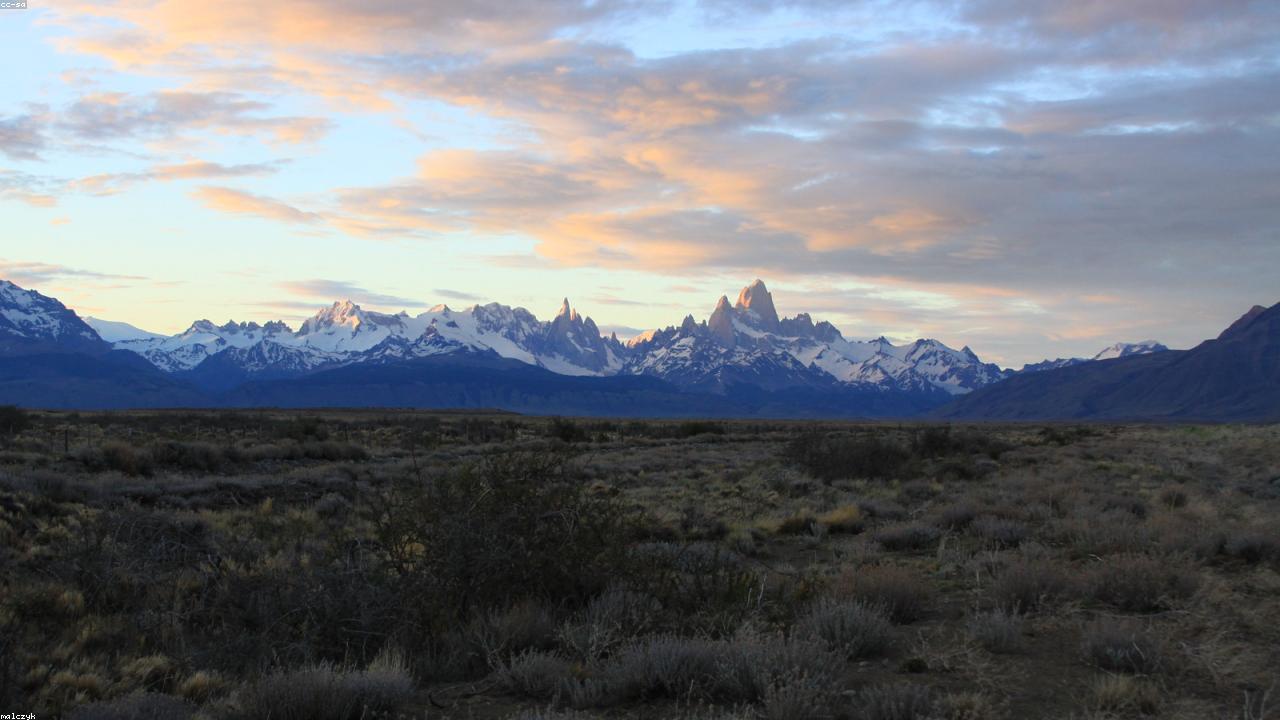
Photo: Ščenza
El Chaltén, Argentina / Chile · South America
Patagonia: the southern Andes and the long empty roads
Patagonia is, at its heart, the experience of being very small in a very large landscape. The wind shapes everything. The granite spires rise on a planetary scale. The travel logistics are demanding. The reward is one of the last genuinely big-empty regions left on earth.
By Ščenza
· updated · 5 min read
It’s 7:14 a.m. at the Laguna de los Tres viewpoint above El Chaltén, in Argentine Patagonia, and the morning fog is just clearing from the Fitz Roy granite massif. The fog reveals the peaks one at a time: Aguja Poincenot first, then Aguja Saint-Exupéry, then the colossal Fitz Roy itself. I’ve been walking since 4:30 a.m. There were six headlamps ahead of me on the trail in the dark; we have all converged on this small alpine lake at 6:50 a.m. for the first light. The wind is the only sound. The granite spires are obscenely beautiful. This is the trip-defining moment I came to Patagonia for.
Why I keep coming back
Patagonia — the vast region covering southern Argentina and Chile from roughly 40°S to the bottom of the continent — is one of the last large genuinely-wild regions on earth. The Andes form its western spine; the steppe runs east to the Atlantic; the southern ice fields are the third-largest non-polar ice mass on the planet. The wind is constant.
Most travel concentrates on two areas: the El Chaltén / Los Glaciares region in Argentina (with the Fitz Roy and Cerro Torre granite peaks, the Perito Moreno glacier nearby at El Calafate) and the Torres del Paine National Park in Chile (with the Towers and the Cuernos granite peaks, the W and O treks).
Where to base yourself
The two key bases are:
El Chaltén, Argentina — A small town below Fitz Roy with several excellent day hikes leaving directly from town (Laguna de los Tres, Laguna Torre, Loma del Pliegue). Walking from town means no logistical complexity.
Puerto Natales, Chile — The gateway town to Torres del Paine. Most travellers stay here a day before the multi-day trek begins.
For those doing only single visits, El Calafate in Argentina is a useful base for the Perito Moreno glacier; Punta Arenas in Chile is the gateway airport for the Chilean side.
What to actually do
Argentine side (El Chaltén / Los Glaciares)
Hike to Laguna de los Tres. The classic 22-km day hike from El Chaltén to the alpine lake under Fitz Roy. The final 1 km is a steep scramble. Best done leaving town at 4:30 a.m. for dawn at the lake. 8–10 hours round trip.
Hike to Laguna Torre. A shorter alternative (18 km) ending at a lake under Cerro Torre. Often equally extraordinary if the famously windy peak is clear.
Visit Perito Moreno Glacier. From El Calafate, an hour’s drive to the most accessible advancing glacier on earth. Boardwalks let you observe the calving (ice blocks the size of buildings falling into the lake) from close range.
Take a glacier-walk on the Perito Moreno. Operators offer ice trekking on the glacier itself; from a 90-minute minitrekking to a full-day big-ice trek.
Chilean side (Torres del Paine)
Trek the W. The classic 4–5 day trek through Torres del Paine, covering the three iconic sections (the Towers viewpoint, the French Valley, Grey Glacier). Refugios (huts) are along the route; book months ahead.
Trek the O. A longer 8–10 day full-circuit trek; less crowded, more remote, requires more experience.
Day trips from Puerto Natales. If you don’t want to do the multi-day trek, the day-trip to the Torres viewpoint is the iconic experience; full-day return.
Wider Patagonia
Tierra del Fuego and Ushuaia — The southernmost city, the gateway to Antarctic cruises, a wilder national park.
Carretera Austral (Chilean Route 7) — A 1,200-km mostly gravel road through northern Chilean Patagonia; a 2-week road trip for the patient.
Peninsula Valdés — A whale-watching peninsula in northern Argentine Patagonia; southern right whales calve here (June–December).
Where to eat
Patagonian cuisine is meat-heavy — lamb on the spit (cordero al palo), king crab in season, regional craft beer.
Pura Vida (El Chaltén) — Reliable mid-range; lamb stew, pizza. La Tapera (El Chaltén) — Mountain food, the lamb-and-vegetable stew. Don Pichón (El Calafate) — Cordero asado. Cabernet or Singular Patagonia (Puerto Natales) — Modern Patagonian cooking; Singular is the upscale. The refugios on the trek — Hot soup and bread is sometimes the meal of the day after a long hike.
When to come
Late November through early March (the southern summer) is the practical season. Even then, the wind is the constant; trekking days are weather-dependent.
December and January are the warmest and most crowded.
February is shoulder; lower crowds, weather still good.
March is the autumn — the southern beech (lenga) trees turn red and gold; the lighting is at its most extraordinary.
April through October is the off-season — many lodges close, winds are even more intense, snow on the high passes. Some specialised tour operators run winter trips.
Practical notes
- Visa: 90 days visa-free for most Western passports for both Argentina and Chile.
- Money: Argentine peso and Chilean peso. The Argentine cuevas exchange situation applies in El Calafate and El Chaltén; carry USD.
- Transport: Most travellers fly into El Calafate (FTE) for the Argentine side and Puerto Natales (PNT) or Punta Arenas (PUQ) for the Chilean side. The roads between are long. The Carretera Austral requires a 4x4 and significant time.
- Crossing the Argentina-Chile border: Multiple crossing points exist between the two Patagonia regions; some are seasonal and have specific opening hours. Plan the route carefully.
- The wind: Real, daily, often 80+ km/h gusts. Tents need careful pitching; loose objects blow away.
- Trekking permits: Torres del Paine has nightly capacity caps on the refugios and campsites; book 4–6 months ahead.
- Cost: Patagonia is expensive by South American standards. Mid-range trekking week US$2000–4000 per person plus international flights.
A final thought
Patagonia is one of the largest still-empty regions on earth in 2026 and one of the great trekking destinations. The combination of the granite peaks, the ice, the steppe, the constant wind, and the geographical scale produces an experience that has no real parallel.
The practical advice is straightforward: book the multi-day treks well in advance; build in buffer days for weather; pace yourself; learn a few words of Spanish (different from the standard Latin American — Patagonian Spanish has its own accent); respect the wind. Two weeks minimum; three is better.
The moment at Laguna de los Tres at first light — Fitz Roy emerging from the fog, the granite spires impossibly perfect in the pale morning sun — is one of the most-photographed moments in modern adventure travel. It earns its reputation. Walk there in the dark. Wait for the fog. The peaks will appear.
If you only have a few days
5 ideal things to do in El Chaltén
Laguna de los Tres before sunrise
From El Chaltén; roughly 22 km returnLeave town in the dark; late November to March
Eight to ten hours, and the final kilometre gains four hundred metres up loose scree that a good number of people descend on their backsides. The reason to walk it in the dark is that Fitz Roy — three thousand four hundred and five metres of granite — turns pink for about four minutes at first light and then simply stops. I have done it twice. The first time the cloud never lifted and I ate a sandwich in a whiteout alongside six strangers, all of us insisting this was fine. The second time it worked.
Laguna Torre and the Cerro Torre view
From El Chaltén; roughly 18 km returnThe better choice on a high-wind day
Shorter and far flatter than the Fitz Roy walk, through lenga forest along the river and out to a grey glacial lake with small bergs drifting in it. Cerro Torre stands at the back, usually inside cloud, and its first ascent was the subject of a decades-long argument about whether it happened at all — a dispute that has outlasted most of the people involved. Even with the spire hidden, the lake with the glacier wind coming off it earns the morning. Nowhere on this trail is sheltered, and the wind knows it.
Chorrillo del Salto
North of El Chaltén on the Lago del Desierto roadEvening, when everyone else is at dinner
Chorrillo del Salto is a modest waterfall on the road heading north out of town, an hour on foot or ten minutes by car, and its purpose is to be the thing you do on the day your legs have withdrawn cooperation. Lenga forest, a pool, some spray. After two hard days it felt entirely reasonable to walk twenty minutes and look at water. Patagonia rewards ambition, but it also rewards recognising the exact moment your knees file a formal complaint.
Lago del Desierto
North of El Chaltén up the Río de las Vueltas gravel roadSummer only; the road is rough and the crosswinds are worse
An hour north of town on gravel beside the Río de las Vueltas, ending at a long narrow lake pinned between forested walls with a glacier at the far end. There is a boat across it, there is a short steep climb to a viewpoint, and beyond the north shore is the walking border crossing into Chile that eventually delivers you to Villa O'Higgins. Mostly, though, what is on offer here is a complete absence of other people, and that is not oversold.
The Perito Moreno glacier boardwalks
78 km from El Calafate; 220 km south of El ChalténAny season; the ice-bridge rupture is not schedulable
Kilometres of steel walkway face a wall of ice several storeys high, and every few minutes a piece the size of a house detaches and hits the lake with a noise that arrives a full second after the sight of it. Everyone flinches. Everyone then pretends they did not. Minitrekking straps crampons on you for about ninety minutes on the surface; the big-ice version runs closer to five hours. The famous rupture, where the glacier dams the lake until the water blows the ice bridge apart, has come anywhere between yearly and once a decade, so do not build a trip around catching it.
From a Split boy’s notebook
The Split lens
What reminded me of home
Empty mountain wilderness at the edge of a country, with a serious trekking culture and a long-distance walking infrastructure. Our Velebit and the Dinaric Alps share Patagonia's scale, the karst-and-granite-peak geometry, and the very low population density. We just haven't built the trail system.
What Split could borrow
Patagonia's W-trek and the Argentine El Chaltén day-hike network are the global standard for accessible long-distance mountain walking. Our Velebit Premium Trail is excellent but stops at Velebit; the broader Dinaric trail network is fragmented. A serious investment in a Dinaric long-distance trail (Velebit to Biokovo to the Pelješac peninsula) would create a Patagonia-class product.
Who can take you
Tour operators & guides to try
A short, opinionated starter list — just my humble opinion. Verify before booking.
Intrepid Travelsmall groupwww.intrepidtravel.com →
Intrepid's Patagonia trips combine the Argentine side (El Chaltén, Perito Moreno) with the Chilean side (Torres del Paine, the W trek as a day-by-day version) over 10–14 days. Group size 12–16. The pace is moderate — accessible day hikes rather than the serious multi-day treks. Caveat: the full W trek with refugio overnights is an Intrepid option but it's at the harder end of their trips; verify your fitness before committing.
Adventure Lifesmall groupwww.adventure-life.com →
Adventure Life specialises in South America and their Patagonia programs are deeper than the mainstream — Torres del Paine in different seasons, El Chaltén with the better trail guides, the Carretera Austral in Chile for the slower travel. Mid-to-upper-tier pricing. Caveat: Patagonia weather is the constant; trips are weather-flexible but plans change daily.
If you liked this, try these
Uyuni, Bolivia
Salar de Uyuni: the white horizon and the highest desert in the world
March 4, 2023
Aguas Calientes, Peru
Machu Picchu: a day at the Inca city in the clouds
June 12, 2022
Hobart, Australia
Tasmania: Australia's island state and its wild Southwest
April 15, 2024