Photo: Ščenza
Bruges, Belgium · Europe
Bruges in November: the small Flemish city, returned to itself
Bruges has, for fifteen years, been a kind of cautionary tale about overtourism — a town of 20,000 in the old centre that absorbs 8 million visitors a year. In November, all but a few thousand of those visitors are elsewhere. Bruges in November is one of the most beautiful walking weeks in Europe.
By Ščenza
· updated · 4 min read
There’s a small chocolate shop on the Wollestraat — the wool-merchants’ street — where the proprietor, a woman called Lieve, has been hand-making pralines in the back room since 1987. In November, by 5 p.m., the windows go warm-yellow against the dusk, and the smell of melted dark chocolate carries half a block. A handful of locals stop in. The day visitors have already left on the train back to Brussels. Bruges, between November and February, becomes the small Flemish town it actually is, hidden under the postcard.
Why I keep coming back
Bruges is, structurally, one of the most preserved medieval cities in Europe. The 14th- and 15th-century urban fabric — the canal network, the stepped-gable houses, the béguinages (lay religious communities for unmarried women), the belfries, the small church windows — survives almost intact because the city’s economic significance collapsed in the 16th century when the Zwin estuary silted up and the trade moved to Antwerp. Bruges fell asleep for three hundred years. The 19th-century rediscovery and the 20th-century restoration preserved what was effectively a Renaissance time-capsule.
What keeps me coming back is the off-season silence. The city in November, with the canals steaming in the cold morning, is genuinely one of the most quietly atmospheric places in northern Europe.
Where to base yourself
Inside the old town, anywhere west of the Markt. Choose accommodation on a quieter street; the centre fills with day-tour buses from 10 a.m. to 4 p.m. but is empty in the mornings and evenings.
Avoid anywhere directly on the Markt itself — the tour buses, the horse-drawn carriages, the noise.
What to actually do
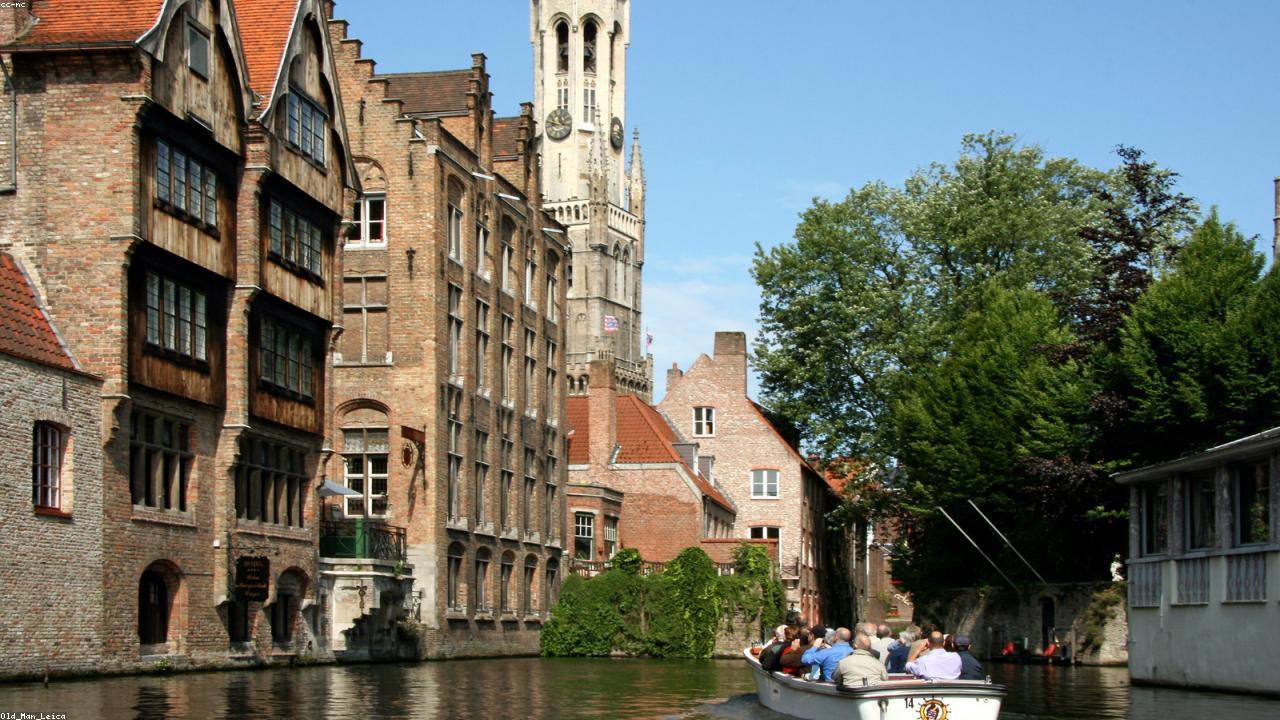
Walk the canals at dawn. The boat tours run from 10 a.m. to 6 p.m. and are crowded. Before 9 a.m., the canals are still, the swans are sleeping, the mist is on the water. Walk the Groenerei, the Dijver, the Rozenhoedkaai. Bring a coffee.
Climb the Belfry. The 13th-century bell tower on the Markt, 366 steps, the city laid out in red roofs below you. In Off-season, there’s no queue; in summer, the timed entry is essential.
Spend an hour at the Groeningemuseum. A small but extraordinary collection of early Flemish painters — Hans Memling, Jan van Eyck, Hieronymus Bosch (one painting, the Last Judgement triptych). The Van Eyck Madonna with Canon van der Paele is one of the great works of the Northern Renaissance.
Visit the Béguinage. A 13th-century courtyard of small whitewashed houses around a central garden, originally for lay religious women, now home to Benedictine nuns. Walk in quietly. Sit on a bench. The peace is real.
Drink a Trappist beer at ‘t Brugs Beertje. The classic Bruges beer cafe, 300+ beers on the menu, with the owner happy to talk you through the Trappists, the lambics, and the sours. Westvleteren 12 is the famous one (made by the monks of Sint-Sixtus, not actually sold in shops; this bar has it occasionally).
Take the train to Ghent. 25 minutes away, a larger and arguably more interesting Flemish city. Day trip. Ghent has the Mystic Lamb (the Van Eyck altarpiece at St Bavo’s), the canals, and a less-touristed but in some ways richer historical centre.
Where to eat
Bruges cooking, like Belgian cooking generally, is honest and substantial. Mussels, frites, stews, the Flemish beer-and-beef carbonnade.
Den Dyver — Beer-based cuisine, each dish paired with a specific Belgian beer in the preparation. Sounds gimmicky; isn’t.
Park Restaurant — Modern Flemish, in a townhouse, prix-fixe lunch a steal.
Sint-Joris — Old-school Vlaams cooking; the vlaamse stoofkarbonaden is the dish.
Frites at De Frituur on the Markt — Hand-cut, twice-fried, with mayonnaise. The proper Belgian fries.
The Old Chocolate House (yes, that’s the name) — A teahouse where the hot chocolate is properly made: a cup of hot milk, a separate cup of chopped chocolate, you stir it in yourself.
When to come
November, January, February. The off-season triumvirate. The city is yours.
Late March and April are also workable.
May through October is the high tourism season; the city is at saturation between 11 a.m. and 4 p.m. daily.
December has the Christmas markets, which are pretty and crowded.
Practical notes
- Visa: Schengen.
- Money: Card.
- Transport: Walking. The town is 1.5 km across. The train to Brussels (an hour) or Ghent (25 minutes) is the easy way in and out.
- Boat tours: The 30-minute canal boats are still fine in off-season. Skip in summer.
- Bicycles: Available to hire; useful for a ride out to Damme, a small village on the canal 6 km away, with a famous bookshop and a tavern.
A final thought
Bruges is one of those small European cities where the gap between the high-season experience and the low-season experience is the largest I’ve found anywhere. In July, the centre is a slow-moving river of tour groups, the prices are inflated, and the local population is largely invisible. In November, you can have whole streets and entire museum rooms to yourself. The chocolate shops smell the same. The light on the canals is, if anything, more beautiful.
The consequence: come in November. Stay three nights. Walk every morning. Eat in a small Flemish restaurant. Take the day train to Ghent. Drink a Westmalle by a fire. You will leave understanding why Bruges is one of the great preserved cities of Europe and you will not have queued for anything, except briefly at the Belfry, where Lieve sometimes brings the morning’s first batch of pralines for the staff.
If you only have a few days
6 ideal things to do in Bruges
Climb the Belfort before the Brussels train arrives
MarktFirst slot of the morning, November to February
Three hundred and sixty-six steps up an 83-metre tower that leans 87 centimetres to the east, and the staircase narrows exactly where you would like it to widen. I went up on a wet Tuesday behind a Flemish grandfather who stopped at the drum chamber to explain the carillon mechanism to nobody in particular, and was right about every word of it. The reward is red roofs out to the polders. In July there is a timed queue; in November there is nobody.
The Van Eyck room at the Groeningemuseum
Dijver, along the canalWeekday mornings
Six centuries of Flemish painting in a building you can cross in forty minutes, which is the mistake almost everyone makes. The Madonna with Canon Joris van der Paele is here, and the canon's face — the pouches, the stubble, the cold — was painted by Jan van Eyck with no mercy whatsoever. There is a Bosch and a Memling triptych within a few rooms of it. Two hours and one bench is the correct dose.
Memling's Ursula Shrine at Sint-Janshospitaal
Mariastraat, opposite the Church of Our LadyMorning; the hospital church goes dim in the late afternoon
Memling painted the sides of a gilded wooden reliquary about the size of a large dog kennel with the entire legend of Saint Ursula, panel by panel, around 1489. It stands inside a hospital founded in 1188 that spent seven centuries as a working ward, and the brick, the beams and the old pharmacy are still there. I went in for one object and stayed for the building, which in this town is usually the right way round.
The Begijnhof Ten Wijngaerde
Wijngaardplein, beside the MinnewaterBefore nine, or at dusk
Whitewashed houses around a walled lawn, Benedictine sisters in residence since 1927, and a sign at the gate asking for quiet that visitors actually obey — which in a centre this photographed is the closest thing to a miracle on offer. In March the courtyard turns yellow with daffodils planted as a nurseryman's gift back in 1931. Go in, sit down, and resist the urge to narrate anything.
De Halve Maan and its underground beer pipeline
Walplein, south of the MarktLate afternoon
Brewing on this spot since 1856, six generations of one family, and when the delivery lorries became impossible on medieval streets the brewery laid a three-kilometre pipeline under the city to the bottling plant instead of moving out. A town that will tunnel beneath its own UNESCO cobbles rather than lose a brewery has its priorities settled. The tour ends on the roof with a Brugse Zot and the whole red-tiled sprawl underneath you.
Ride out to Damme along the Damse Vaart
6 km north-east, out through the DampoortAutumn, when the poplars turn
Napoleon ordered this canal dug, and the poplars stand along it in a single line the whole way, on ground as flat as a billiard table — which after a life of Dalmatian hills felt like cheating. Twenty-five minutes on a hired bike puts you in a village of one long street with a Gothic town hall, a couple of taverns and no coaches. The wind off the polders is the only climb you will do all day.
From a Split boy’s notebook
The Split lens
What reminded me of home
Small medieval town with one of the most beautiful old centres in Europe, overrun by day-trippers between 10 a.m. and 4 p.m. and quietly itself before and after. Bruges in November is what our old town feels like on a wet Tuesday in January — beautiful, quiet, lit from inside.
What Split could borrow
Bruges discourages cruise day-trippers in favour of overnight stays. Split currently does the opposite — we welcome the day-traffic and the day-traffic pays nothing into the city. A modest overnight-stay incentive plus a stiff day-visitor levy would shift the economics in our favour.
Who can take you
Tour operators & guides to try
A short, opinionated starter list — just my humble opinion. Verify before booking.
Context Travelspecialistwww.contexttravel.com →
Context's Bruges program is small — a single walking tour, essentially — but it's well-done with a medieval-history specialist. The Groeningemuseum visit is the highlight. Caveat: Bruges is small enough that you don't really need a guided tour to navigate it; this is for the historical depth, not the orientation. Skip if you have less than 24 hours; just walk.
QuasiMundo Bike Toursactivitywww.quasimundo.com →
QuasiMundo is Bruges's longest-running bicycle-tour outfit (since the late 1990s) — the city itself, and the longer polders ride through Damme and into the Netherlands. Groups stay around 10–15; bikes included, guides bilingual and Bruges-resident. Caveat: the in-town ride is more interesting in November than in July, when you're cycling slowly through tourist crowds. Take the polder route instead in high season — better cycling and largely empty back roads.