Photo: Ščenza
Chefchaouen, Morocco · Africa
Chefchaouen: the blue town in the Moroccan Rif
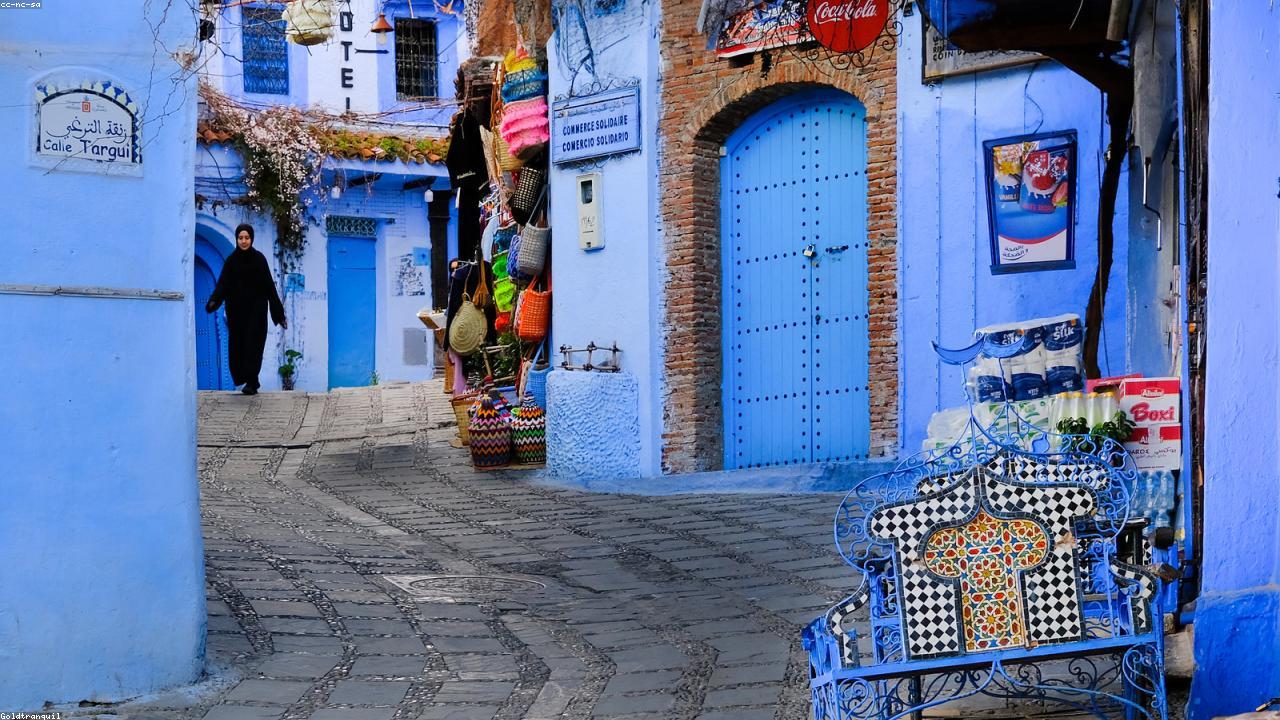
Chefchaouen — universally and a little reductively known as 'the Blue City' — is a small mountain town in northern Morocco where the medina is washed in shades of cobalt, sky blue, and indigo. The blue is the postcard. The slower, kif-scented mountain life is the longer reward.
By Ščenza
· updated · 4 min read
It’s 6:34 a.m. in the medina of Chefchaouen, in the Rif Mountains of northern Morocco, and the blue is just lighting up. The walls are washed in shades of cobalt and sky and indigo; the doors are blue; the small steps between houses are blue; the laundry lines stretched between buildings are blue. A cat is asleep on a blue step. A woman in a long brown djellaba is sweeping the front of her house with a wooden broom. The Plaza Uta el-Hammam, the small main square, is still empty. By 10 a.m. it will be full of day-trippers from Tangier. The first three hours of the day, however, are mine.
Why I keep coming back
Chefchaouen was founded in 1471 by Moorish exiles from Spain after the Reconquista, and remained essentially closed to non-Muslims until the Spanish protectorate of the 20th century. The blue washes — the famous chromatic identity of the medina — are of debated origin: one theory holds that the Jewish refugees who settled here in the 1930s and 1940s introduced the indigo as a spiritual association; another that it repels insects; another that it was simply an aesthetic decision by the municipality in the 1970s. All three are partly true.
The town sits at 600 m in the Rif Mountains, which makes it slightly cooler than the rest of Morocco — useful in summer. The surrounding mountains have excellent hiking, particularly in the Talassemtane National Park.
Where to base yourself
Inside the medina at a small dar or riad. The town is small enough that the location decision is mostly about how much you want the inner-medina noise.
Dar Echchaouen or Casa Hassan are the heritage mid-range options. Lina Ryad & Spa for the upper end.
What to actually do
Walk the medina at first light. This is the entire point of the visit. By 9 a.m., the day-tour buses arrive and the streets fill with Instagram photographers. Before 8, you have the blue town to yourself.
Hike to the Spanish Mosque. A 30-minute climb up the hill east of the town to a small 1920s mosque (named after the Spanish era, not the religion). The classic sunset viewpoint over the blue medina. Crowded at sunset; quiet at sunrise.
Hike to Akchour and the God’s Bridge. A day-walk in the Talassemtane National Park, 30 minutes’ drive from town. Two waterfalls and a natural stone arch in a river canyon; locals swim in the pools in summer. About 15 km round trip; moderate difficulty.
Visit the Kasbah Museum. A small museum in the restored 15th-century fortress at the centre of the main square; Andalusian-Moroccan history and some good textile collections.
Buy a wool blanket. The Rif Mountains have a long weaving tradition; the local cooperatives produce striped wool blankets, particularly in the eastern medina. Around 600–1500 dirham for a substantial piece.
Walk the Ras El Maa. The mountain spring at the eastern edge of the medina where local women still wash clothes; a quiet, social, gendered space. Walk through respectfully.
Where to eat
Chefchaouen’s food is mountain-Moroccan — heavier on goat cheese, mountain herbs, and northern-Moroccan tagine variations.
Casa Aladdin (medina) — Reliable Moroccan; rooftop terrace. Restaurant Tissemlal / Casa Hassan — Traditional Riffian; the goat tagine. Cafe Clock Chefchaouen — A branch of the famous Fes café; modern Moroccan, good for a less heavy meal. Bab Ssour — Goat tagine and Moroccan classics; popular. Aladin Restaurant — Reliable; views of the main square.
When to come
April–June and September–November. The mountain spring and autumn weather is the most pleasant; the medina light is at its best.
Summer (July–August) is warm in the medina but cooler than the rest of Morocco — useful as an escape from coastal heat.
Winter is cold; the higher mountain hikes are sometimes snow-affected (which is its own beauty).
Practical notes
- Visa: 90 days visa-free for most Western passports (Morocco).
- Money: Moroccan dirham. Card accepted in mid-range hotels and some restaurants; cash everywhere else.
- Transport: Bus from Tangier (2.5 hours), Fes (4 hours), or a private driver/grand taxi share. The town has no train station.
- Kif: The Rif Mountains are Morocco’s traditional cannabis-growing region. Kif (the local term) is openly visible. Sale and use is technically illegal but tolerated; locals will offer it. Foreign visitors are sometimes targets of plain-clothes police; declining politely is the recommended approach.
- Photography: The blue streets are extraordinary photogenic; the locals are tired of being photographed without permission. Ask, or photograph from far enough away that no one is in shot.
A final thought
Chefchaouen is one of the small towns that has, over the past decade, been transformed by Instagram from a quiet mountain pilgrimage destination into one of the most-photographed locations in North Africa. The blue medina is real and worth seeing. The peak of the photo-tourism wave has, however, made the daytime hours genuinely difficult.
The town rewards the visitor who arrives the night before, sleeps in the medina, walks at dawn, hikes during the day, and returns to the medina at dusk. Two nights minimum. Three is better. Skip the lunchtime crowds. Drink a mint tea on the Plaza Uta el-Hammam at 7 p.m. The mountains are still there. The blue is still cobalt. The cats are still asleep on the steps. Most of the day-trippers have gone back to Tangier.
If you only have a few days
5 ideal things to do in Chefchaouen
Plaza Uta el-Hammam and the Grand Mosque's octagonal minaret
Centre of the medinaBefore eight in the morning, or after eight at night
Everything in this town funnels into one square, with the fifteenth-century kasbah along one side and the Grand Mosque on another, its minaret octagonal rather than square — an unusual shape for Morocco, and the giveaway that the place was founded in 1471 by Andalusians who had just been pushed out of Spain. Between roughly ten and four the square belongs to the day buses from Tangier. Before and after, it belongs to old men, cats, and somebody methodically sweeping. Diocletian's Peristyle in Split runs the same two-shift arrangement, and I have made the same scheduling mistake in both places.
The Kasbah Museum and its tower
Plaza Uta el-HammamThe middle of the day, when the medina outside is at its worst
Small museum, modest holdings — Rif weaving, old photographs, some archaeology — inside the restored fifteenth-century fortress on the main square, with an Andalusian garden in the courtyard that is the only genuinely cool spot in the town centre at two in the afternoon. Climb the tower. From up there the medina is not the cobalt of the alley photographs but a roofscape of terracotta and satellite dishes with blue showing only in the gaps between, which is a considerably more honest portrait of the place.
Ras el-Maa and the path up to the old mills
Eastern edge of the medina, at the foot of the mountainMorning, and briefly — this is somebody's workplace
Where the mountain water arrives in the town: a stone spout, a run of washing slabs, and women doing laundry in cold water as they have for centuries, while a rotating audience of visitors photographs them doing it. Do not join that audience. Walk through, keep the camera down, take a mint tea on one of the small terraces above the stream, then carry on up the path towards the ruined mills, where within two minutes the noise stops and there is nobody working at all.
The Spanish Mosque at sunrise
On the hill east of the medina, about half an hour up on footDawn, not sunset
Built in the 1920s during the Spanish protectorate and never really brought into use, it sits on a bare hill with the best view there is of the blue town below. Everybody goes at sunset, and the hilltop becomes a crowded terrace with drones over it. At dawn there were four of us and a dog, the light was coming onto the medina from the east instead of from behind it, and the walk up in the cool cost nothing. Same view, opposite hour, a tenth of the people. The path is steep but impossible to lose.
Akchour and the Bridge of God
Talassemtane National Park, about half an hour's drive north-eastSpring or early autumn; summer weekends fill with Moroccan families
There are two walks from the same trailhead: upstream to a pair of waterfalls with pools that families swim in all summer, or the shorter and steeper climb to the Pont de Dieu, a natural rock arch standing over a gorge and looking structurally implausible right up until you are on top of it. The park was created in 2004 to protect the last of Morocco's fir forests. I did both walks on the same day in the wrong shoes and spent the following morning entirely horizontal on a roof terrace, which I now recommend as a plan in its own right.
From a Split boy’s notebook
The Split lens
What reminded me of home
Small mountain town with a single signature visual identity (blue paint in their case, limestone-and-tile-roofs in our island villages). Chefchaouen's whole town has chosen to look one way and enforced it. Komiža and Bol have the potential to be similarly visually disciplined but each year more aluminum-and-plastic accretion.
What Split could borrow
Chefchaouen's blue-paint discipline is partially municipal regulation and partially community pride. The model is replicable. Our island villages could each adopt a visual code (limestone-only facades, traditional shutter colours, no plastic) and the municipalities could back it with a small annual paint-and-restoration grant.
Who can take you
Tour operators & guides to try
A short, opinionated starter list — just my humble opinion. Verify before booking.
Intrepid Travelsmall groupwww.intrepidtravel.com →
Intrepid's Morocco circuits visit Chefchaouen on the way between Fes and Tangier — typically a single night, which I think is the right minimum. Group size 12–16. The town's medina is small enough that the half-day guided walk plus a free evening is sufficient. Caveat: the Instagram-led overtourism is at peak between 11 a.m. and 4 p.m.; choose itineraries that have you in town overnight rather than as a day trip.
Plan-It Moroccotailoredwww.plan-it-morocco.com →
Plan-It Morocco is the Marrakech-based tailored-Morocco operator that covers the north — Chefchaouen, the Rif Mountains, Tetouan — with proper depth, where most operators treat the blue town as a single overnight stop. They'll arrange a 3-day Talassemtane mountain trek combined with the village. Caveat: mid-to-upper-tier custom operator, quoted per trip — budget around USD 200–400 per person per day for a quality north-Morocco itinerary.