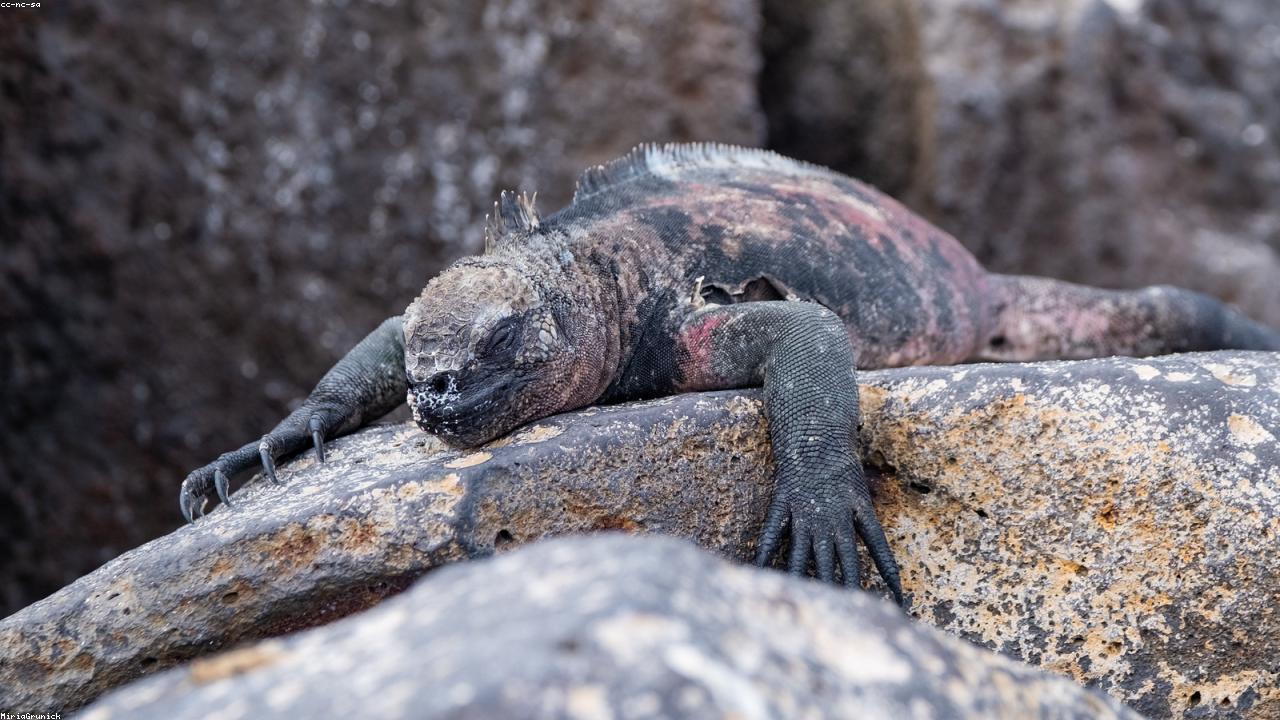
Photo: Ščenza
Puerto Ayora, Ecuador · South America
Galápagos: the Pacific archipelago that taught us evolution
The Galápagos Islands are the closest thing left on earth to an undisturbed wildlife laboratory — animals that have no significant fear of humans because, for most of their evolutionary history, they had no humans to fear. The experience is genuinely irreplaceable.

By Ščenza
· updated · 4 min read
It’s 7:14 a.m. on a small black-sand beach on Fernandina Island, the most westerly of the Galápagos, and a marine iguana about a metre away from me is, with no apparent interest in my presence, working through the morning ritual of warming up on a rock. The iguana has been here forever, on terms that include no fear of human beings. A Galápagos sea lion is sleeping fifteen metres further on. Two flightless cormorants are drying their absurd vestigial wings in the sun. This is the experience the Galápagos offers and offers nowhere else: animals that have no reason to flee you.
Why I keep coming back
The Galápagos archipelago — 19 main islands and over a hundred smaller ones, scattered across 800 km of Pacific Ocean 1,000 km off the coast of Ecuador — is one of the world’s great evolution laboratories. Charles Darwin spent five weeks here in 1835; the observations led, decades later, to On the Origin of Species. The islands have remained, by global standards, very lightly disturbed. About 97% of the archipelago is national park.
The wildlife is the trip. Marine iguanas (the only sea-going lizards on earth), Galápagos giant tortoises, blue-footed boobies, frigatebirds, Galápagos penguins (the only equatorial penguin), Galápagos sea lions, Galápagos hawks, the famous finch species that gave Darwin his clue. The animals are not just visible — they are accessible at a distance that is genuinely surreal.
How to visit
Two formats:
Live-aboard cruise: 4 to 15 nights on a small expedition vessel (8–100 passengers). The vessel moves between islands at night, with each day’s activities (snorkelling, walks, panga-boat tours) led by licensed naturalist guides. This is the way to see the more remote islands.
Land-based: Stay on Santa Cruz, San Cristóbal, or Isabela (the inhabited islands) and take day-boat tours. Cheaper and slower; access to fewer remote islands.
The trade-off: the cruise format is significantly more expensive but lets you visit the western islands (Fernandina, Isabela’s western coast, Genovesa for birding), which are off-limits from the inhabited islands.
Where to base yourself / which cruise
Land-based: Puerto Ayora on Santa Cruz is the largest town and best base. Smaller boutique hotels (Pikaia Lodge, Royal Palm) are the upper-end land options.
Cruise tier: Operators range from upper-budget (US$3,500–5,000 per person for a 5-day trip) through mid-range (US$5,000–8,000) to luxury (US$8,000–15,000+). Lindblad/National Geographic, Ecoventura, Aqua Expeditions are some of the established options. The smaller vessels (16 passengers) often have better access to landing sites than the larger ones (100 passengers); the larger vessels have more amenities.
What you’ll see (a representative cruise itinerary)
Day 1: Fly from Quito or Guayaquil to Baltra; transfer to ship. Day 2: Genovesa Island — red-footed boobies, frigatebirds, fur seals. Day 3: Bartolomé Island — the iconic Pinnacle Rock photo; snorkelling with sea lions; possibly Galápagos penguins. Day 4: Fernandina and Isabela islands’ western coast — marine iguanas, flightless cormorants, possible Galápagos hawks. Day 5: Santa Cruz highlands — giant tortoise sanctuary; Charles Darwin Research Station; flight home next morning.
Variants are many.
Where to eat
On the cruises, all meals are provided and quality varies by operator. On land, the seafood in Puerto Ayora is fresh — The Rock and Almar are reliable mid-range; Isla Grill for the casual.
When to come
Year-round destination: temperatures are equatorial-mild year-round.
June to November is the cooler/drier season — better for seabird breeding (boobies, frigatebirds), the Humboldt Current is strong (better for snorkelling with marine iguanas and penguins). The water is cooler (a wetsuit is more important).
December to May is the warmer/wetter season — better for terrestrial wildlife (the giant tortoises are active), warmer water, but more variable visibility for snorkelling.
Major events: green turtle nesting in January–March; sea lion pupping in August–October.
Practical notes
- Visa: Ecuador offers 90 days visa-free for most Western passports.
- Money: Ecuador uses the US dollar. ATMs in Puerto Ayora.
- Park entry: US$200 for non-Ecuadorians (recently increased from US$100) plus US$20 for the transit card. The fees go directly to conservation.
- The flight: From Quito or Guayaquil to either Baltra (GPS) or San Cristóbal (SCY). Around 90 minutes from Guayaquil.
- Wildlife rules: Stay 2 m from animals (less for some species; the guides will brief). No flash photography. No food on the islands. The rules are strict and they matter.
- Health: Galápagos itself is healthy; the mainland Ecuador may require yellow-fever vaccination depending on your route.
- Cost: A genuine deep Galápagos trip is one of the most expensive trips in this guide on a daily basis. Budget US$1,000–2,000 per person per day for a quality cruise, less for the land-based experience.
A final thought
The Galápagos are one of the few destinations that consistently exceed every expectation I have brought to them. The proximity to the wildlife, the geological strangeness of the volcanic islands, the snorkelling with sea lions and marine iguanas and the occasional reef shark — all of these produce experiences that genuinely cannot be replicated elsewhere on earth.
The trip is expensive. The conservation rules are tight. The number of visitors is limited. All of this is the right approach to one of the planet’s most consequential ecological reservoirs.
If you can afford the cruise, do the cruise. Pick a smaller ship (under 20 passengers) for the more intimate access. Bring a polarising filter for your camera and an underwater housing for the snorkelling. Spend the money. The Galápagos do not disappoint and they will not, in their current state, last forever.
If you only have a few days
6 ideal things to do in Puerto Ayora
Charles Darwin Research Station and the Fausto Llerena tortoise centre
East along the shore from Puerto Ayora's main streetFirst thing, before the day boats unload
Open every day, and largely a working science campus with a visitor route threaded through it. The Fausto Llerena breeding centre is the part that matters: pens of tortoises graded by age, from things the size of a fist up to animals that were already adults when your grandparents were born. Lonesome George, the last Pinta Island tortoise, died here in 2012, and the exhibition does not soften what that means. It is a walk along the shore in full equatorial sun, which I did at midday, once, and only once.
Walk out to Tortuga Bay
Signed footpath west out of Puerto Ayora; sign in at the gateEarly, before the wind gets up
You cannot drive there, which is exactly why it works. A paved path runs out of town through cactus scrub and drops you onto a long white beach with surf that is not for swimming in. Keep walking to the far end and there is a mangrove lagoon where the water goes flat, marine iguanas are stacked on the rock like discarded gloves, and white-tipped reef sharks slide past in water at knee height. Nothing moves out of your way. Nothing moves out of anything's way. That is the arrangement on these islands and it takes a few days to stop finding it unnerving.
The Santa Cruz highlands: El Chato, Los Gemelos and a lava tunnel
Half an hour uphill on the road towards BaltraMorning; the highlands fog over by afternoon
Half an hour up from the coast the vegetation goes green and dripping, and the giant tortoises are simply out in the fields at El Chato and Rancho Primicias, doing nothing whatsoever at enormous scale. Los Gemelos, two collapsed magma chambers either side of the road, are on the way up. So is a lava tube over two kilometres long that you walk through with a torch and a permanently insufficient headroom. I struck my head on the roof of it. The tortoises, when I got back to them, were unmoved.
North Seymour day boat
Small island off Baltra, north of Santa CruzFrigatebird display is strongest in the cooler months
A two-kilometre loop over broken lava with nesting magnificent frigatebirds on one side and blue-footed boobies displaying on the path itself, refusing to move for anybody. The males inflate a scarlet throat pouch to roughly football size and then sit there looking enormously satisfied for hours at a time. The land iguanas here descend from animals moved over from Baltra in the 1930s, which went considerably better than most conservation experiments of that decade. The closest serious wildlife day out from Puerto Ayora.
Bartolomé Island and Pinnacle Rock
Off Santiago; a long day boat from Puerto AyoraCooler season for the best penguin odds
Six hundred metres of boardwalk up a bare volcanic cone to a viewpoint at a hundred and fourteen metres, through a landscape of spatter cones and ash that looks like a planet that has not finished cooling. At the top is the photograph everybody has already seen of the Galápagos, Pinnacle Rock and two crescent bays. Snorkel off the north beach afterwards; there is a small penguin colony in a cave behind the rock, and they go past you underwater at a speed that feels like a personal remark.
Sierra Negra caldera walk, Isabela
From Puerto Villamil, a speedboat crossing from Santa CruzDrier months; the rim clouds over in minutes
The largest caldera in the archipelago at roughly seven by nine kilometres, and the trail runs along its rim before turning north into the lava fields left by the 2018 eruption, which are still black and still cracking underfoot. It is more often a wet, muddy walk than not, and the crater fills with cloud faster than you can get your camera out, so you are frankly gambling. Getting to Isabela at all means a two-hour speedboat crossing in open swell that I would describe, carefully, as character-forming.
From a Split boy’s notebook
The Split lens
What reminded me of home
Marine ecosystem of global significance, accessible primarily by small-vessel cruise, with a strict licensing regime to protect it. Our Kornati archipelago is the Mediterranean's marine-park equivalent at a smaller scale — endemic species, fragile coral, day-tripper pressure. The conservation tools are the same; we just haven't deployed them.
What Split could borrow
The Galápagos requires licensed naturalist guides aboard every visiting vessel and caps the number of vessels at each anchorage. Our Kornati national park sees private yachts arrive freely with no required onboard guide, no anchorage rotation, and significant cumulative coral damage. The Galápagos guide-and-rotation model is directly applicable.
Who can take you
Tour operators & guides to try
A short, opinionated starter list — just my humble opinion. Verify before booking.
Lindblad Expeditionsexpeditionwww.expeditions.com →
Lindblad Expeditions partnering with National Geographic runs some of the best small-ship Galápagos cruises in the market — 96-passenger or 48-passenger vessels, top-tier naturalists, well-paced landings. Upper-tier pricing (USD 7,000–12,000 per person for a week). Caveat: this is honeymoon-and-bucket-list pricing; for budget travellers the smaller 16-passenger vessels via local operators are also excellent and significantly cheaper.
Adventure Lifesmall groupwww.adventure-life.com →
Adventure Life specialises in Latin America and handles Galápagos with strong relationships with the smaller 16-passenger vessels — Ecoventura, the Galápagos Sea Star Journey, others. They'll book the right itinerary for your priorities (the western islands need a longer cruise; the central islands are sufficient for shorter trips). Mid-to-upper-tier pricing. Caveat: their cruise availability is sometimes booked 6–12 months out for the prime weeks.
If you liked this, try these
Santa Elena, Costa Rica
Monteverde: the cloud forest in the Costa Rican highlands
January 8, 2024
Cairns, Australia
The Great Barrier Reef: diving the last decades of the world's largest reef
September 20, 2023
Uyuni, Bolivia
Salar de Uyuni: the white horizon and the highest desert in the world
March 4, 2023