Photo: Ščenza
Santa Elena, Costa Rica · Central America
Monteverde: the cloud forest in the Costa Rican highlands
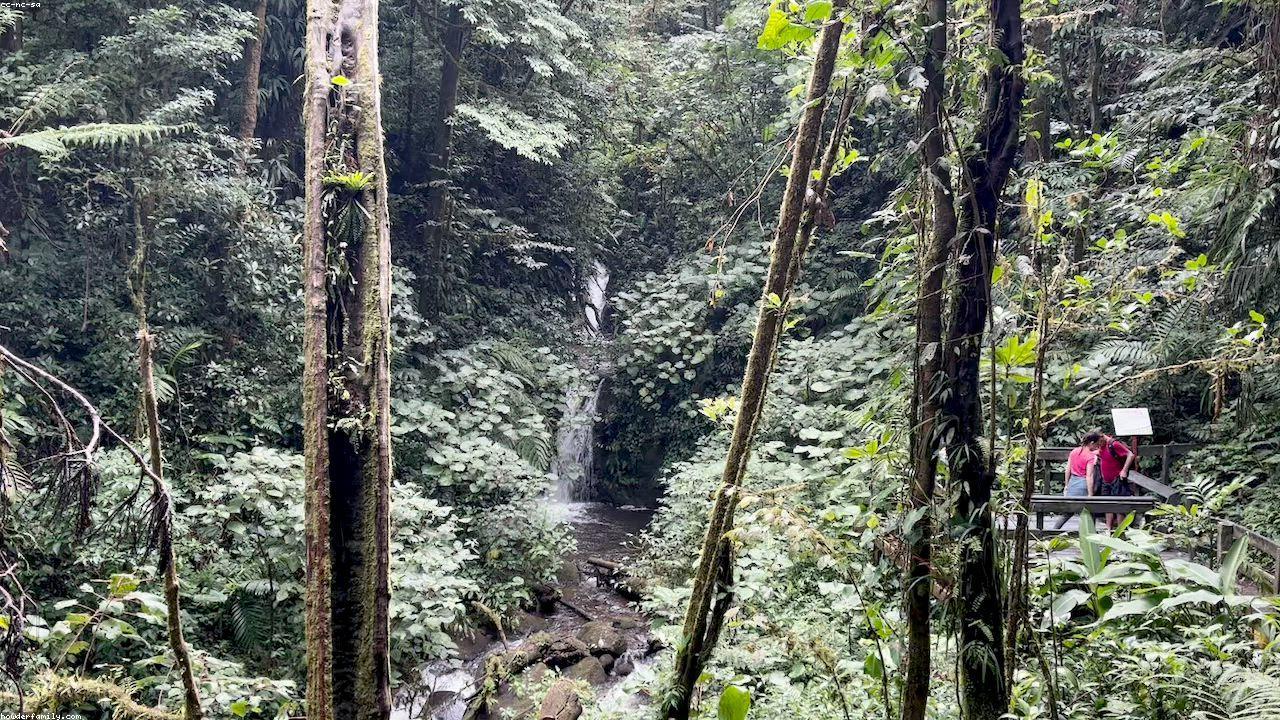
Monteverde's cloud forest hangs in the mist along the Costa Rican Continental Divide. The air is wet. The trees are draped in mosses and bromeliads. The biodiversity, per hectare, is among the highest on earth. The cloud forest is the reason to come.

By Ščenza
· updated · 4 min read
It’s 6:11 a.m. on a damp trail in the Monteverde Cloud Forest Biological Reserve and the morning mist is doing what cloud forest mist does — sitting in the canopy above me, occasionally lifting to reveal trees, dropping back to wrap the trail in cotton wool. A small bird — possibly a resplendent quetzal, possibly not, my guide will say later it was — flashes through the foliage twenty metres away. The orchids on the tree trunks are five centimetres across. The whole forest is breathing in slow motion. This is the experience the Costa Rican cloud forest offers and almost no other forest does.
Why I keep coming back
The Monteverde Cloud Forest sits at 1,400 m along the Continental Divide of Costa Rica. The combination of Pacific moisture rising from the Pacific lowlands and Atlantic moisture from the Caribbean produces near-permanent mist condensation in the upper canopy. The result is a cloud forest — biome distinct from rainforest — in which the trees collect water directly from the mist, the epiphyte loads on the trees are enormous, and the biodiversity per square metre is some of the highest on earth.
Monteverde is also one of the world’s pioneering ecotourism destinations, founded in part by American Quaker settlers in the 1950s and gradually professionalised over six decades. The reserves are now extensive: the original Monteverde Cloud Forest Biological Reserve, the larger and quieter Santa Elena Cloud Forest Reserve, and several private reserves.
Where to base yourself
Santa Elena is the small town that services the cloud forest visitors; small, walkable, hostels through to upper-end lodges.
Monteverde Lodge & Gardens is the long-running upper-mid-range eco-lodge.
Hotel Belmar is the boutique mid-range.
What to actually do
Walk the cloud forest trails at dawn. The 4 a.m. starts give you the chance of resplendent quetzal sightings (the iconic male has a 60-cm tail-streamer); the morning birds are at their most active in the first two hours. Use a licensed guide for the first walk — the species identification is genuinely difficult without one.
Canopy walks and zip-lines. Several operators offer hanging-bridge walks at canopy level (Selvatura is the largest); zip-lines through the canopy (Selvatura, Original Canopy Tour). The zip-lines are touristy and fun.
Visit a hummingbird gallery. The cloud forest hosts dozens of hummingbird species; small feeders attract them in extraordinary numbers. The Hummingbird Garden at the entrance to the Monteverde Reserve is the easiest.
Night hike. The cloud forest at night is a different ecosystem; with a guide and torches, the chances of seeing tarantulas, kinkajous, owls, and sleeping birds are high.
Visit a sustainable coffee farm. The volcanic soil produces excellent coffee; Don Juan Coffee Tour or Café Monteverde are the long-running options.
Day-trip to Arenal Volcano. Three hours by road; the famous conical volcano (last major eruptions ended around 2010 but the surrounding national park, hot springs, and lake remain extraordinary). A 1-night stay there is the standard.
Where to eat
Monteverde’s food scene is small but increasingly competent.
Tree House Restaurant — Mid-range; the building includes a tree growing through it. Sabor Tico — Local Costa Rican; the casado (the Costa Rican lunch plate — rice, beans, plantain, meat, salad) is the standard. Sofia — Latin fusion, popular. Stella’s Bakery — Long-running for breakfast. Costa Rican coffee at any local café — Costa Rican coffee is the country’s other agricultural pride after bananas.
When to come
December through April is the dry season — clearer mornings, less rain.
May through November is the rainy season — but in a cloud forest the distinction matters less; the rainforest is wet always. The wildlife is often more active in the wet months.
Quetzal nesting season (roughly March through May) is the highest-probability window for spotting the iconic bird.
Practical notes
- Visa: 90 days visa-free for most Western passports.
- Money: Costa Rican colón; US dollars are widely accepted as well. Card accepted in most establishments.
- Transport: From San José, around 3 hours by road; many shuttle-van operators run the route. The mountain road into Monteverde was famously bad for decades and is now paved for almost all of it.
- Park entry: Around US$25–30 for the Cloud Forest Biological Reserve.
- Wildlife rules: Don’t touch, don’t feed, don’t make noise. The licensed guides will police this gently.
- The cloud: Real, daily, mostly in the upper canopy. Visibility on the trails is sometimes 10 m. Dress in layers; the temperature is 12–18°C, often damper than the numbers suggest.
A final thought
Monteverde is one of the most accessible cloud-forest experiences on earth, with a developed ecotourism infrastructure that has been refining the visitor experience for forty years. The biodiversity per hectare is some of the highest in the Americas; the guided walks deliver the species identification that the casual visitor will not get alone.
Four or five nights at Monteverde and Arenal combined is the standard Costa Rica trip; pair it with a few days at the Pacific or Caribbean coast for a 10-day Costa Rica visit. The country’s pura vida — the famous national catchphrase, roughly ‘pure life’, applied to the laid-back Tico hospitality — is a real cultural quality and one of the country’s most enduring features.
Walk the cloud forest in the morning. Take a guide. Spot the quetzal if it shows. Listen to the forest. Drink the coffee. The cloud forest has been doing this work — converting Pacific mist into trees draped in epiphytes — for a long time, and it remains, for now, one of the most extraordinary small ecosystems available to the patient traveller.
If you only have a few days
6 ideal things to do in Santa Elena
First walk of the day in the Monteverde Cloud Forest Biological Reserve
About 6 km up from Santa Elena, on the Continental DivideFirst entry; quetzal nesting runs roughly March to May
Ten thousand hectares straddling the divide, more than five hundred orchid species, four hundred birds, and mist that sits in the canopy and arrives on you as actual rain. Take a guide for the first walk. Mine stopped mid-sentence, put a scope on a branch forty metres off, and showed me a male quetzal with a tail streamer longer than my forearm that I had looked directly at twice without seeing anything at all.
Curi-Cancha Reserve for the birds
Between Santa Elena and the Monteverde reserveEarly morning
A privately owned reserve with the same forest as its famous neighbour and a fraction of the boots on the trail, which matters more to birdwatching than the size of the protected area does. Quetzals nest here. So do bellbirds, motmots and a long list of things I could not have named that morning. The trails are open enough that you can get a scope on something, which in a cloud forest is not a given.
Santa Elena Cloud Forest Reserve
About 5 km north-east of Santa Elena townAny morning; wetter and windier than Monteverde
Leased and run by the local high school since 1992, with the entry money going back into the school — biology, tourism, technology. On a clear day the lookout hands you Arenal across the valley; on the other days, which is most of them, it hands you cloud moving through at eye level. Fewer people come. That is a fact about the road and the marketing budget, not about the forest.
The Treetop Walkways at Selvatura
Up near the Santa Elena reserveMorning, before the afternoon cloud closes in
Eight suspension bridges strung along three kilometres of trail, the longest of them 157 metres, putting you level with the epiphytes instead of squinting up at them. It is engineered, ticketed and thoroughly signposted, and none of that stops the canopy from being a genuinely different ecosystem to the forest floor. The bridges move. Everyone pretends not to mind, and nobody stops in the middle.
Night walk at Bajo del Tigre
Children's Eternal Rainforest, run by the Monteverde Conservation LeagueDeparts at dusk; reserve ahead
The Children's Eternal Rainforest exists because a class of Swedish schoolchildren started raising money for it in the 1980s, and it is now the largest private reserve in Central America. Bajo del Tigre is its walkable corner. After dark the forest swaps species entirely — tarantulas out of their holes, birds asleep at eye level, a kinkajou overhead making a noise like a badly hung door. Torches off when the guide says off.
The Monteverde cheese factory
Santa ElenaWeekday; tours run morning and early afternoon
Quaker families arrived here from the United States in 1951, having decided that a country which had just abolished its army suited them better, and started making cheese in 1953. They also set aside the forest above their farms as watershed, which is where the whole conservation story on this mountain begins. The tour is unglamorous and the ice cream at the end is very good. As a Dalmatian I am obliged to be sceptical of anyone else's cheese; I bought some anyway.
From a Split boy’s notebook
The Split lens
What reminded me of home
Highland forest with a real ecological identity and a serious eco-tourism economy built on biodiversity rather than beaches. The Krka and Plitvice rivers and the Velebit forests are our equivalent — temperate-ecology rather than tropical, but globally rare freshwater ecosystems with high endemism. We treat them as scenery; Costa Rica treats theirs as a national asset.
What Split could borrow
Costa Rica funds park ranger salaries, biodiversity research, and surrounding-community schools through park entry fees. The fees are higher than ours and the allocation is more transparent. Raising our park fees modestly and binding the revenue explicitly to local conservation would build community support and improve the parks.
Who can take you
Tour operators & guides to try
A short, opinionated starter list — just my humble opinion. Verify before booking.
Intrepid Travelsmall groupwww.intrepidtravel.com →
Intrepid's Costa Rica trips combine Monteverde with Arenal and the Pacific coast. Group size 12–16. The Monteverde portion includes a guided cloud-forest walk (essential — you'll see significantly more wildlife with a guide than alone), a hanging-bridges walk, and a coffee-plantation visit. Caveat: their accommodation in Monteverde tends to be in Santa Elena rather than at the upper-end cloud-forest lodges; ask if it's the Monteverde Lodge level or below.
G Adventuressmall groupwww.gadventures.com →
G Adventures runs Costa Rica circuits at a similar price-point and structure. Group size 12–18. Their wildlife guides at Monteverde are usually well-trained. Caveat: choose between operators based on the specific itinerary days rather than the operator name; the Monteverde portion is similar across operators, but the Arenal and Pacific coast components vary more.
If you liked this, try these
Antananarivo, Madagascar
Madagascar: the eighth continent and the slow road through it
September 26, 2022
Sesriem, Namibia
Sossusvlei: the dunes of the Namib and the country around them
October 15, 2022
Seronera, Tanzania
Serengeti: the East African plains and the great migration
July 4, 2022