Photo: Ščenza
Cairns, Australia · Oceania
The Great Barrier Reef: diving the last decades of the world's largest reef
The Great Barrier Reef is the largest living structure on earth. It is also one of the most visibly distressed marine ecosystems on the planet, with successive bleaching events over the past decade. The visit is worth making, more carefully than the brochures suggest.

By Ščenza
· updated · 4 min read
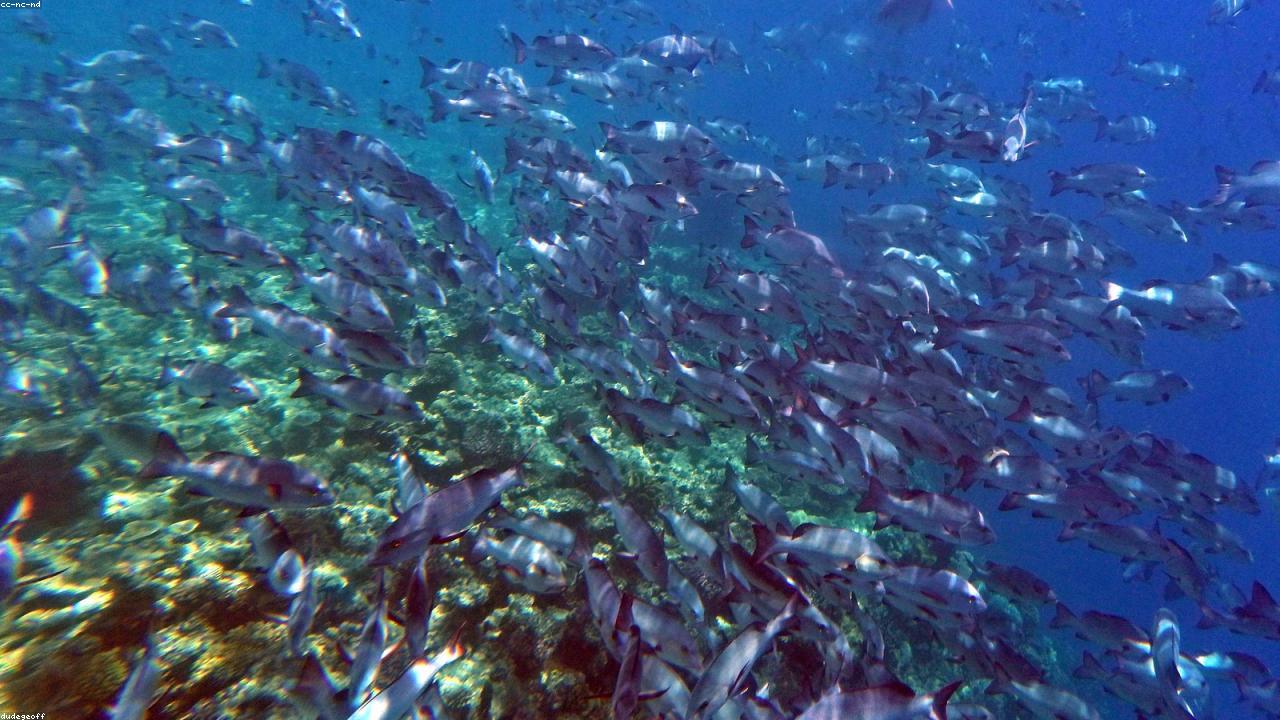
I’m 18 metres down on Norman Reef in October 2023, with a divemaster called Lara who has been working the outer Great Barrier Reef for sixteen years. The water is the clearest I have ever dived. The coral structures around us are extraordinary — table corals, branching corals, the soft fans waving in the current — and many of them are visibly bleached, white where they should be brown or pink. The species count is still impressive. Three reef sharks circle the deeper edge. A green turtle, my age, drifts past. Lara mentioned topside that this reef looks much better than what she dove last year. The Great Barrier Reef is, in 2026, a place worth visiting with full awareness of what it has been and what it is becoming.
Why I keep coming back
The Great Barrier Reef extends for 2,300 km along the northeast coast of Australia and is the largest coral-reef system on earth — visible from space, comprising over 2,900 individual reefs and 900 islands. It is also one of the world’s most extensively monitored marine ecosystems and one of the most ecologically threatened.
Multiple bleaching events since 2016 have damaged significant portions of the reef. Climate change, runoff from the Queensland sugar-cane coast, and crown-of-thorns starfish outbreaks have all played roles. The reef is, in 2026, fragile in a way that it was not in 2006.
Going now is, in some ways, the case for going now — both because the reef remains genuinely extraordinary in many of its sections and because the experience may not be available indefinitely at this quality.
Where to base yourself
Cairns is the main gateway in tropical North Queensland; mid-range to upper-end resorts; the launching point for most reef trips.
Port Douglas is the smaller, slightly more upmarket town an hour north of Cairns.
Lizard Island and Heron Island are the small private-island reef-resort options, on the reef directly.
Hamilton Island in the Whitsundays for the southern-reef section.
What to actually do
Dive or snorkel the outer reefs. The inner reefs (closest to shore) are more damaged; the outer reefs (a longer boat ride) are in better shape. Day trips from Cairns to Norman, Saxon, or Hastings Reefs are the standard; serious divers do liveaboard trips to the Cod Hole and the Ribbon Reefs further north.
Take a liveaboard. 2–7 night dive vessels operate out of Cairns to the more remote outer-reef sites. The Spirit of Freedom, Mike Ball Dive Expeditions, ProDive Cairns are the established operators.
Hire a sea kayak. From a small private-island resort like Lizard Island, you can kayak directly out to the surrounding reefs.
Visit the Daintree Rainforest. North of Cairns, the world’s oldest continuous rainforest (180 million years), at the edge of the reef. The Mossman Gorge and the Cape Tribulation drive.
Walk the Atherton Tablelands. The volcanic plateau west of Cairns; waterfalls, cooler climate, cassowaries (the prehistoric flightless bird).
Sail the Whitsundays. The 74-island group along the central reef; bareboat sailing or skippered charters are the way; Whitehaven Beach is the iconic destination.
Where to eat
Cairns and Port Douglas have a reasonable food scene; the inland and island options are more variable.
Ochre (Cairns) — Modern Australian, native ingredients. Salsa Bar & Grill (Port Douglas) — Reliable, popular. Nautilus (Port Douglas) — Upper-end.
On the islands and the liveaboards, meals are provided.
When to come
June through October is the dry season; better underwater visibility, no jellyfish concerns, more reliable weather. Peak season.
November through May is the wet season; underwater visibility is sometimes lower; the box jellyfish (irukandji) is present and dangerous; stinger suits are required on swimming beaches.
Coral spawning (October–November, in the days after the full moon) is one of the great marine events; specialised dive operators run trips.
Practical notes
- Visa: ETA.
- Money: Australian dollar.
- Reef tax: An Environmental Management Charge (currently AU$7) applies to most reef tours and supports reef management.
- The bleaching: Real, visible, partially recovering in some areas, getting worse in others. The reef-management authority (GBRMPA) publishes condition reports.
- Sun and reef etiquette: Wear reef-safe sunscreen (zinc-based, without oxybenzone or octinoxate). Don’t touch coral. Don’t stand on coral. Don’t take anything.
- The crocodiles: Estuarine (saltwater) crocodiles inhabit the rivers and some beaches of tropical North Queensland. Heed the warning signs.
- The stingers: Box jellyfish (and the smaller irukandji) are present in mainland-coast water October–May. Stinger nets and lycra stinger suits are standard.
A final thought
The Great Barrier Reef in 2026 is a more complicated visit than it was in 2006. Significant portions are visibly damaged. The conversation about coral-reef collapse, climate change, and the future of marine ecosystems is, in this water, immediate and visible.
Go, in my view, with thoughtful planning. Choose operators that work with the GBR Foundation and the reef-management authority. Visit the outer reefs where coral health is better. Bring reef-safe sunscreen. Don’t touch anything. Make your visit a small input to the conservation conversation by spending money on the operators who are doing the careful, science-aware work.
Four or five nights in the region minimum. Two or three days on the reef (day trips or a liveaboard). One day in the Daintree. The reef remains, despite everything, one of the most extraordinary marine environments accessible to a non-specialist diver or snorkeller. Go while it’s still here at this quality.
If you only have a few days
5 ideal things to do in Cairns
Snorkel Michaelmas Cay
33 km east of Cairns; a morning's sail outJune to October — dry season, better visibility, no stingers inshore
Thirty-three kilometres east of Cairns there is a low sand cay holding more than one per cent of the world's greater and lesser crested terns, which is why visitors are confined to a roped-off wedge of beach and the birds get everything else. They are extremely loud and entirely unbothered by you. Underwater the coral is in better shape than the inshore reefs, though 'better' is doing real work in that sentence — bleached table coral sits alongside healthy stuff, and a good crew will tell you honestly which is which if you ask them.
The Cod Hole on Ribbon Reef No. 10
Far northern reef, reached by liveaboard out of CairnsThree to seven nights aboard, dry season
Ribbon Reef number ten, well beyond day-boat range, and the reason serious divers put up with a bunk roughly the dimensions of a coffin for four nights running. The resident potato cod are enormous and completely habituated to people, which is both the appeal and the ethical problem: decades of hand-feeding did that, and survey counts of the fish fell sharply through the 1990s. Several established operators run north from Cairns. Ask what their feeding policy is before you book, and take the answer seriously.
Mossman Gorge and the road to Cape Tribulation
Daintree National Park, 80–110 km north of CairnsA full day, with the Daintree River cable ferry built into the plan
Ninety-odd kilometres north of Cairns the Mossman River comes down out of Daintree National Park, and there is a 2.4-kilometre loop walk across a suspension bridge into rainforest that has been doing this continuously for longer than most things have existed. This is Kuku Yalanji country and the guided walk is the better version of the visit. Keep driving, cross the river by ferry, and the road ends at Cape Tribulation where World Heritage rainforest runs straight into World Heritage reef. Read the crocodile signs. They are not decorative.
Skyrail up, Kuranda Scenic Railway down
Smithfield to Kuranda, up the Atherton escarpmentGo up early; cloud settles on the tableland through the afternoon
Two entirely different methods of climbing the same escarpment, and the sensible move is one of each. The cableway runs 7.5 kilometres over the canopy with stops at Red Peak and Barron Falls. The railway takes 37 kilometres of 1880s track through fifteen tunnels and across fifty-five bridges to achieve the same gain, slowly and loudly and much better. I did it in the wrong order — train up, gondola down — and spent the descent wishing I had saved some attention for the canopy.
The waterfall circuit at Millaa Millaa
Atherton Tablelands, about ninety minutes southwest of CairnsAfter rain, which up on the tablelands is most of the time
Millaa Millaa is the waterfall from every Queensland tourism poster, and the plunge pool underneath it is genuinely swimmable: cold, dark, ringed with dripping vegetation and, on a Tuesday in June, almost empty. The circuit continues to Zillie and Ellinjaa Falls within a few kilometres of road. The tablelands sit high enough to run noticeably cooler than the coast, which after four days of tropical Cairns registered as a personal favour.
From a Split boy’s notebook
The Split lens
What reminded me of home
A marine ecosystem of global significance, under climate-and-tourism pressure, that requires careful stewardship. Our Adriatic is at a smaller scale (and less imperilled) but Posidonia seagrass beds, the noble pen shell, and the loggerhead turtle populations need the same kind of serious monitoring and protection.
What Split could borrow
The GBR has a formally funded marine-park authority that monitors reef health, enforces operator licensing, and publishes annual condition reports. Our Adriatic monitoring is fragmented across several ministries and the public condition reporting is essentially absent. A formal Adriatic Park Authority with transparent annual reporting is overdue.
Who can take you
Tour operators & guides to try
A short, opinionated starter list — just my humble opinion. Verify before booking.
Intrepid Travelsmall groupwww.intrepidtravel.com →
Intrepid's Great Barrier Reef trips include a 2–3 day reef visit (typically from Cairns) within a longer Queensland or East Coast Australia itinerary. Group size 12–16. They use the more reputable outer-reef operators rather than the in-shore mass-market boats. Caveat: the reef's bleaching condition varies year-to-year; the outer reefs are healthier than the inner reefs, and the operator's specific reef sites matter — ask for the current sites being used.
Aurora Expeditionsexpeditionwww.auroraexpeditions.com →
Aurora Expeditions runs a small expedition vessel — the Coral Geographer — that does multi-day reef cruises with serious naturalist programming, snorkelling and diving daily, and access to the more remote northern reefs. Upper-tier pricing. Caveat: this is a more substantial commitment than a day boat from Cairns; budget at least 5–7 nights aboard and the time-and-cost premium that implies.