Photo: Ščenza
Hanoi, Vietnam · Asia
Hanoi at the small plastic stool: a city of broth and motorbikes
Hanoi is a city of small plastic stools. They are on every pavement. They appear at dawn, around the noodle carts, and disappear at midnight, after the last beer. They are how you eat in this city. They are how you watch the city. Get comfortable on them.

By Ščenza
· updated · 5 min read
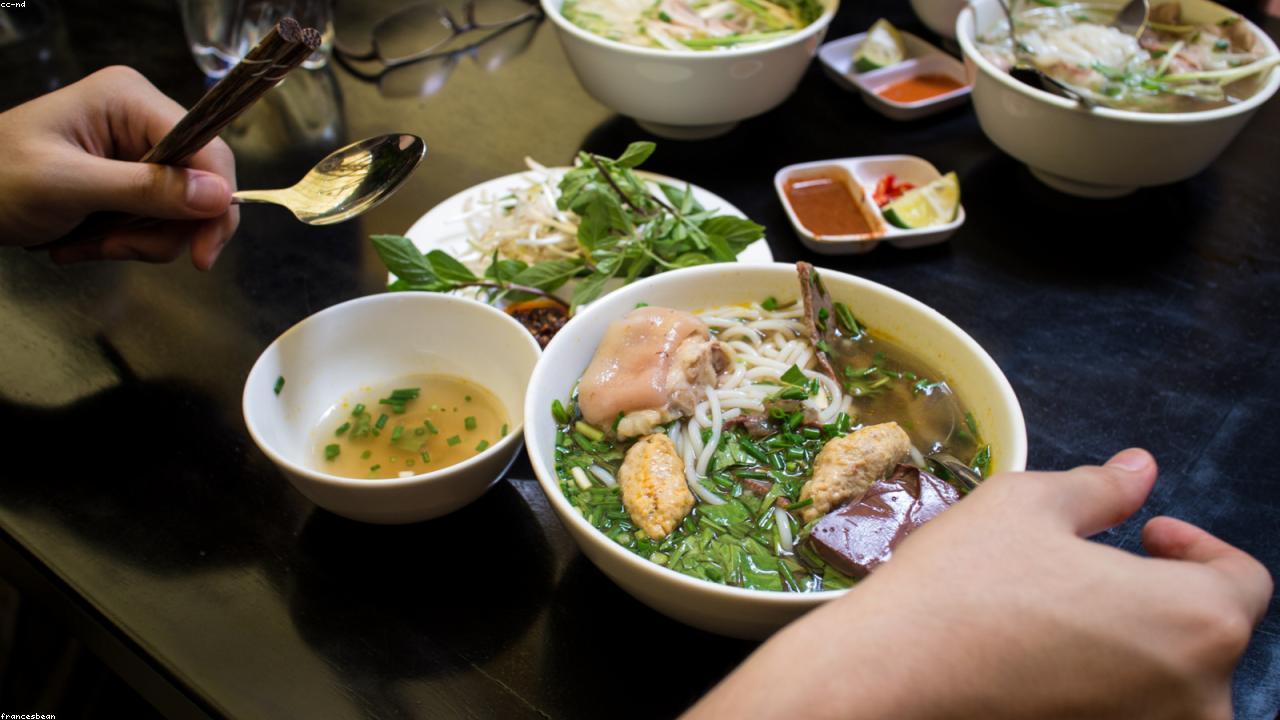
It’s 6:11 a.m. and I’m crouched on a red plastic stool barely six inches off the pavement, with a bowl of pho bo on my knees, in front of a corner shop on Bat Dan Street that has been open since around 4:30. The proprietor — Bà Tu, sixty-eight, has been making this pho for forty-one years — ladles broth into another bowl behind me. The broth has been on since yesterday. The beef shanks, the charred ginger, the star anise. A motorbike with a family of four passes the corner. This is Hanoi.
Why I keep coming back
Hanoi is, for me, the great undersold city of Southeast Asia. Saigon (Ho Chi Minh City) is the headline; Hanoi is the longer, slower, more reverberant experience. It has been a capital, in various forms, for a thousand years. The Old Quarter — the 36 phố phường, the 36 guild streets — is a tangled grid of narrow streets where each historically specialised in a single trade (Silver Street, Silk Street, Tin Street, Bamboo Street).
The food is one of the most refined street cuisines on earth — pho, bun cha, banh mi, banh cuon, bun bo nam bo, ca phe trung — each developed at a single shop over decades.
Where to base yourself
The Old Quarter for the street life. Choose a quieter street (Hang Quat, Hang Bac) rather than the noisy bar streets (Ta Hien).
French Quarter (south of Hoan Kiem Lake) for the wider streets, the colonial-era architecture, and slightly more breathing room.
West Lake (Ho Tay) if you want a calmer, less compressed base; a 15-minute taxi to the centre.
What to actually do
Walk the Old Quarter at 5 a.m. The motorbike traffic is at its lowest; the noodle shops are opening; the night-shift food stalls (banh my, bun rieu) are still serving. By 7 a.m. the city is fully awake. The first two hours are quietly extraordinary.
Walk the Hoan Kiem Lake at dawn. The central lake of the city, with the Turtle Tower in the middle and the red bridge to the Ngoc Son temple. At dawn, the lakeside is full of Hanoians doing tai chi, ballroom dancing (yes, on the pavement, to Vietnamese pop music from portable speakers), and badminton.
Visit the Ho Chi Minh Mausoleum and complex. Ho Chi Minh’s preserved body is on display in a Soviet-style mausoleum; the queues are organized, the experience is sober and short. The neighbouring Presidential Palace and the wooden Stilt House where Ho actually lived (refusing the palace) are part of the same visit.
Spend an afternoon at the Temple of Literature. The first national university of Vietnam, founded in 1070; five courtyards of stone steles, dragons, and lotus ponds. A surprisingly contemplative space in the centre of a busy city.
Take a day trip to Ninh Binh. Two hours south by train. The ‘inland Halong Bay’ — vertical limestone karsts rising out of flooded rice fields, traversed by small rowboats. Tam Coc and Trang An are the boat-route villages. Less famous than the coastal Halong Bay and arguably more atmospheric.
Hear ca trù. The classical Vietnamese chamber music form; the Thang Long Ca Trù Theatre in the Old Quarter does an hour-long performance several evenings a week. Strange, hypnotic, ancient.
Where to eat
The small specialist shops are the show.
Pho Gia Truyen (Bat Dan St) — Classic pho bo; one bowl, one variation, no nonsense. Queue at 6 a.m. Bun Cha Huong Lien (Le Van Huu St) — Bun cha (grilled pork patties in broth-dip, with vermicelli and herbs). The dish Obama and Anthony Bourdain ate here in 2016; the queues remain. Banh Cuon Gia Truyen (Hang Ga St) — Steamed rice rolls with minced pork and mushroom; you’ll watch them being made in front of you. Banh Mi 25 (Hang Ca St) — The classic Hanoi banh mi. Cafe Giang (Nguyen Huu Huan St) — The original egg coffee shop; thick whipped-yolk topping on Vietnamese coffee. Strange, excellent. Cha Ca Thang Long (Cha Ca St) — Hanoi’s famous turmeric-fried fish, a 130-year-old dish at this shop. Bia Hoi corner (Ta Hien & Luong Ngoc Quyen) — Local fresh draft beer, 8,000 dong (under US$0.50) a glass, on the plastic stools. The evening institution.
When to come
Late September to November, or March to early May — the spring and autumn windows. Pleasant temperatures, low rainfall.
December through February has cold north-Vietnamese winters (12–18°C, often grey); a different city, also beautiful.
Avoid May through September — hot, humid, with afternoon thunderstorms.
Practical notes
- Visa: E-visa or visa-on-arrival for most Western passports; processed online, takes a week, around US$25.
- Money: Vietnamese dong. ATMs are everywhere. Card increasingly accepted; cash for street food.
- Crossing the street: A genuine art form. The motorbikes will weave around you; you walk slowly and steadily, never run, never stop suddenly. Locals do it without looking.
- Transport: Walking and Grab. The taxis are mostly Grab-app-based now. Buses are useful for longer hops.
- Halong Bay: The classic boat-cruise destination 4 hours east. The 2- or 3-day overnight cruises are the move; day trips are exhausting.
- The hawking: The Old Quarter has aggressive street vendors aimed at tourists; the doughnut and fruit-on-a-shoulder-pole photographs are not free, and the vendors will demand payment if you photograph or accept their handover. Walk past politely.
A final thought
Hanoi is one of the cities that has changed most rapidly in the past twenty years and remained most recognisably itself. The motorbike count has gone from low millions to nearly 8 million within the metropolitan area. The skyline of the outer districts is now high-rise. And yet the Old Quarter, the central streets, the lake-side dawn rituals, the pho shops, the egg-coffee houses — these have persisted.
The city rewards a particular kind of attention: the willingness to sit on a low plastic stool, on a noisy pavement, with a bowl of something on your knees, and to take twenty minutes to eat it. The dishes are simple. The cooks are masters. The shops are old. The seats are uncomfortable. The transaction is roughly two dollars. This is the meal of Hanoi. Have it five times in a week. Walk slowly between them. Sleep in the Old Quarter. The city, for now, still works the way it worked a generation ago, and that is — increasingly in modern Asia — a rare thing.
If you only have a few days
7 ideal things to do in Hanoi
The Old Quarter's guild streets at first light
North of Hoan Kiem LakeBetween five and seven in the morning
Thirty-six streets, each named for what it once sold — Hàng Bạc for silver, Hàng Mã for paper offerings, Hàng Thiếc for tin — and a good few still doing it, with a man cutting sheet metal on the pavement at half past five. The traffic is at its thinnest and the broth pots have been on since long before that. By seven it is finished and the city is fully awake. I have never once managed this two mornings running.
A lap of Hoan Kiem Lake before the city starts
Central HanoiDawn; the ring of streets closes to traffic Friday evening to Sunday night
One point eight kilometres round, the Turtle Tower on its islet, and the red Huc Bridge over to Ngoc Son temple. At dawn the path belongs to tai chi groups, badminton doubles and, one memorable morning, a ballroom class working through a foxtrot to Vietnamese pop from a speaker the size of a suitcase. From Friday evening the surrounding streets close to motorbikes entirely, which is when you learn how loud this city normally is.
The Temple of Literature and the doctors' stelae
Văn Miếu, west of the Old QuarterOpening hour, or the last of the afternoon
Founded in 1070, with Vietnam's first university attached six years later and running until 1779. Five courtyards, and in the third, 82 surviving stone tablets riding on the backs of stone tortoises, first commissioned in 1484 and carrying the names of 1,307 examination graduates. Students still come here before their exams and touch things they have been asked not to touch. The courtyards are the quietest ground in central Hanoi.
The Imperial Citadel of Thăng Long
Hoàng Diệu Street, Ba ĐìnhLate afternoon; pairs with the Ho Chi Minh complex next door
Thirteen centuries of political power on one site, dug into only since 2002 and still producing — palace foundations, wells, ceramics, layer beneath layer beneath a lawn. UNESCO listed it in 2010. Most visitors give the afternoon to the mausoleum next door instead, which leaves the citadel's courtyards close to empty, and I once sat on a wall there for an hour without anyone trying to sell me anything, which in this district is close to a miracle.
Hỏa Lò Prison Museum
Hỏa Lò Street, French QuarterWeekend evenings for the Sacred Night programme
The French built it as Maison Centrale to hold Vietnamese political prisoners; the American pilots held here decades later gave it the sardonic nickname the Hanoi Hilton. The guillotine is still standing in its room. The museum tells the story firmly from the Vietnamese side, and it is better to walk in expecting that than to be surprised by it halfway round. The weekend evening programme is theatrical and needs booking; the daytime visit is quieter and no lighter.
Egg coffee at Café Giảng
Nguyễn Hữu Huân, Hoàn KiếmMid-morning, upstairs
Nguyễn Văn Giảng was a bartender at the Metropole, and in 1946, short of fresh milk, he whipped egg yolk into coffee instead. The family still makes it the same way, up an alley and a staircase built for smaller people than me. It arrives in a small glass standing in a bowl of hot water, tastes like warm tiramisu, and is the only sweet thing I will drink before noon.
Trang An by rowing boat
Ninh Bình, about two hours southA full day; go midweek
Limestone karsts rising straight out of flooded paddy, and a small metal boat threaded through low caves — some low enough that you lie back on the bench — by a woman rowing with her feet, which is how it is done here and looks impossible until roughly the third stroke. Tam Cốc is the shorter, more famous route; Trang An's is longer and goes through more caves. Either way it eats the day, and either way you tip the rower properly.
From a Split boy’s notebook
The Split lens
What reminded me of home
Plastic-stool culture on every pavement, with the older generation cooking the working classics for the office crowd. Hanoi's pho at dawn is what our marenda (mid-morning workers' meal) used to be — early, cheap, eaten standing. Both cities still understand that some of the best food is from a corner cart.
What Split could borrow
Hanoi's small food carts are licensed and located by trade — the pho corner, the bún chả corner, the bánh mì cart. Our old-town food economy is dominated by tourist-priced sit-down restaurants. A municipal framework for a half-dozen licensed small carts (good salt cod fritters at the Pazar would be a start) would be useful.
Who can take you
Tour operators & guides to try
A short, opinionated starter list — just my humble opinion. Verify before booking.
Intrepid Travelsmall groupwww.intrepidtravel.com →
Intrepid's Vietnam trips run Hanoi as a 2–3 night chapter inside a longer south-to-north loop. The Old Quarter food walk, the Ha Long Bay overnight cruise (Intrepid uses one of the better-rated junks), the train transfers — they handle the logistics intelligently. Group size 12–16. Caveat: the Ha Long Bay cruise quality varies year-to-year; verify which boat they're currently using before booking.
EXO Traveltailoredwww.exotravel.com →
EXO Travel's Hanoi desk is the right partner for a tailored Vietnam trip with private-guide days. Their north-Vietnam offering — Hanoi, Ha Long Bay, the highland villages around Sapa, the Tonkinese Alps — is among the deeper itineraries in the country. Mid-to-upper-tier pricing. Caveat: usually booked through a Western travel agent rather than directly; if you want direct contact, their offices in Hanoi do reply but slowly.