Photo: Ščenza
Hoi An, Vietnam · Asia
Hoi An by lantern light: the small port town that survived
Hoi An's central trading town, the old port on the Thu Bon river, is one of the most architecturally preserved towns in Southeast Asia. It is also, on lantern-festival nights, a crowded selfie corridor. The trick is the early morning, the rainy afternoons, and the bicycle to the beach.

By Ščenza
· updated · 5 min read
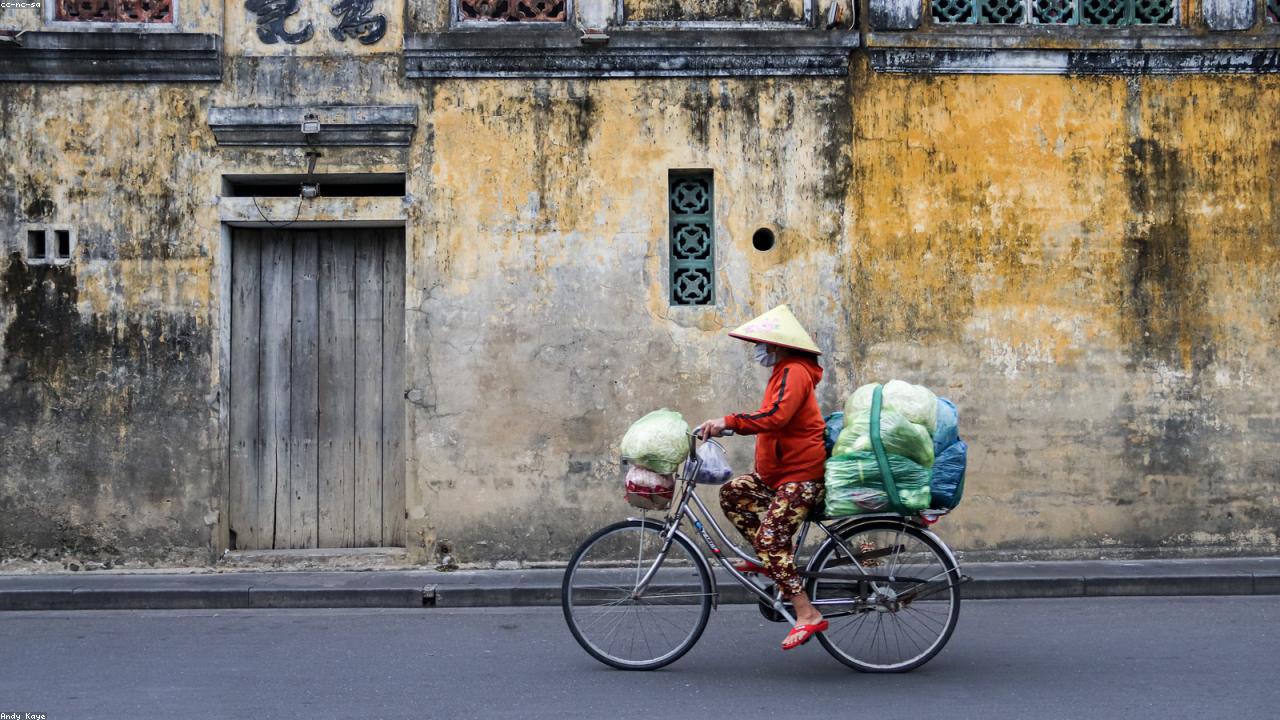
It’s 5:47 a.m. on a misty morning in the central Vietnamese town of Hoi An and I’m cycling along the Thu Bon riverfront with the silk-lantern strings still hanging from the night before. A fisherman in a conical hat is throwing a circular net from a small boat. A monk is sweeping the courtyard of the Phuc Kien Assembly Hall. The shophouses — 200-year-old single-storey timber-and-stucco buildings, painted in the local Hoi An ochre — are still shuttered. For the next two hours I have one of the most beautiful small towns in Southeast Asia largely to myself.
Why I keep coming back
Hoi An was a major trading port from the 15th to the 19th centuries — Japanese, Chinese, Dutch, and Portuguese traders all settled here — until the river silted up and the trade moved to Danang. The town fell asleep, preserved its architectural fabric by accident, and was rediscovered as a UNESCO World Heritage site in 1999.
The central old town is a small grid of around twelve streets and one bridge (the Japanese Covered Bridge, 1593). The shophouses, the Chinese assembly halls, the small museums, the working tailors. The tailors are the unintended joke of Hoi An — somehow this UNESCO town became the world’s largest impromptu suit-and-dress-tailoring centre, with hundreds of shops promising same-day delivery.
Where to base yourself
Inside the old town in one of the small boutique guesthouses (the Anantara Hoi An Resort is the upscale riverside option; smaller homestays line the side streets).
Cam Pho or An Hoi island for a slightly quieter base just outside the central pedestrian zone.
Cua Dai or An Bang beach if you want to combine the town with a beach base. 4 km out, 10 minutes by bicycle.
What to actually do
Walk the old town between 5:30 and 7:30 a.m. This is the entire trip-defining experience. By 9 a.m. the tour buses arrive and the streets fill. The first two hours are quiet, atmospheric, and beautiful.
See the lantern festival. On the 14th day of each lunar month, the town turns off most of its electric lights and lights its 600 silk lanterns. People float small paper lanterns on the river. It’s stunning and also, by 8 p.m., genuinely crowded. Arrive at 6.
Visit at least two Chinese assembly halls. The Phuc Kien (Fujian), the Quang Trieu (Cantonese), the Hai Nan (Hainan). Each was a guild house for a community of Chinese traders; the ornate altars and ceramic dragons are extraordinary.
Get a piece of clothing made. I know — it sounds clichéd. It’s also one of the lasting tactile pleasures of a Hoi An visit. Decent tailors: Yaly Couture, Bebe Tailor, Kimmy Tailor. Avoid the cheapest shops; budget around US$80–150 for a quality cotton or linen shirt, US$200–400 for a suit. 24- to 48-hour delivery is standard.
Cycle to An Bang or Cua Dai beach. Beach hire bicycles are standard at most guesthouses, no charge or a few dollars a day. The cycle is flat, 10 minutes through rice fields. The beach has fresh-seafood shacks. Best in the morning or late afternoon.
Take a cooking class. Hoi An’s Chinese-Vietnamese-Cham mixed cuisine includes specific local dishes — cao lau (a unique noodle with crackling, herbs, and pork), banh mi Hoi An (the proper baguette tradition, often cited as Vietnam’s best), white rose dumplings. Red Bridge Cooking School is the long-running classic; classes start with a market visit.
Where to eat
Banh Mi Phuong — The Anthony Bourdain endorsement made this one famous; the queues are real and the sandwich is still very good. ฿35,000 dong. Bale Well — A 30-year-old family banh mi and banh xeo (savoury rice pancake) shop in the old town. Family-style menu. Cao Lau at Thanh Cao Lau — One of the better Cao Lau shops; eat at the small plastic-stool tables. Morning Glory — Touristed but with reliably good local dishes; useful if you have only one dinner. Mango Mango — Modern Vietnamese fine dining on the riverfront. The Market Hall — Hoi An’s covered market; the small food court at the back has dozens of working stalls for ฿20,000–40,000 dong meals.
When to come
February to April, or September to early November. Pleasant temperatures, lower rainfall.
May to August is hot (35°C+). October and November have heavier rains and occasional Thu Bon flooding.
The Lantern Festival, on the 14th day of every lunar month, is the iconic experience; check the lunar calendar and book accommodation early.
Practical notes
- Visa: As Hanoi — e-visa or visa-on-arrival.
- Money: Vietnamese dong. Card accepted at hotels and restaurants; cash for street food.
- Transport: Bicycle and feet. The old town is car-free during pedestrian-only hours.
- Tailoring: Budget 48 hours minimum from first fitting. The first fitting will need adjustments; insist on a second fitting before paying.
- Tickets to the old town: A combined-attraction ticket (around 150,000 dong) gives entry to a selection of the assembly halls and merchant houses. The ticket is required during the day for entry to the central section.
A final thought
Hoi An is one of the most successful UNESCO preservation projects in Southeast Asia and one of the most-photographed small towns. The success has had the predictable consequence: by day, the central streets are a slow procession of tour groups and selfie-takers. By 7 p.m., during lantern festivals, the town is a slow river of phones held above heads.
The town is still worth coming for, but the experience is heavily dependent on timing. The dawn streets, the rainy afternoons, the bicycle to the beach, the off-festival evenings — these are when Hoi An delivers what it promises. Spend three or four nights. Cycle. Eat banh mi Phuong. Have one piece of clothing made if you’re so inclined. Drink Vietnamese coffee at 6 a.m. on a riverside bench. The town has been doing this for four hundred years. It can still do it well, if you arrive at the right hours.
If you only have a few days
5 ideal things to do in Hoi An
The old town at first light
Protected zone, along the Thu Bồn riverfrontDawn, every morning you are there
Everything worth having in this town happens before the coaches arrive from Da Nang. The ochre shophouses are still shuttered, the market is loading, someone is sweeping a temple courtyard, and the mist is sitting on the river. The Japanese Covered Bridge — sixteenth-century, reopened in August 2024 after a nineteen-month restoration that half of Vietnam argued about because the fresh paint looked fresh — can be crossed at that hour without joining a queue. By nine it is a different town, and there is nothing whatever to be done about that.
The Fujian Assembly Hall and one old merchant house
Trần Phú street, inside the ticketed zoneMid-morning; the old-town ticket covers a set number of sites
Chinese trading communities each built their own guild hall here — Fujian, Cantonese, Hainanese — and the Fujian one, given over to the sea goddess Thiên Hậu, is all ceramic dragons, coiled incense hanging from the beams and a model junk for the sailors who did not come back. Then do exactly one merchant house: Tấn Ký, two hundred years old, still in the same family, with flood marks on the wall showing where the Thu Bồn has been. Your ticket buys a few sites, not all of them, which is a useful discipline for someone like me who otherwise attempts the lot.
Mỹ Sơn at opening
About 40 km southwest — an hour by roadFirst arrival of the day, or you will share it
Brick temple towers raised by the Cham between the fourth and thirteenth centuries, in a jungle valley ringed by hills, built with a mortar nobody has convincingly reproduced since. A week of American bombing in 1969 destroyed the finest group; the craters are still there, and so are the unexploded-ordnance signs, which are not decorative. Go at opening — the site is compact, the heat is serious by ten, and the gap between Mỹ Sơn empty and Mỹ Sơn at eleven is the gap between a place and a queue.
Cycle out to An Bàng beach
About 4 km northeast, flat the whole wayEarly morning swim, or after four in the afternoon
Guesthouses lend bicycles, the land is entirely flat, and the ride takes a quarter of an hour through paddy fields with family graves standing in the middle of them. An Bàng has a public stretch of sand, seafood places behind it and enough shade to sit out the worst of the day. I have ridden it in a downpour with a rented poncho flapping like a badly packed parachute; the beach was empty, the fish was hot, and it stands as the best afternoon I have had in central Vietnam.
A full-moon lantern night
Old town, both banks of the riverThe 14th day of each lunar month — check the calendar
Once a month the town cuts most of its electric light and runs on silk lanterns instead, and people float paper lanterns out onto the Thu Bồn. It is genuinely lovely for about forty minutes and then it becomes several thousand people moving at the pace of the slowest phone. Arrive as it gets dark, walk the far bank rather than the main street, and be out of the centre before the crush sets in. The Riva in Split in August taught me this manoeuvre and it transfers intact.
From a Split boy’s notebook
The Split lens
What reminded me of home
Small, preserved trading-port town overrun by photo-tourism. Hoi An's lantern-festival nights are uncomfortably similar to what the Riva turns into during summer high season — a slow river of people holding phones above heads. Beautiful old port towns, both currently struggling with their own success.
What Split could borrow
Hoi An enforces a strict heritage signage code in its protected zone — building colours, sign sizes, electrical-wiring concealment. Our old town's wiring is visible across nearly every street and the air-conditioning units are on the facades. Hoi An's discipline is the discipline we need.
Who can take you
Tour operators & guides to try
A short, opinionated starter list — just my humble opinion. Verify before booking.
Intrepid Travelsmall groupwww.intrepidtravel.com →
Intrepid's Vietnam trips give Hoi An a 2-night chapter and treat it well — tailoring appointment, cooking class, bicycle to the beach, the evening lantern walk. Group size 12–16. Hoi An is one of the towns where Intrepid's mid-tier accommodation is actually pleasant (a small boutique riad-style hotel within walking distance of the bridge). Caveat: in low-season (October-November rains) the schedule sometimes gets compressed by flood; build in buffer.
EXO Traveltailoredwww.exotravel.com →
EXO Travel's Hoi An component within a custom Vietnam itinerary tends to push the better tailors and the lantern-festival timing where possible. Useful for a longer or more refined trip than the Intrepid framework. Caveat: the tailoring time (48 hours minimum for a quality result) constrains the overall pacing; if Hoi An is your tailoring stop, budget 3 nights, not 2.