Photo: Ščenza
Kathmandu, Nepal · Asia
Kathmandu: a medieval city at the foot of the Himalayas
Kathmandu is two cities — the dusty, traffic-choked, modern capital, and the medieval Newari city of pagoda temples, hidden courtyards, and 1500-year-old shrines. The second city is the one to come for.
By Ščenza
· updated · 4 min read
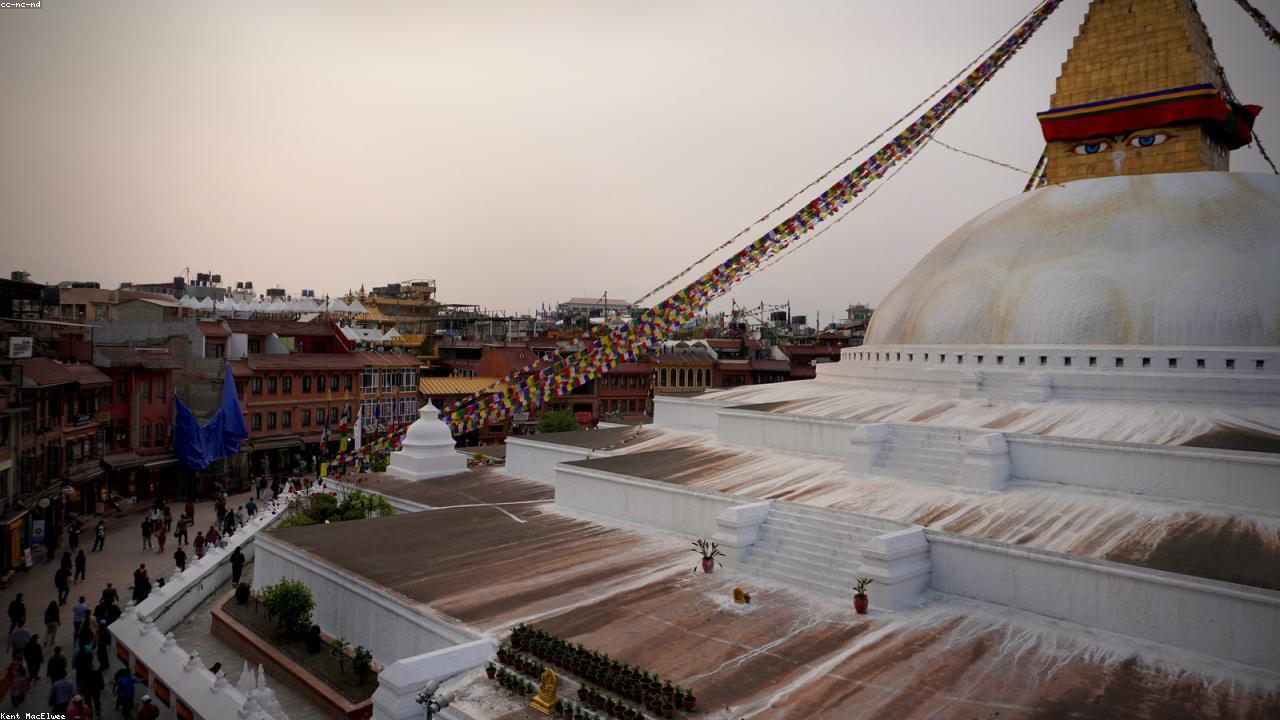
It’s 6:14 a.m. on a Tuesday at the Boudhanath stupa, the great white-domed Buddhist monument east of central Kathmandu, and the morning kora — the ritual clockwise walk around the stupa — is in full swing. Older Tibetans, many of them refugees from the 1959 exodus, are spinning the prayer wheels mounted around the base. A young monk in maroon robes is prostrating himself the full body-length on the flagstones. The air smells of juniper smoke from the morning incense fires. The Boudhanath stupa was substantially rebuilt after damage in the 2015 earthquake, and it looks now as it has looked, more or less, for the past fifteen hundred years.
Why I keep coming back
Kathmandu Valley is one of the most remarkable historical urban regions in Asia. The Newari civilisation — the dominant culture of the valley before the 18th-century Gorkha conquest — produced a particular form of medieval pagoda architecture, hidden-courtyard urban planning, and woodcarving that has no real analogue elsewhere. The three royal capitals — Kathmandu (Hanuman Dhoka), Patan (Lalitpur), and Bhaktapur — are all UNESCO sites within an hour of each other.
The city is also the gateway to Himalayan trekking — the trailheads for the Annapurna Circuit, the Everest Base Camp trek, the Langtang Valley, the smaller and quieter Manaslu and Kanchenjunga circuits, all leave from here.
Where to base yourself
Thamel is the traditional tourist district — dense, noisy, useful for trekking-gear shopping but unpleasant as a longer-stay base.
Patan (Lalitpur) across the river is the quieter, more architecturally rich heritage option.
Bhaktapur is the most preserved of the three royal cities and a calm, walkable base.
Boudhanath if you want to stay near the Tibetan-Buddhist community.
What to actually do
Walk the kora at Boudhanath. The morning kora at the great Buddhist stupa is the city’s most atmospheric daily ritual. Free.
Spend a day at Patan Durbar Square. The Malla-era royal square, with its overlapping cluster of pagoda temples, the Krishna Mandir, the Patan Museum (housed in the old palace; the best-curated small museum in Nepal). The earthquake of 2015 damaged some buildings; reconstruction is still ongoing.
Spend a day at Bhaktapur. The most preserved of the medieval cities, an hour east of central Kathmandu. The Nyatapola temple, the Dattatreya square. Stay overnight if you can — at sunrise the city is yours.
Visit Pashupatinath at sunset. The great Hindu temple complex on the Bagmati river — a smaller Varanasi-equivalent, with cremation ghats and sadhus and the temple itself (closed to non-Hindus, viewable from the opposite bank).
Walk the Swayambhunath kora. The ‘Monkey Temple’ on a hilltop in central Kathmandu; another active Buddhist stupa, with monkeys (be careful with bags). 365 steep steps up.
Do at least a short trek. Even if a multi-week Himalayan trek isn’t on the menu, the Nagarkot day trip (a hilltop viewpoint a 90-minute drive east, with Himalayan panoramas at sunrise) or a Shivapuri day hike from the north of Kathmandu gives you the mountains.
Where to eat
Nepalese food is heavily Indian and Tibetan-influenced; the local Newari cuisine is distinct and worth seeking.
Bhojan Griha (central) — Traditional Newari banquet in a restored heritage building; touristy but well-done. Yangling Tibetan Restaurant (Thamel) — Tibetan momos and noodle soups; cheap, excellent. Honacha (Patan Durbar Square) — A 17th-century Newari restaurant; the bara (lentil patties) and chhoyla (spiced grilled meat). Roadhouse Café (Thamel) — Pizza and Western food when you need a break; reliable. Or 2 Kathmandu — Modern Nepalese fine dining. Dal bhat — The Nepalese daily meal — rice, lentil soup, vegetable curry, pickle. Available everywhere for ₹250–400.
When to come
October and November is the peak trekking season — clear mountain views, stable weather.
March through May is the second trekking window — rhododendron blooming, slightly hazier views.
June through September is monsoon — landslides on the mountain trails, frequent flight delays, but lush green valleys.
December through February is cold and clear in the valley; high passes closed.
Practical notes
- Visa: Visa-on-arrival for most Western passports; bring two passport photos and US$30–50 cash for 15–90 days.
- Money: Nepalese rupee. ATMs in Kathmandu work; cash needed in smaller towns and on trek.
- Air quality: A real issue in Kathmandu, especially in winter when the valley inversion traps pollution. Mask up if sensitive.
- Trekking permits: TIMS card and a separate park permit for the major trekking areas; most teahouse-trekking circuits no longer require a guide but the new 2023 rules require a guide on some routes; check current rules.
- The 2015 earthquake: Substantial reconstruction has been completed but some sites are still under work. Don’t expect every Durbar Square to be at full historical visibility.
- Power cuts: Less common than they used to be but still occur in the city.
A final thought
Kathmandu is the rare capital city that is, materially, much poorer than its visitors and yet maintains a religious and architectural culture that the visitors come specifically to see. The temples are functioning religious institutions. The kora walks are active devotions. The trekking circuits employ hundreds of thousands of Nepalese as guides and porters.
The Western trekking-tourism economy has been deeply transformative for Nepal, both economically (positive) and culturally (mixed). Be a thoughtful trekker — pay your porters fairly, hire local guides through the official agencies, leave nothing on the trail, learn a dozen Nepali words.
Spend at least three full days in the valley before any trek. Walk the kora at Boudhanath at dawn. Sleep in Bhaktapur once. Eat dal bhat with a guide’s family if you’re trekking. The Himalaya are the postcard; the Newari city in the valley is the deeper culture, and it’s the one that earns the return visit.
If you only have a few days
7 ideal things to do in Kathmandu
The dawn kora at Boudhanath
North-eastern Kathmandu, a few kilometres from ThamelFirst light, any morning
Thirty-six metres of white dome, the largest stupa in Nepal, and at dawn a slow clockwise river of people walking around it: Tibetan families, monks, shopkeepers, and one or two tourists visibly working out which way round to go. Clockwise. Always clockwise. The spire cracked in the 2015 earthquake and was rebuilt on private donations and thirty kilos of gold, reopening in 2016 — the first of the valley's World Heritage sites to come back. Juniper smoke, prayer wheels turning under a hundred hands, and no queue at all, because it is barely light.
Patan Durbar Square and the museum in the old palace
Lalitpur, across the Bagmati from central KathmanduLate afternoon, when the temple plinths fill up
The museum inside the old royal palace explains Newar bronze casting well enough that you walk back out into the square and finally see what you have been looking at all week. Outside: the Krishna Mandir of 1667 with its twenty-one gilt pinnacles, the Bhimsen temple of 1680, and Sundari Chowk with its sunken Tusha Hiti water tank. The Hari Shankar temple collapsed entirely in 2015 and was fully rebuilt by 2023. Sit on the steps in the last hour of light and watch a UNESCO site being used, quite properly, as a living room.
Sleep a night in Bhaktapur
About 13 km east of central KathmanduStay over; the day buses leave in the late afternoon
Bhaktapur is where the medieval Newar city survives best, and the argument for staying the night is pure arithmetic: everyone else is on a bus back to Thamel by evening, and then the 55-Window Palace of 1708, the Golden Gate of the 1750s and the whole brick-and-timber grid belong to the people who live there and to you. There is still a square where potters lay clay out to dry in the sun. Of ninety-nine original courtyards perhaps fifteen remain, and the 1934 earthquake did more of that damage than 2015 — which nobody mentions on the day tours.
The eastern stairway up Swayambhunath
Hilltop west of the cityLate afternoon, as the valley haze turns gold
Pratap Malla built these stairs in the seventeenth century and they go up in one unbroken line, steep enough that most people stop pretending at about two-thirds. Macaques own the hill and will take anything not zipped shut; I lost a bag of oranges in under four seconds, and the operation was so professionally executed I could not summon any real annoyance. At the top: the stupa, re-gilded in 2010 with twenty kilos of gold, painted eyes facing all four directions, and the whole valley smoking gently below you.
Pashupatinath from the eastern bank
On the Bagmati, out towards the airportLate afternoon into the evening ritual
Non-Hindus cannot enter the main courtyard, so you cross the river and watch from the terraces opposite, which is honestly the better vantage point anyway. Below you, cremations proceed on the ghats in full view — families, wood, the river doing its work — and none of this is staged for anyone's benefit. Watch quietly, keep the camera down, and if that feels like more than you want, it is entirely reasonable not to come at all. The complex runs to 246 hectares and something over five hundred smaller shrines, so allow longer than you planned.
The bazaar walk from Indra Chowk to Asan
Old Kathmandu, north-east of Hanuman DhokaMorning, when the vegetable sellers hold the square
Six streets converge at Asan and the square they make has been trading since it sat on the road between India and Tibet. The Annapurna Ajima temple presides over it, the goddess represented by a heaped grain measure — the most practical piece of theology I have run into anywhere. Walk up from Indra Chowk through the textile and bead sellers and let the crowd move you along. There is nothing to tick off: just brass, spices, motorbikes threading through gaps that do not exist, and a smell that changes completely every fifteen metres.
An hour in the Garden of Dreams
Kaiser Mahal, at the edge of ThamelMidday, when Thamel is at its least bearable
A walled neo-classical garden built in 1920 for a Rana field marshal, left to collapse for four decades, then restored between 2000 and 2007 with Austrian funding. Pavilions, a pond, an amphitheatre, and the actual product on sale: silence, ten metres from one of the loudest streets in South Asia. I have gone in twice purely to stop being sold trekking equipment, sat under a pergola for an hour reading nothing, and walked straight back out into it.
From a Split boy’s notebook
The Split lens
What reminded me of home
Religious-pilgrimage centre with strong daily-ritual public life. The morning *kora* around Boudhanath is the rhythm our Easter processions used to have — and still have in the smaller villages on Pelješac. Both cultures keep the religion in the daily walk, not just the Sunday mass.
What Split could borrow
Kathmandu's monastery-and-stupa circuit is signposted, walking-mapped, and presented as one continuous spiritual itinerary. Our equivalent — the Stations-of-the-Cross route around Marjan, the saint-day circuit through Veli Varoš's small chapels — is undocumented and unknown to most visitors. A short pilgrimage-circuit map would surface a beautiful thing we currently hide.
Who can take you
Tour operators & guides to try
A short, opinionated starter list — just my humble opinion. Verify before booking.
Intrepid Travelsmall groupwww.intrepidtravel.com →
Intrepid's Nepal trips do Kathmandu Valley as a 3–4 day chapter on the way to a trek (Annapurna or the easier teahouse routes around Pokhara). The valley portion handles Bhaktapur and Patan competently. Group size 12–16. Caveat: the city's air quality from January through April is genuinely difficult; Intrepid can't fix that — plan around it if you can choose dates.
MT Sobeksmall groupwww.mtsobek.com →
MT Sobek is the right operator for a serious Himalayan trek that uses Kathmandu as the launch point — the Everest Base Camp, the Annapurna Circuit, the less-walked Manaslu route. Their guide-and-porter operation has been running for decades; the standard is high. Higher cost than the local Kathmandu outfitters but the logistics are tighter. Caveat: their itineraries are often booked a year ahead for the peak October-November window.