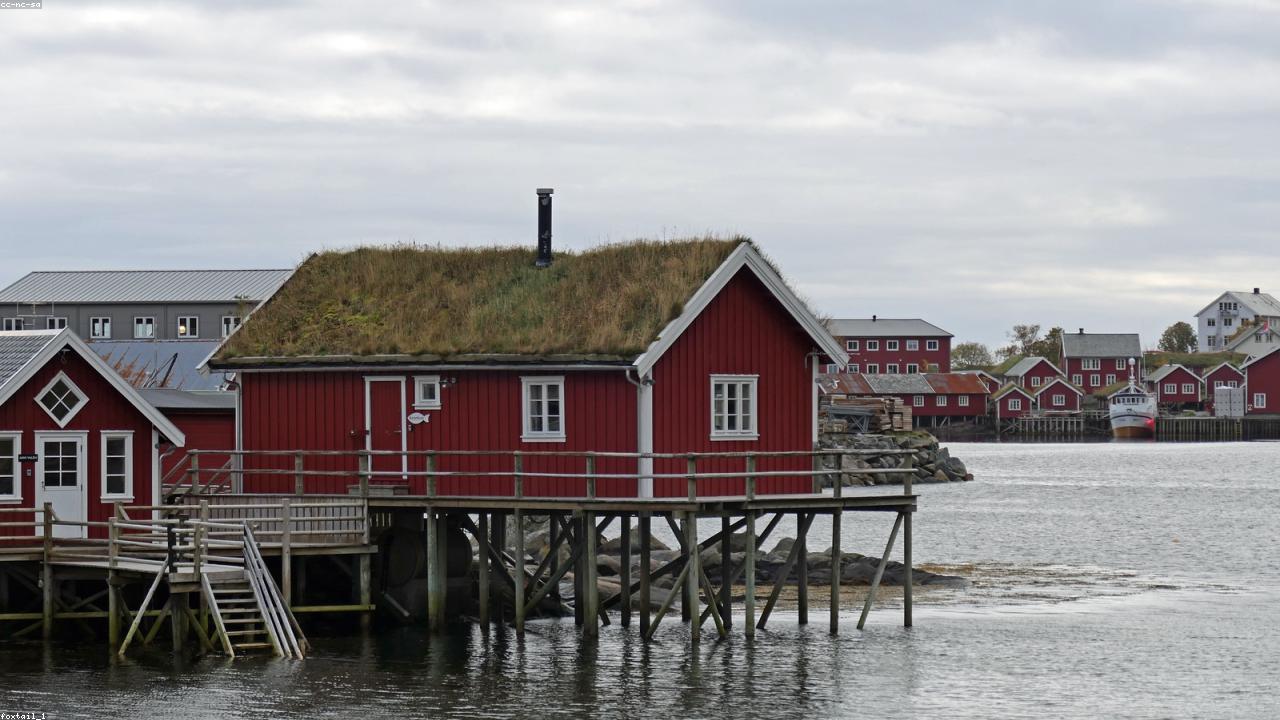
Photo: Ščenza
Reine, Norway · Europe
Lofoten: the Norwegian archipelago above the Arctic Circle
Lofoten is a string of granite peaks rising directly from the Norwegian Sea, north of the Arctic Circle. The small fishing villages on the coast, the cod-drying racks, the midnight sun in summer, the northern lights in winter — Lofoten is one of the most photographed landscapes on earth and remains, somehow, undertraveled.
By Ščenza
· updated · 4 min read
It’s 11:42 p.m. on a clifftop above Reine, in the southern Lofoten Islands, in late June, and the sun has not gone below the horizon for nearly a week. The light is the strange persistent gold of the midnight sun — the same light that makes everything look both real and rendered. Reine below me is a small fishing village of red-painted wooden cottages on stilts over the harbour. The jagged peaks of Olstinden and Reinebringen rise sharply behind the village. The cod-drying racks (the hjell) are visible on the harbour edge, still mostly empty in summer but loaded with dried cod from January through May. This is Lofoten, and it is one of the most distinctive places on earth.
Why I keep coming back
Lofoten is a chain of granite peaks rising directly from the Norwegian Sea, between 67° and 68° north latitude — well inside the Arctic Circle. The islands have been continuously inhabited since at least the Iron Age; the cod fishing has been the economic anchor for over a thousand years.
The islands are now connected by a single road (the E10) that runs the length of the archipelago, crossing bridges and brief tunnels between islands. The result is one of the most accessible Arctic landscapes anywhere — you can drive the entire archipelago in 5 hours.
The combination of the dramatic mountains, the small fishing villages preserved largely as they were, the seasonal extremes (midnight sun in summer, polar night in winter), and the surprisingly mild Gulf Stream-warmed climate produces a destination that is genuinely unlike anywhere else.
Where to base yourself
Reine or Hamnøy (southern Lofoten) for the iconic fishing-village landscape; the rorbu (the traditional fisherman’s cabins on stilts) converted into accommodation.
Henningsvær — A small fishing village built on a few rocky islands; arguably the most photogenic concentration in Lofoten.
Svolvær (Austvågøya) — The main town; useful as a base for the northern end of the archipelago.
What to actually do
Hike Reinebringen. The granite peak above Reine, with the postcard view down on the village and the surrounding peaks. The stair trail (1,500 stone steps) takes 90 minutes up; the view is the canonical Lofoten photograph.
Drive the E10. From Å (the village at the southern end) to Svolvær and beyond. Allow a full day; many photo stops.
Visit Henningsvær. The fishing village built on islets; walk slowly through, eat lunch at a harbourside restaurant. The famous football pitch on a sea-rock at the end of the village.
Walk the beaches. Lofoten has unexpected white-sand beaches: Haukland, Uttakleiv, Kvalvika. Cold water, dramatic backdrops.
Sea kayak. The fjords and the protected channels between the islands are excellent for kayaking. Several operators in Reine and Svolvær.
Fish for cod. Sport-fishing trips are widely offered; the cold-water cod here are some of the largest in the world.
See the northern lights (September through March). Lofoten is on the auroral belt; clear nights with high solar activity produce some of the world’s best northern-lights viewing.
Where to eat
Hattvika Lodge (Ballstad) — Refined modern Norwegian. Anita’s Sjømat (Sakrisøy) — Fish-cake takeaway; the institution of the southern Lofoten food scene. Børsen Spiseri (Svolvær) — Traditional Norwegian, the stockfish (dried cod) preparation. Lysstøperiet (Henningsvær) — Brunch and dinner in a converted candle factory. Holmen Lofoten — Hugely admired chef-led retreat; reservations weeks ahead. Kafe Kaia (Henningsvær) — Reliable harbourside café.
When to come
June through August for the midnight sun and the long hiking days. Peak season.
Late August through September for slightly cooler weather and the start of the aurora season.
February and March for the best aurora viewing combined with extending daylight and the cod-fishing season at peak.
December through January is the polar night — interesting but the days are extremely short.
Practical notes
- Visa: Schengen rules.
- Money: Norwegian krone. Card universally.
- Transport: Rent a car from the Svolvær (SVJ) or Bodø airport (BOO). The E10 is the spine of the archipelago.
- Weather: Maritime, surprisingly mild for the latitude. Pack rain gear; the weather changes quickly.
- Cost: Norwegian prices — expensive. A mid-range meal is NOK 350–500 per person.
- Daylight: Extreme variation. June 21 has 24-hour daylight; December 21 has roughly 5 hours of low-angle twilight.
- The roads: Narrow in places; the Reinebringen trail closures for repair have been regular in recent years; check before.
A final thought
Lofoten is one of the most visually distinctive destinations in Europe and one that, despite the rise in tourism over the past decade, remains relatively well-spread out. The road infrastructure works. The fishing villages are still working villages. The light, in midsummer, is unrepeatable.
Five to seven nights is the right length. Drive the full E10. Hike one peak. Walk the white-sand beaches. Eat fresh stockfish. Watch the midnight sun stretch across the harbour. If you can, combine with a visit to the Norwegian mainland coast (Trondheim, Bergen, the Hurtigruten coastal ferry) for a longer Scandinavian itinerary. The Arctic, on the Lofoten setting, is one of the most welcoming versions of the Arctic available.
If you only have a few days
5 ideal things to do in Reine
Reinebringen by the Sherpa stairway
Directly above Reine; trailhead on the E10Summer and early autumn; check the trail is open first
Nepali stonemasons laid a stone stairway up 448 metres of steep hillside between 2016 and 2019, which turned a notorious mudslide into a climb most reasonably fit people manage in about an hour. It is still steep, still slick in rain, and the stretch above where the steps end is where people get themselves into difficulty. The view down onto Reine, Hamnøy and the sounds between them is the photograph that sells this archipelago. It shuts for repairs and weather often enough that you should check before driving out.
Henningsvær, football pitch included
Austvågøya, about half an hour from SvolværLate afternoon, for the light off the water
Five hundred people live on a handful of rocky islets joined by bridges, with cod-drying racks, a working harbour, climbers in the summer, and the sea about four metres from most front doors. The football pitch out on the rock at the edge of the village is the one you have seen shot from a drone: no stands, no fence, Atlantic on three sides. There is no clubhouse either. Anyone who has played on a Dalmatian island pitch can tell you roughly how many balls a season that costs.
Walk over to Kvalvika beach, and up Ryten if it stays clear
Trailhead near Fredvang, MoskenesøyaJune to September; boardwalk over the boggy sections
Over a low pass from the Fredvang road, on duckboards where the ground turns to peat, and down onto a beach with no road to it — which is the entire point, because in Lofoten any beach you can drive to comes with a car park and a coach. Ryten rises above one end if you want the view looking down on the sand. Two Norwegians once spent the better part of a year in a driftwood shelter on this coast and made a film about it; on a still evening you understand the impulse completely, and on a wet one you don't.
Å, at the end of the E10, and its fishing village museum
Moskenesøya, the southern tip of the archipelagoThe museum runs through the summer season
Drive until the road stops and you are in a village called Å, which is one letter and the last one in the Norwegian alphabet — a joke the Norwegians did not set out to make. The Norwegian Fishing Village Museum here is a set of original buildings, boathouses and a cod-liver-oil works you can smell before you get to the door, covering how this coast actually lived from about 1840 to 1960. Dry, unsentimental, very good indeed. Komiža and Maslinica could copy the entire model tomorrow.
Lofotr Viking Museum at Borg
Vestvågøya, mid-archipelago, just off the E10Main season is summer; the hall is best in bad weather
Ploughing at Borg in 1983 turned up the floor of an 83-metre longhouse, the largest Viking building ever found in Norway, and the reconstruction now stands on the site with a fire running down the middle of it and the smoke looking for the roof hole. There are boats to row, a smithy, mead, and yes, a certain amount of theatre. The hall itself at the far end — long, dark, warm, smelling of woodsmoke — does something no display case has ever managed. Save it for the day the weather has already ruined.
From a Split boy’s notebook
The Split lens
What reminded me of home
Working fishing villages on a coastline of jagged limestone-and-granite peaks. The *rorbu* fisherman cabins repurposed as accommodation are kindred to our *gajeta* boat-sheds turning into small inns on Šolta and the outer Brač coast. Both regions have learnt that the working buildings ARE the tourism asset.
What Split could borrow
Norway has a long tradition of paying fishermen to maintain their working buildings as visible heritage. Our outer Dalmatian fishing villages — Komiža, Maslinica, Stomorska — have most of the same building stock falling into disrepair. A small heritage-maintenance grant to working fishermen would preserve more than any museum ever will.
Who can take you
Tour operators & guides to try
A short, opinionated starter list — just my humble opinion. Verify before booking.
Hurtigrutenexpeditionwww.hurtigruten.com →
Hurtigruten's coastal voyages call at Stamsund and Svolvær on the regular Bergen–Kirkenes route. The classic-ferry experience (not the expedition fleet) is a calm and slightly old-fashioned way to see the islands; you get off, look around for an hour or three depending on the port, get back on. Caveat: this format gives you a glimpse, not a stay; to actually walk in Lofoten you need 4–7 nights on the islands themselves, not on the ship.
Lofoten Aktivactivitywww.lofoten-aktiv.no →
Lofoten Aktiv is the Reine-based outdoor-tour outfit — sea kayaking around the islands, guided summits of Reinebringen and the harder Hermannsdalstind, fishing day trips. Small groups (typically 6–10). The local-guide knowledge of weather and route conditions is the real value. Caveat: in summer the demand is heavy and bookings should go in 2–3 months ahead for July–August; in winter the operations scale back to a handful of weather-permitting days each week.
If you liked this, try these
Tórshavn, Faroe Islands (Denmark)
The Faroe Islands: eighteen rocks in the North Atlantic
July 4, 2024
Hallstatt, Austria
Hallstatt at dawn: a tiny Alpine village before the buses
February 22, 2024
Oia, Greece
Santorini after the cruise ships leave: a defence of the obvious island
June 4, 2021