Photo: Ščenza
Luang Prabang, Laos · Asia
Luang Prabang: the small Lao town on the Mekong
Luang Prabang is small. The entire peninsula between the Mekong and the Nam Khan rivers can be walked in 20 minutes. It is also one of the most preserved colonial-and-monastic towns in Southeast Asia, and the dawn alms procession remains, for now, an unforced daily ritual.
By Ščenza
· updated · 5 min read
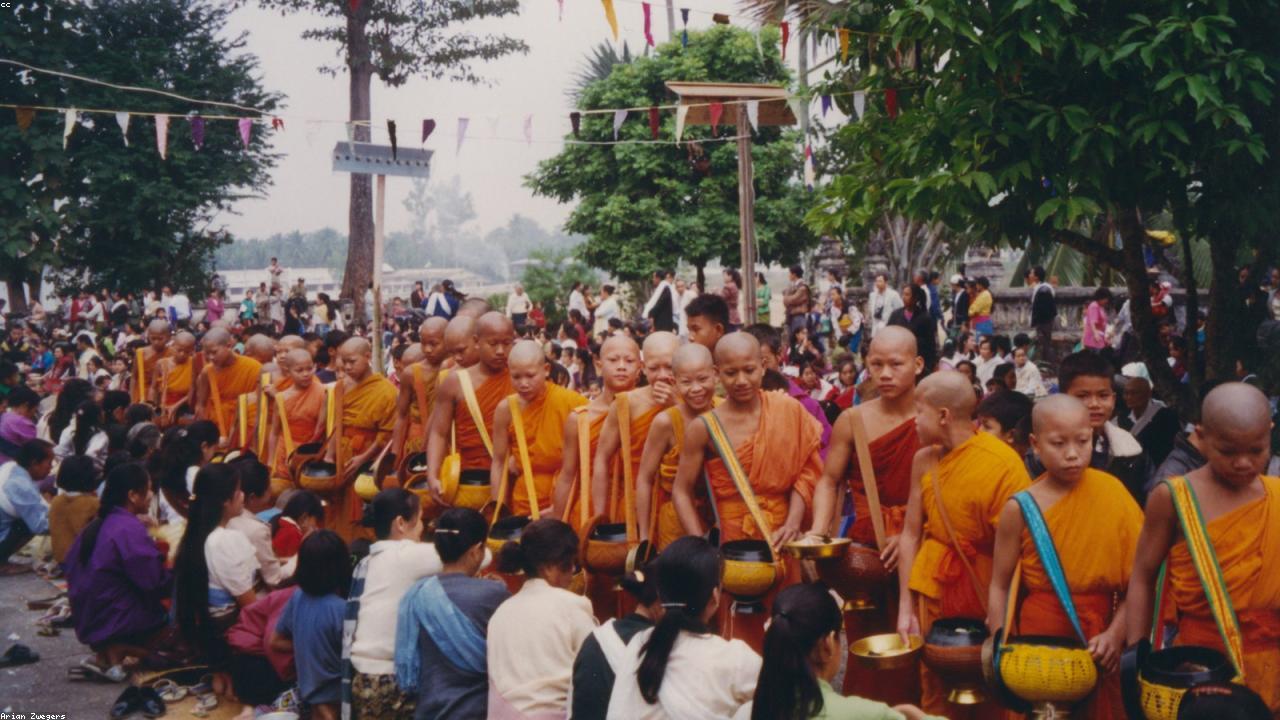
It’s 5:51 a.m. and a line of saffron-robed monks is walking, single-file and silently, down the main street of Luang Prabang on the morning tak bat — the alms procession. A handful of locals are kneeling on small mats by the side of the road, putting sticky rice and bananas into the monks’ bowls. The morning is cool and slightly misty over the Mekong. The Wat Xieng Thong temple at the head of the peninsula is just starting to catch the first light. There are perhaps a dozen visitors watching, quietly, from a respectful distance. By 6:30, the procession is over and the monks are back in their temples. The town goes back to making coffee.
Why I keep coming back
Luang Prabang was the royal capital of the Lan Xang kingdom for six centuries and then the seat of a French Protectorate. The combination produced a small town of about 50,000 with 33 working Buddhist monasteries, 700 surviving wooden colonial-era buildings, and a setting at the confluence of the Mekong and the Nam Khan rivers that is one of the most beautiful in Southeast Asia. It became a UNESCO World Heritage site in 1995, and the listing has, with some pressure, mostly preserved the architecture.
The town is also the gateway to the slow boat down the Mekong to the Thai border and to the smaller villages of northern Laos.
Where to base yourself
The peninsula, between the two rivers, anywhere. The town is small enough that it doesn’t really matter which street.
Heritage boutique hotels — the small French-colonial-era restored hotels are where to stay if budget permits. Maison Souvannaphoum, 3 Nagas, Satri House.
Guesthouses are clean and cheap if budget is tighter.
What to actually do
Witness the alms procession respectfully. The monks walk every morning between roughly 5:30 and 6:30 a.m. Tourist presence has, in recent years, become a problem; some monasteries have stopped processing on busy days. The rules: do not stand in the monks’ path. Do not photograph with flash. Do not engage the monks in eye contact or conversation. If you want to participate, buy sticky rice from a local seller (not the cynical tourist-rate vendors at the main streets) and kneel quietly. If you only want to watch, watch from the opposite side of the street, sitting, silent.
Climb Mount Phou Si at sunset. A 328-step climb to a small hilltop temple in the centre of the peninsula. The view over the rivers and the town is the postcard. Crowded at sunset; nicer at sunrise.
Visit Wat Xieng Thong. The 16th-century royal temple at the head of the peninsula; the most beautiful single building in the town. The mosaics, the gilded reliefs, the carved doors.
Take a boat to the Pak Ou caves. Two hours up the Mekong by long-tail boat. The caves contain hundreds of small Buddha statues, accumulated over centuries by pilgrims. A half-day trip.
Visit Kuang Si waterfall. 30 km south, a series of turquoise tiered pools and a 50-metre main fall. Swimming allowed in some of the lower pools. Half a day.
Visit the night market. Sissavangvong Road, every evening from 5 to 10 p.m. Hmong textiles, lacquerware, lao-lao rice spirits. The food alley behind the market has the cheapest meals in town.
Take the slow boat down the Mekong. A two-day journey from Luang Prabang to the Thai border at Huay Xai. The slow boats stop overnight in Pak Beng. Touristy on the standard route but a memorable journey.
Where to eat
Lao food is similar to northern Thai but with more sticky rice, more bitter herbs, and the fermented fish sauce (padaek) replacing nam pla.
Manda de Laos — Modern Lao in a garden setting; the or lam (slow-stewed stew with sticky-rice-flour thickener) is the signature. Tamarind — A long-running Lao cuisine restaurant with tasting menus; book. Khaiphaen — A training restaurant for at-risk Lao youth; the khao soi Luang Prabang (different from the Thai version, the Lao kind has fermented soybean) is the local soup. The buffet alley at the night market — 15,000 kip (about US$1) for an all-you-can-pile plate; the broken-rice ramen broth is excellent and cheap. Saffron Coffee — The French-Lao patisserie heritage; the croissant and Lao coffee combination. L’Elephant — French-Lao fusion in a colonial building; the special-occasion option.
When to come
November through February is the cool, dry season — pleasant days and cool nights.
March and April are the burning season in northern Laos and Thailand; air quality is unhealthy. Avoid.
May through September is the rainy season; less crowded, more lush, occasional river-level disruptions on boat trips.
Lao New Year (Pi Mai, mid-April) is the biggest festival; water fights in the streets, three days of national holiday. Accommodation books months ahead.
Practical notes
- Visa: Most Western passports get a 30-day visa-on-arrival or e-visa.
- Money: Laotian kip; US dollars and Thai baht widely accepted; cards in tourist establishments.
- Transport: A new high-speed rail link (the Chinese-built Boten–Vientiane railway) connects Luang Prabang to Vientiane and the Chinese border in 2 hours. Daily flights from Bangkok and Hanoi.
- Alms procession etiquette: The single most important visitor rule. The procession is a daily religious obligation, not a tourist show. The tour-bus companies that bus passengers in for photos have eroded the practice in recent years. Be the visitor who is part of the solution.
- The night curfew: Officially, the town has a midnight curfew; most bars close by 11:30 p.m. The ‘bowling alley’ on the outskirts is the locals’ late-night spot.
A final thought
Luang Prabang is one of the small towns of Southeast Asia that has, against the odds of mass tourism, preserved its essential character. The monasteries still function as monasteries. The monks still walk in the morning. The Mekong still flows past at the same gentle pace. The architectural fabric — the cluster of teak and stuccoed-brick wooden buildings along the peninsula — is largely intact.
The pressure is real. The new railway has made the town more accessible. The alms procession is increasingly contentious. The architecture is being adjusted by careful and not-so-careful renovations. The future is not guaranteed.
Go for at least four nights. Walk the peninsula. Witness the alms procession respectfully (if at all). Climb Phou Si at dawn rather than sunset. Eat at the night market. Take the boat to the Pak Ou caves. Drink Lao coffee with a French croissant. The combination of Southeast Asian Buddhist piety, French colonial architecture, and Mekong-river daily life produces a small town unlike any other in the region. Visit while it’s still itself.
If you only have a few days
5 ideal things to do in Luang Prabang
Watch the tak bat from the opposite pavement
The main street of the peninsulaFirst light, before six
Monks leave the monasteries at dawn and walk the street in single file while people kneel to put sticky rice into their bowls. It is a daily obligation, not a performance, and the correct posture for a visitor is: far side of the road, sitting, silent, no flash, and nothing bought from the vendors who materialise for tourists. I stood too close on an early visit and a Lao woman gave me a look I have thought about for years.
Mount Phou Si at sunrise instead of sunset
The hill in the middle of the peninsulaSunrise; everyone else comes at six in the evening
Three hundred and twenty-eight steps up a hundred-metre hill to a gilded stupa, with both rivers in view from the top. Every guidebook on earth says sunset, so at sunset the summit holds a couple of hundred people and their phones held above their heads. At sunrise it holds a monk with a broom and possibly you. Same steps, same view, entirely different population.
Wat Xieng Thong
Head of the peninsula, above the MekongEarly morning, before the groups walk up
King Setthathirath finished this in 1560, and the roof is the reason to come: nine layers sweeping down almost to the ground, a shape that makes no sense at all until you watch rain hit it. The rear gable carries a tree of life worked in coloured glass mosaic. Behind the temple a separate hall holds a twelve-metre gilded funeral carriage, which is not what I expected from a building I had already decided was restrained.
Kuang Si falls, and the bears next to the car park
About thirty kilometres south of townAt opening or after three; midday is the crowd
Turquoise limestone pools in tiers beneath a fifty-metre fall, and you can swim in the lower ones, which in the cool season is braver than it sounds. On the path in there is a rescue centre run by Free the Bears, holding moon bears taken off bile farms and out of the wildlife trade. Almost everyone walks straight past it towards the water. Give it twenty minutes on the way out; the bears are the more instructive half of the day.
The Traditional Arts and Ethnology Centre
At the foot of Phou Si hillAllow an hour, longer if the textiles get you
Laos has dozens of ethnic groups and almost none of them survive contact with a four-day itinerary. This small independent museum — Hmong, Akha, Tai Dam, Katu and others — explains the textiles properly instead of hanging them up as decoration. Spend an hour and the night market stops reading as a souvenir stall and starts reading as about eight regional traditions competing for your money, which is both more interesting and considerably better for the weavers.
From a Split boy’s notebook
The Split lens
What reminded me of home
Small UNESCO town built between two rivers, with a strong religious-procession daily life and a colonial architectural layer (French in their case, Venetian in ours). The morning alms procession is exactly the dawn-ritual seriousness our older churches once had.
What Split could borrow
Luang Prabang's strict heritage code applies to building exteriors, signage, noise hours, and even garden landscaping inside the protected zone. Our old town has UNESCO status and a comparatively soft enforcement regime. Adopting Luang Prabang's discipline — written rules, real fines, visible enforcement — would protect what we have.
Who can take you
Tour operators & guides to try
A short, opinionated starter list — just my humble opinion. Verify before booking.
Intrepid Travelsmall groupwww.intrepidtravel.com →
Intrepid's Indochina circuits include Luang Prabang as a 2–3 night chapter between Vietnam and the Mekong slow-boat to Thailand. The town portion handles the alms procession responsibly (observation from a distance, no participation unless individually arranged). Group size 12–16. Caveat: the slow-boat to Huay Xai is a long two days; some travellers find it the highlight, others find it a slog. Read the day-by-day before booking.
EXO Traveltailoredwww.exotravel.com →
EXO Travel's Laos desk handles the Luang Prabang component within a longer tailored Indochina trip — Mekong river extensions, the Plain of Jars in Xieng Khouang, the southern 4,000 Islands. Mid-to-upper-tier pricing. Caveat: the country's logistics outside the main tourist circuit are genuinely slow; budget extra days for road transfers if you want the lesser-walked regions.