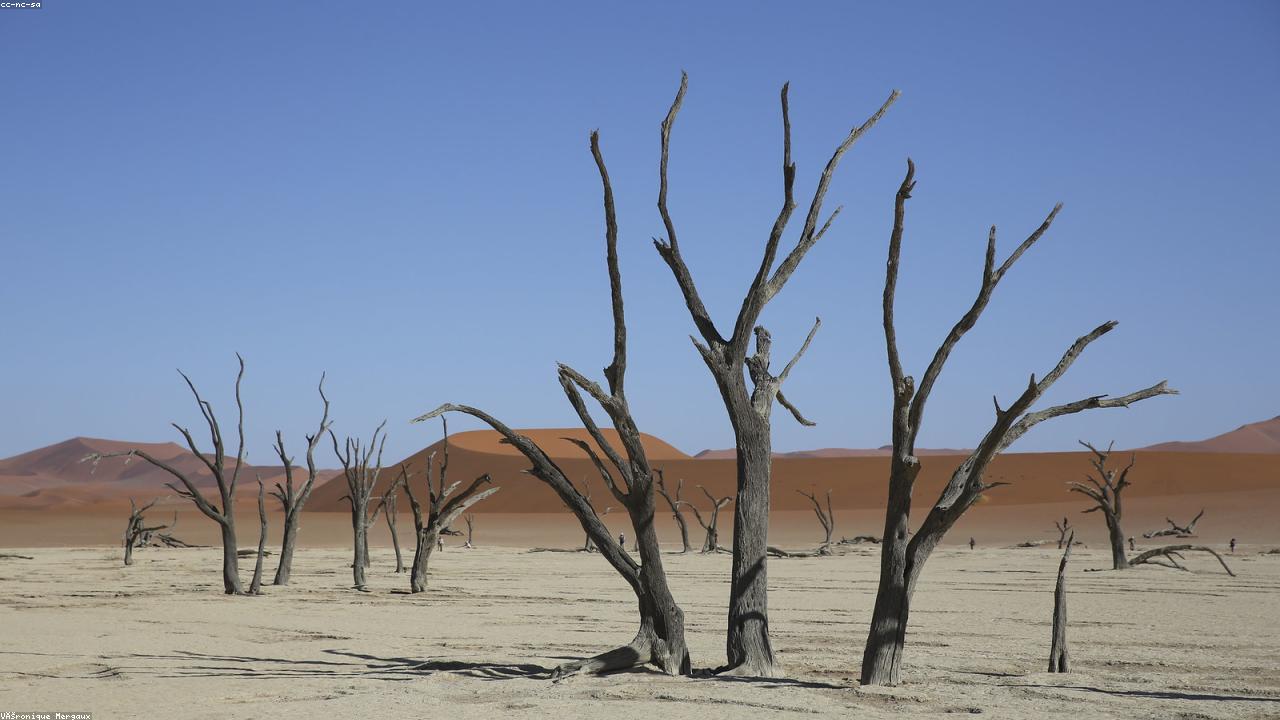
Photo: Ščenza
Sesriem, Namibia · Africa
Sossusvlei: the dunes of the Namib and the country around them
The Sossusvlei dunes of the Namib Desert are some of the oldest and tallest in the world. Climbing one at dawn, with the orange sand turning red against the indigo of the not-yet-lit sky, is one of the iconic experiences of African travel.

By Ščenza
· updated · 5 min read
It’s 6:18 a.m. and I’m halfway up Big Daddy, the 325-metre dune that overlooks the Dead Vlei white-clay pan in the Namib Desert. The sand is cold under my feet (you go barefoot for the grip; sand-filled shoes don’t grip). The sky behind the next dune over — Dune 45 — is going from indigo to orange to the colour of cantaloupe. The world is silent in a way I don’t really have words for. By the time I reach the top, the sun is up. The shadows on the dunes are razor-sharp. Below me, in Dead Vlei, the camel-thorn trees — dead some six or seven hundred years, black against the white clay — are doing their famous photograph.
Why I keep coming back
The Namib is one of the oldest deserts on earth — possibly 55 million years arid in some places — and the dunes of Sossusvlei are among the tallest in the world. The combination of geological age, dry climate, and iron-oxide-rich sand has produced a landscape that, photographed correctly, is one of the most iconic in African travel.
Namibia, more broadly, is one of the best self-drive countries on the African continent. The roads are mostly gravel but well-maintained; the population density is the second-lowest of any country on earth (after Mongolia); the wildlife in Etosha National Park is dense and easily seen.
Where to base yourself
For Sossusvlei: stay at one of the Sesriem-area lodges. The park gate is at Sesriem; the dunes are 60 km inside (only park residents and lodge guests can enter before the public gate opens at sunrise).
Sossus Dune Lodge is inside the park (the only one); the others are clustered just outside: Kulala Desert Lodge, &Beyond Sossusvlei Desert Lodge, the more affordable Desert Camp and Sossus Oasis Camp.
Namibia itself is a 14–21 day self-drive: typically Windhoek → Sossusvlei → Swakopmund (the coastal town) → Damaraland → Etosha → back to Windhoek.
What to actually do
Climb a dune at sunrise. The classic targets: Dune 45 (the photographable one along the road, easily climbed), Big Daddy (the tallest, behind Dead Vlei, 325 m), or Dune 7 (in the wider Walvis Bay area, technically the tallest in the world).
Walk Dead Vlei. The white-clay pan with the dead camel-thorn trees — they died around 1340–1430, and the air is too dry to rot them — surrounded by orange dunes. Walk in from the parking lot a kilometre away. The shadows shift quickly; the best photos are in the first or last hour of light.
Visit Sossusvlei pan itself. The end-of-the-road pan, which floods only occasionally; usually a flat sandy basin. The drive in requires 4x4 from the last 4WD-only section of road; shuttle service runs from the 2x4 parking lot.
Walk Sesriem Canyon. A 3-km natural slot canyon near the park entrance, eroded by the Tsauchab river over millennia; cool and shady, a good afternoon walk after the morning dunes.
Combine with Swakopmund and the Skeleton Coast. From Sossusvlei, the drive north to Swakopmund (4–5 hours) brings you to the coastal city and the Skeleton Coast — a strip of cold, fog-bound Atlantic coast where whaling-era shipwrecks rust on the sand and Cape fur seal colonies number in the hundreds of thousands.
Etosha National Park further north for the wildlife — large salt pan, dense waterhole-based game viewing, particularly excellent in the dry season.
Where to eat
Namibian food at lodges is mostly continental with game-meat options.
Lodge dinners (your main meals) — Most lodges do a high-quality, half-board dining experience; the kudu, oryx, and ostrich are good. Joe’s Beerhouse (Windhoek) — Famous, touristy, fun; the country’s beer-and-game restaurant. Stellenbosch Tasting Room (Windhoek) — Sophisticated South African and Namibian wine focus. Swakopmund seafood restaurants — The Tug, Kuki’s Pub & Restaurant — fresh Atlantic fish and the German-Namibian heritage cooking (eisbein, schnitzel — yes, in southern Africa, courtesy of the German colonial era).
When to come
May through October is the dry, cool season — ideal for both Sossusvlei and Etosha. Daytime temperatures 20–28°C, nights cold (sometimes near freezing at the desert lodges in June–July).
November through April is the warmer, wetter season; Sossusvlei can be very hot (40°C+), and very rare desert rains produce extraordinary photography but uncomfortable conditions.
May and September are the sweet spots — pleasant temperatures, low crowds, predictable weather.
Practical notes
- Visa: 90 days visa-free for most Western passports.
- Money: Namibian dollar (1:1 with South African rand; the rand is also accepted everywhere). Card is widely accepted; cash for fuel and small purchases.
- Self-drive: Strongly recommended. A 4x4 (typically a Toyota Hilux) with a rooftop tent or rooftop-only is the standard rental setup; major operators include Asco, Camping Car Hire, and others. Distances are large; plan 200–400 km per driving day with buffer time.
- Fuel: Stations are spaced and not 24-hour; fill up whenever you can.
- The park rules at Sossusvlei: The outer gate opens at sunrise for non-residents; lodge guests inside the park boundary can leave before sunrise to be at the dunes at first light. The gate closes at sunset.
- Health: Yellow-fever zone for entry from yellow-fever countries; otherwise standard. Malaria risk in the north (Etosha and beyond).
- Cost: Mid-range Namibia self-drive is around US$200–400 per person per day; luxury Sossusvlei lodges (e.g. &Beyond) are US$1000+ per person per night.
A final thought
Sossusvlei is the rare landscape that genuinely lives up to its reputation. The combination of the dune size, the colour, the silence, and the access — you can climb the dunes, walk the pans, sit in Dead Vlei alone for half an hour — produces one of the most extraordinary morning experiences in African travel.
The wider Namibia is, in my view, the best introduction to southern Africa for a first-time visitor — a self-drive, English-speaking country with good roads, low population density, dramatic landscapes, and excellent wildlife. Pair Sossusvlei with Etosha and the Skeleton Coast for a 12-day loop that covers the country’s signature landscapes.
Stay at least two nights at Sesriem. Climb a dune at sunrise. Walk Dead Vlei when the shadows are sharp. Spend the heat of the day at the lodge pool. Drive the long roads. The country is mostly empty and mostly silent, and that combination — at this point in the 21st century — is rarer and more valuable than almost anything else travel can offer.
If you only have a few days
4 ideal things to do in Sesriem
Big Daddy, then down the face into Deadvlei
Inside the park, 60 km beyond the Sesriem gateStart at first light; by nine the sand is unwalkable
You climb the ridgeline barefoot, because sand inside your shoes gives you no grip whatsoever, and it takes most people an hour of two-steps-up-and-one-back. Then you run straight down the face into Deadvlei, which takes ninety seconds and is the most fun available to anyone carrying that much sand in their clothing. The pan below is white clay with black camel-thorn skeletons standing in it, dead six or seven hundred years and still upright because nothing out here rots. No shade, no water. Carry more than you think and be back at the car before the heat arrives.
Dune 45 at sunrise
45 km along the road in from the Sesriem gateFirst light; this is the standard sunrise stop and everybody knows it
Named, with a magnificent bureaucratic lack of romance, for its distance in kilometres from the gate. It is the easy climb — clean ridge, car park at the bottom, a scatter of camel thorns in the foreground — which is why every vehicle in the park stops here at dawn and why that ridge carries a line of small silhouettes in roughly every photograph ever taken of Namibia. Go anyway. Nothing a queue can do will spoil what the first twenty minutes of light does to that sand.
Sesriem Canyon in the afternoon
About 4 km from the park gateThe heat of the day, after the dunes are done
Roughly a kilometre of slot canyon, thirty metres deep, cut by the Tsauchab through cemented gravel and narrow enough in places to touch both walls at once. The name is Afrikaans for six thongs — the length of rawhide rope the Dorsland trekkers needed to lower a bucket to the water. There are permanent pools down there and the birds know all about them. It is the only cool place for a hundred kilometres in any direction and costs nothing but the walk in, which after a morning on Big Daddy is precisely the right level of ambition.
The night sky over the Namib
Sesriem, or the NamibRand reserve to the southAny moonless night; June and July are the coldest and the clearest
NamibRand has been an International Dark Sky Reserve since 2012, and the air is dry enough out here that the Milky Way throws a shadow. I did not believe that phrase either until I held a hand out over pale gravel and watched it happen. Several lodges keep observatories, but you need nothing of the sort: walk two hundred metres away from the campsite lights, give your eyes twenty minutes, and lie down on your back. Take a fleece. It was six degrees in June and I had packed for a desert, like an idiot.
From a Split boy’s notebook
The Split lens
What reminded me of home
A landscape so empty it feels rare. Our Velebit and the Dalmatian hinterland share that scale at smaller magnitude — the karst plateaus above Klis, the empty back roads of Pelješac, the Vrlika canyon. Both regions have the wide-horizon emptiness that has become rare in the European Mediterranean.
What Split could borrow
Namibia's self-drive tourism model — a paved-and-gravel route network with strategically placed lodges and zero-impact campsites — is well-tuned for a country with a small population and a large empty interior. Our Dalmatian hinterland is structurally similar but undeveloped for self-drive tourism. A signposted hinterland route network with a dozen small inns would diversify our coast-only economy.
Who can take you
Tour operators & guides to try
A short, opinionated starter list — just my humble opinion. Verify before booking.
&Beyondluxurywww.andbeyond.com →
&Beyond's Sossusvlei Desert Lodge is the upper-tier accommodation at the dunes — private viewing decks, a star-observatory, the only private lodge with concessionary dawn access to the dunes before the public gate opens. USD 1,500+ per person per night. Caveat: this is honeymoon-tier pricing; for budget-conscious travellers, the cheaper Sesriem-area lodges with the same dawn-access advantage are nearly as good for half the price.
Wildernessluxurywww.wilderness.com →
Wilderness's Namibia camps include Little Kulala at Sossusvlei and Damaraland Camp further north. Strong conservation work in the surrounding concessions, comfortable safari-style camps. Upper-tier pricing. Caveat: a 7–10 day Namibia self-drive in a rental 4x4 covers similar terrain at a fraction of the cost and is one of the great African road trips; the lodge format suits travellers who don't want to drive.
If you liked this, try these
Seronera, Tanzania
Serengeti: the East African plains and the great migration
July 4, 2022
Antananarivo, Madagascar
Madagascar: the eighth continent and the slow road through it
September 26, 2022
Santa Elena, Costa Rica
Monteverde: the cloud forest in the Costa Rican highlands
January 8, 2024