Photo: Ščenza
Samarkand, Uzbekistan · Central Asia
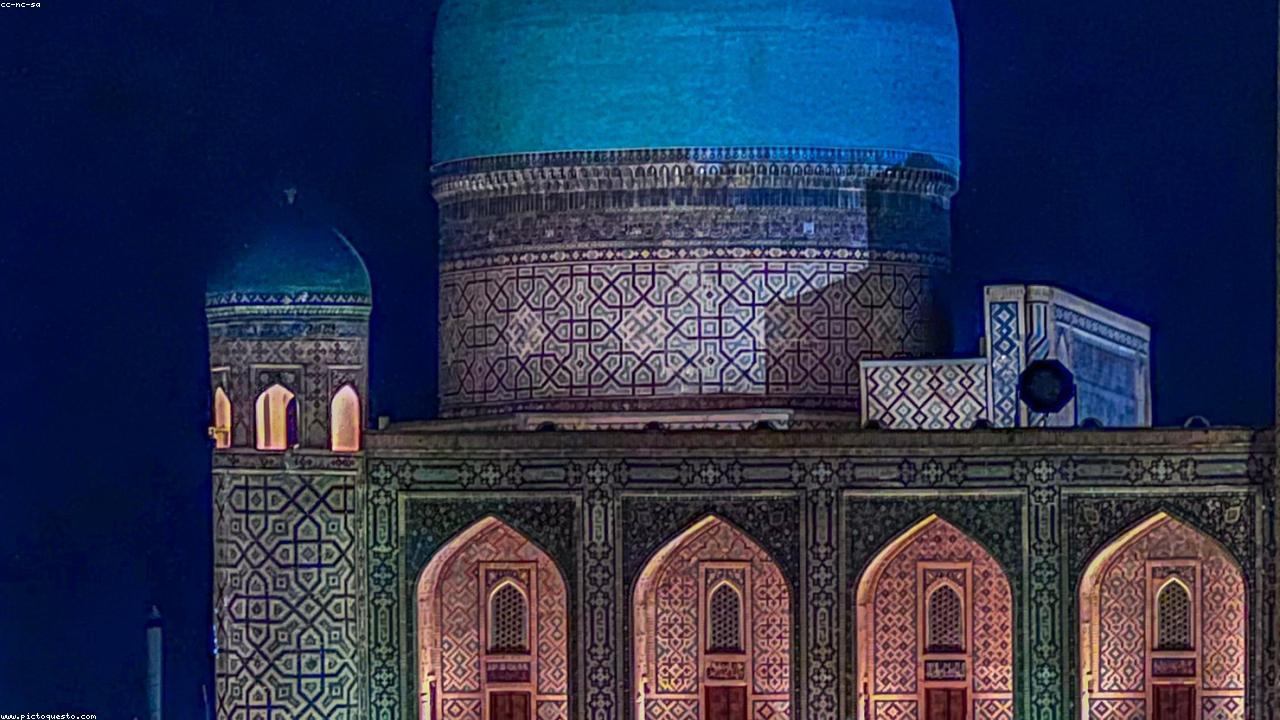
Samarkand: the blue domes on the Silk Road
Samarkand is the great Timurid capital, with the most extraordinary 14th- and 15th-century Islamic architecture in Central Asia. Uzbekistan has, since 2018, dramatically liberalised tourist access; the country is now one of the most rewarding regions in the world to visit.
By Ščenza
· updated · 4 min read
It’s 5:14 a.m. at the Registan square in central Samarkand and the three madrasas — the Ulugh Beg (1417), the Sher-Dor (1636), and the Tilya-Kori (1660) — are still in shadow but the sky behind them is going from indigo to that particular Central Asian dawn blue. The turquoise-tiled facades, fifteen metres tall on each of the three sides of the square, will start glowing in about fifteen minutes. The place is, simply, one of the most extraordinary architectural set pieces I have ever stood in. By 9 a.m., the Russian and Chinese tour groups arrive. The hour before is mine.
Why I keep coming back
Samarkand was the capital of Timur (Tamerlane) — the 14th-century Central Asian conqueror who built an empire stretching from the Mediterranean to India — and the city is, architecturally, the most ambitious surviving Timurid project. The turquoise-domed mosques, the madrasas with their portals and minarets, the geometric tilework — Samarkand is one of the great Islamic-architecture cities and one of the most consequential stops on the Silk Road.
Uzbekistan, until 2018, was one of the world’s most restrictively governed tourist destinations — visa hurdles, registration requirements, currency restrictions. The post-2018 liberalisation under President Mirziyoyev has opened the country dramatically. The country is now, in 2026, one of the most rewarding regions to visit in the post-Soviet space.
Where to base yourself
Samarkand for the central Silk Road experience.
Bukhara (5 hours by road, 90 minutes by fast train) for the other great Uzbek city — older, more intact, with its surviving 16th-century khanate-era core.
Khiva (a further drive west) for the smallest and most preserved of the three Silk Road centres.
Tashkent is the modern capital — useful for the airport but not a destination.
The standard tourist route is Tashkent → Samarkand → Bukhara → Khiva, by train or car, 10–14 days.
What to actually do
Walk the Registan at dawn. The defining experience of the city. Bring coffee. Sit on the steps. Watch the light hit the tile.
Visit Shah-i-Zinda. The ‘Tomb of the Living King’ — a small alley of tombs from the 11th to the 15th centuries, each more elaborately tiled than the last. Some of the most refined ceramic-tile work in the Islamic world.
Visit the Gur-e-Amir. Timur’s own mausoleum; the lapis-blue ribbed dome is the architectural prototype that influenced the Taj Mahal and many other later Islamic buildings.
Climb the Ulugh Beg Observatory. Timur’s grandson Ulugh Beg built a giant astronomical instrument here in the 1420s; the surviving stone sextant arc is preserved at the base, with a small museum.
Day-trip to Shahrisabz. Two hours south; Timur’s birthplace; the massive ruined portal of his Ak-Saray palace.
Walk Bukhara’s old city. Smaller than Samarkand and more intact at the residential level; the Kalyan minaret, the Lyabi-Hauz pond, the working madrasas, the small ceramic shops.
Visit Khiva’s old town (Itchan Kala). The 19th-century khanate walled city, almost completely preserved within its mud-brick walls; small and walkable in a day.
Where to eat
Uzbek cuisine is heavily wheat-and-lamb-based: plov (the pilaf with lamb and yellow carrot, the national dish), shashlik (grilled lamb skewers), manti (steamed lamb dumplings), somsa (samosa-like baked pastries), the rich variety of bread (non) baked in domed clay ovens.
Plov Center (Tashkent) — A vast plov-only restaurant; the daily preparation is the show. Karim Bey (Samarkand) — Reliable mid-range Uzbek. Lyabi-Hauz tea houses (Bukhara) — Cool by water, the classic chaikhana experience. Old Khiva (Khiva) — Traditional Uzbek in a heritage building. Local chaikhana (tea house) anywhere — the centre of Uzbek public life; tea, bread, plov, conversation.
When to come
April–May and September–October for the most pleasant temperatures and the lower-crowd shoulder months.
June through August is hot (40°C+) in Samarkand and Bukhara.
November through March is cold (occasionally well below freezing in January) but the architecture under a thin snow is extraordinary and the crowds are minimal.
Practical notes
- Visa: Uzbekistan is visa-free for most Western passports since 2019.
- Money: Uzbek so’m; ATMs work in Samarkand and Bukhara; cash is still the standard for smaller transactions.
- Transport: The Afrosiyob high-speed train connects Tashkent–Samarkand–Bukhara in just over 2 hours each leg; book online. The slower trains continue to Khiva (10+ hours; the overnight option).
- Language: Uzbek is the official language; Russian is widely understood by older generations; English is increasingly common in tourism but still limited.
- The Soviet inheritance: Uzbekistan was a Soviet republic until 1991 and the urban-Soviet legacy (the grid plans, the apartment blocks, the centralised bureaucracy) is still visible alongside the older Timurid and Islamic architecture.
- Hospitality: Uzbeks are extraordinarily hospitable; declining a tea or a meal invitation is sometimes culturally fraught. Accept when offered.
A final thought
Uzbekistan is one of the most rewarding travel discoveries of the post-2018 era. The architectural depth — the Timurid monuments in Samarkand, the older Islamic city in Bukhara, the preserved khanate at Khiva — is among the most consequential in the wider Islamic world and remains, despite the rapidly growing tourist numbers, well below the saturation point of the more famous Western destinations.
Ten days is the right length. Train the three cities. Walk slowly. Drink chai. Talk to the carpet sellers and the ceramicists in the small shops (Uzbek silk and ceramic traditions are alive and active). The Silk Road is, after a thousand years of fame and a century of Soviet eclipse, doing its thing again. Visit while the experience is still uncrowded.
If you only have a few days
6 ideal things to do in Samarkand
The Registan at first light
Central SamarkandDawn from the outside; the coaches land mid-morning
Three madrasas on three sides of one square: Ulugh Beg's from 1417 to 1420, the Sher-Dor of the 1630s with its tigers-and-rising-sun mosaic cheerfully ignoring the usual prohibition on living creatures, and the Tilya-Kori of the 1640s to 1660s, gilded inside to a degree that stops being architecture and becomes an argument. Come at dawn and watch the tile go from grey to that particular turquoise over about fifteen minutes. Bring your own tea and sit on the steps opposite. Later in the day it is a car park with a monument attached.
Shah-i-Zinda, the avenue of tombs
North-east, on the edge of the Afrasiyab moundEarly; the lane is one person wide in places
A narrow street of more than twenty mausoleums climbing a hillside, built and rebuilt between the eleventh century and the nineteenth and linked by small domed arches. The tilework gets denser and stranger the higher you go, until it stops resembling decoration and starts resembling obsession. Ulugh Beg's astronomer, Kazi Zade Rumi, lies under the double-domed tomb near the bottom — a very Samarkand ranking, in which the mathematician gets the good spot by the entrance. There is no overtaking on the stairs, so go before anyone else has had breakfast.
Gur-e-Amir, Timur's mausoleum
A ten-minute walk south of the RegistanAfter dark, when the dome is lit
The ribbed blue dome here is the ancestor of half the domes of Mughal India, including the famous one at Agra. Beneath a slab of dark green jade that had already served as a Chinese emperor's ceremonial stone and then as a Mongol khan's throne lies Timur, with two sons, two grandsons and his spiritual teacher. Soviet anthropologists opened the tomb on 20 June 1941 and rebuilt his face from the skull: about a hundred and seventy-two centimetres, and a heavy limp. Germany invaded two days later. Every guide in the city tells you the curse story and not one of them quite disowns it.
Bibi-Khanym Mosque and the produce bazaar behind it
Between the Registan and the old townMorning, while the bread ovens are still going
Built after Timur's Indian campaign of 1399 at a hundred and sixty-seven metres by a hundred and nine, with a forty-metre dome, and bricks were dropping out of it within a few years — an overreach so complete it becomes almost likeable. An earthquake in 1897 took the portal arch; Soviet reconstruction started in 1974 and is still being funded. A vast marble Quran stand from Timur's own time sits in the courtyard. Then walk out the back into the produce market for bread the size of a bicycle wheel and dried apricots you will regret rationing.
The Ulugh Beg Observatory
North-east, on the road out past AfrasiyabCombine with Shah-i-Zinda; half an hour is enough
What survives is a trench. The underground portion of a sextant with a forty-metre radius, marble-lined, sunk into the hillside because building the instrument above ground would have needed a tower nobody could keep upright. The star tables produced here in the 1420s were not bettered for two centuries. Ulugh Beg was assassinated in 1449, the observatory was demolished, and the site stayed lost until the archaeologist Vyatkin dug it out in 1908. The museum takes twenty minutes; the arc itself takes five and is the part that stays with you.
Day trip to Shahrisabz over the mountain road
About 80 km south of SamarkandA full day; the pass road is half the point
Timur was born near here and built a summer palace, the Ak-Saray, from 1380 with craftsmen deported from Khwarezm. What remains is two colossal gate towers with the arch between them long gone, still mosaiced in blue and gold, still ridiculous in scale. Be told in advance: UNESCO put the historic centre on its in-danger list in 2016 after the medieval fabric around the monuments was cleared for parks and parking, so what you get is great objects standing in a strangely swept setting. The drive over the pass is genuinely worth the day on its own.
From a Split boy’s notebook
The Split lens
What reminded me of home
An old Silk Road monument city with a single architectural high point (the Registan in their case, the Diocletian's Palace in ours) and a complicated post-Soviet recovery. Both cities are slightly under-visited considering their architectural significance.
What Split could borrow
Uzbekistan's 2018 visa liberalisation and tourism-infrastructure investment turned the country from a difficult destination into a quietly thriving one within five years. The lesson is that strategic, deliberate national tourism strategy works. Croatia's tourism strategy has been more incremental and less explicitly cultural. A more deliberate cultural-Croatia (over coast-Croatia) strategy is overdue.
Who can take you
Tour operators & guides to try
A short, opinionated starter list — just my humble opinion. Verify before booking.
Wild Frontierssmall groupwww.wildfrontierstravel.com →
Wild Frontiers' Uzbekistan trips are the operator I most commonly recommend for the Silk Road triangle — Samarkand, Bukhara, Khiva — with strong local guiding and the right Soviet-history context that softer operators sometimes skip. Group size 8–12. Caveat: the country's visa-free status for most Western passports has been simplified since 2019; you can also do this trip independently with the high-speed train, which is genuinely easy now.
Steppes Traveltailoredwww.steppestravel.com →
Steppes Travel's Uzbekistan program is the tailored-and-private end — private guides at each city, longer stays in the lesser-visited Fergana Valley and the Aral Sea region. Upper-tier pricing. Caveat: the country is one of the better-value Central Asian destinations; Steppes works at a higher price point than the experience necessarily requires. Wild Frontiers is the better mid-tier balance for most travellers.