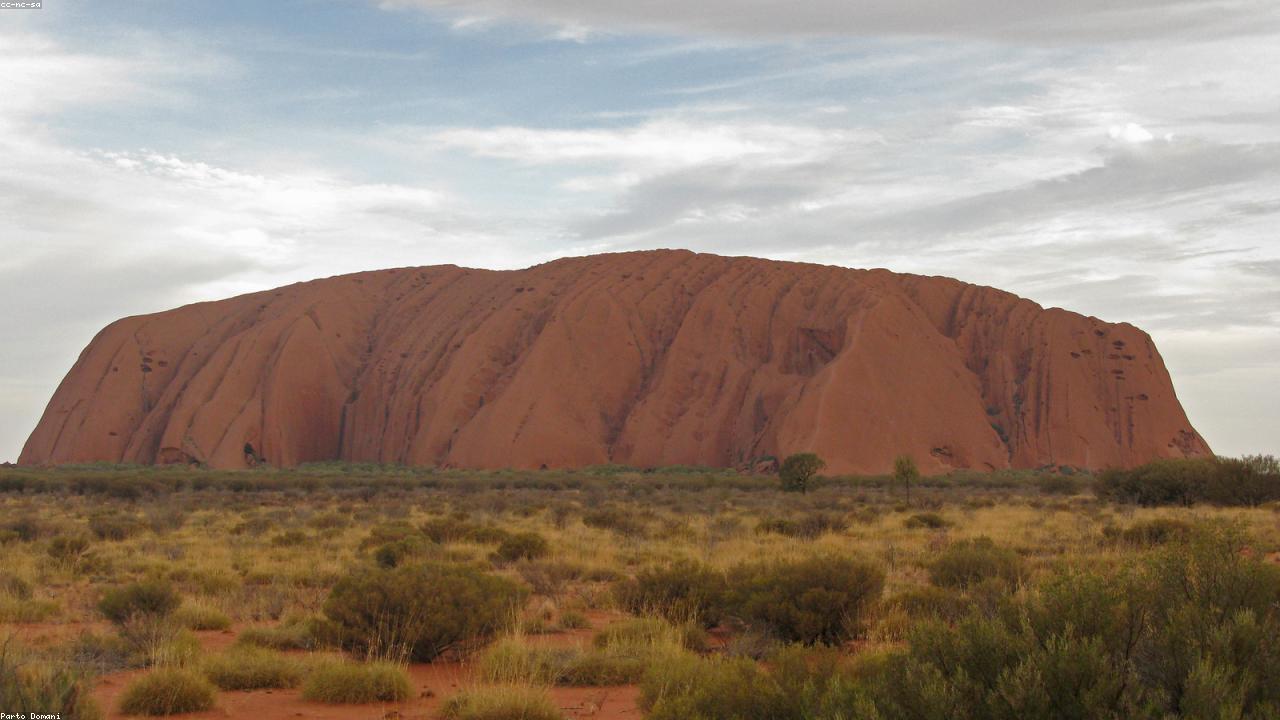
Photo: Ščenza
Yulara, Australia · Oceania
Uluru: the desert monolith at the heart of Australia
Uluru — the great red sandstone monolith in the centre of Australia — is one of the most photographed natural features on earth and a deeply sacred site for the Anangu people who have managed this land for tens of thousands of years. Walking around its base, especially at dawn, is one of the most quietly extraordinary experiences in Australian travel.

By Ščenza
· updated · 4 min read
It’s 5:42 a.m. at the Mala car park at the base of Uluru and the rock is still mostly in shadow. The sky behind it is going from indigo to blue to the orange of about to be morning. The Mala Walk — a 2-km section of the 10-km base walk — starts here. I am alone except for a small group of Japanese hikers and a park ranger who is walking ahead to unlock the Kantju Gorge. The desert is silent except for the very high call of a small bird I cannot see. The sandstone, in the next minute, will start to turn the colour the postcards capture.
Why I keep coming back
Uluru — formerly called Ayers Rock by the British, returned to its Pitjantjatjara name in 2002 — is the sandstone inselberg at the centre of the Australian continent. The exposed monolith is 348 m high and 9.4 km in circumference. The structure extends an estimated 6 km below the surface; what you see is the tip.
The rock has been a site of profound religious and cultural significance to the Anangu people — the traditional owners — for tens of thousands of years. The rock is managed jointly by the Anangu and Parks Australia. Climbing the rock — for decades a tourist staple — was permanently banned in October 2019 out of respect for Anangu wishes.
Where to base yourself
Yulara is the small purpose-built tourism town outside the national park boundary. Several accommodation tiers from camping to upper-end:
Sails in the Desert for the central upper-mid-range.
Longitude 131 for the luxury tented lodge with private rock views; one of Australia’s most-celebrated luxury properties.
Outback Pioneer for the budget option.
What to actually do
Walk the base of Uluru at sunrise. The 10-km base walk takes 3–4 hours at a moderate pace. The eastern side is best at dawn; the western side at sunset. Many Anangu sacred sites are marked ‘no photography’ and the request should be respected absolutely.
Sunrise from one of the Uluru viewing platforms. The east-facing platforms catch the rock as it begins to glow.
Walk Kata Tjuta (the Olgas). A 30-minute drive from Uluru; a separate, equally significant rock formation of dome-shaped monoliths. The Valley of the Winds walk is the classic 7.4-km circuit. Best in the morning before the heat.
Field of Light. Bruce Munro’s land art installation at the base of Uluru — 50,000 small lit stems across the desert floor. Started as a temporary installation in 2016, the Anangu invited it to remain. Best at the post-sunset slot.
Dot-painting workshop or Anangu cultural tour. Several operators offer indigenous-led cultural experiences; Maruku Arts runs the long-standing painting workshops. The Anangu-led tours give the cultural context that the standard ranger tour does not.
Dinner under the stars at Sounds of Silence. A multi-course outdoor dinner in the desert with a didgeridoo and astronomy presentation; touristy and worth doing once.
Where to eat
Food at Yulara is mostly hotel-restaurant-based with limited options.
Tali Wiru (literally ‘beautiful dune’) — A small-group outdoor dinner-under-the-stars experience; the upper-end of the regional dining options.
Mayu Wiru at Sails in the Desert — The mid-range option.
Outback BBQ at the Outback Pioneer for the casual.
Wintjiri Wiru — A drone-and-projection light show with dinner; the newest of the regional experiences.
When to come
May through September is the cool season — daytime 18–25°C, cold nights (sometimes below freezing).
December through February is the hot season — daytime 35–45°C; walks must be done at dawn; some walks close above 36°C.
Practical notes
- Visa: ETA.
- Money: Australian dollar.
- Park pass: 3-day park pass currently AU$38 per adult.
- Transport: Direct flights from Sydney, Melbourne, and Cairns to Ayers Rock airport (AYQ), 10 minutes from Yulara. Alternatively a 5-hour drive from Alice Springs.
- Climbing: The Uluru climb is permanently closed. Respect this; don’t try to climb.
- Sacred-site photography: Some sections of the rock are marked as no-photography; the signs are clear; respect them. The Anangu request privacy for these sacred sites because the images themselves carry cultural significance.
- The flies: A real feature of the Australian desert; a fly net (sold at Yulara) is genuinely useful.
- Distance: Uluru is genuinely remote — 450 km from the nearest town (Alice Springs). The flight or a long drive is unavoidable.
A final thought
Uluru is one of the most distinctive natural features on earth and one of the most culturally consequential indigenous sites accessible to non-indigenous visitors. The combination of the rock’s visual power, the Anangu cultural depth, and the surrounding desert silence makes the visit one of the most quietly impressive in Australian travel.
The post-2019 closure of the climb has, in my view, significantly improved the visitor experience. The rock is now visited as a sacred site rather than a tourist conquest; the Anangu-led tours have grown; the cultural respect is more visible.
Three nights minimum. Walk the base at dawn. Visit Kata Tjuta in the morning. See the Field of Light at dusk. Take an Anangu-led tour. The rock has been here for 500 million years and culturally important for tens of thousands. The visitor is briefly part of a story much longer than themselves; the appropriate response is patience, attention, and respect.
If you only have a few days
5 ideal things to do in Yulara
The free ranger-guided Mala Walk
Mala car park, northwest face of UluruMorning — earlier in the hot months, later in the cool ones
Parks Australia rangers walk this two-kilometre stretch every day, it costs nothing, and it is better than most of what is sold out of Yulara. You get the Mala story, the rock shelters, the cooking hollows, the ochre, and an explanation of the no-photography sections that actually lands once you have heard the reasoning. It finishes at Kantju Gorge, where the wall goes straight up and the sound of the place changes. Turn up early — there is no booking and no queue system, just a ranger and a hat.
Uluru-Kata Tjuta Cultural Centre
Inside the park, a short drive from the rockThe middle of the day, when the light is flat and the flies win
Mud brick, low, laid out to Anangu design, free, and the one place in the park with an air-conditioned reason to slow down: the Tjukurpa tunnel, an information room in several languages, and two galleries where Anangu artists work — Maruku and Walkatjara. Money spent here goes where it should, which is not true of everything sold at the resort. There is a picnic area behind with the rock in full view. Give it two hours, on your first day, so the rest of the trip means something.
Kuniya Walk to Mutitjulu Waterhole
South side of UluruLate afternoon. After rain it is a different place entirely
Short, flat and mostly in shade, which makes it the walk you can still do on a day when the base loop is out of the question. It ends at a permanent waterhole tucked against the rock wall, dark green and absolutely still, with rock art in the shelter above it. The Kuniya and Liru story is written into the geology here and the signs will show you where; once you have seen the marks it leaves in the stone you cannot stop seeing them. I sat there forty minutes and a bird came down to drink and that was the afternoon.
Walpa Gorge, Kata Tjuta
Forty minutes' drive west of UluruEarly morning. Valley of the Winds shuts when it gets hot
Everyone does the Valley of the Winds and then drives away, and Walpa is the short walk on the other side that gets skipped for being easy. It runs up a slot between two of the domes on a gentle rock ramp, and the wind funnels through it without stopping — walpa is the word for wind. At the top there is a patch of spearwood, some shade, thirty-six conglomerate domes stacked around you, and no sound whatsoever except moving air. Twenty minutes each way, and worth an hour.
Cycle the Uluru base loop
Bike hire at the Cultural CentreFirst thing, ahead of the heat and the coaches
Ten and a bit kilometres round the base; walking it takes most of a morning, and riding it takes under two hours, which means it can be done before breakfast by a person who still wants a day afterwards. The track is flat, sandy in patches, and you get off and walk at the sacred sections, which is correct. My one complaint about the bicycle is that it makes it very easy to go past things, and this is emphatically not a rock you want to go past.
From a Split boy’s notebook
The Split lens
What reminded me of home
A single iconic rock at the centre of a country's tourism identity, with an indigenous community whose voice has been gradually restored to managing the site. Our Diocletian's Palace is, on a smaller scale, a similarly central national heritage site with a similar question about whose voice manages it.
What Split could borrow
Uluru permanently banned climbing in 2019 out of respect for the Anangu traditional owners. The decision lost some tourism in the short term and increased respect (and visit quality) in the long term. Our equivalent — the unrestricted access to the substructure tunnels under Diocletian's Palace, often used for events — has heritage costs we don't account for. Stricter access discipline is needed.
Who can take you
Tour operators & guides to try
A short, opinionated starter list — just my humble opinion. Verify before booking.
Intrepid Travelsmall groupwww.intrepidtravel.com →
Intrepid's Red Centre trips do Uluru with Kata Tjuta and Kings Canyon over 3–5 days. Group size 12–16. They use Yulara accommodation (the only base for non-private-resort visits) and arrange the dawn and dusk Uluru sessions properly. Caveat: the Field of Light installation is worth doing once — verify your itinerary includes it; the standard Intrepid trip used to include it but check current bookings.
Audley Traveltailoredwww.audleytravel.com →
Audley Travel's tailored Australia trips treat Uluru as a 2–3 night component, typically with the Longitude 131 lodge or the smaller Sails in the Desert. Upper-tier pricing. Caveat: Longitude 131 is at the upper end of Australian accommodation pricing (~AU$2,000 per night per person); for travellers who want the dawn Uluru view from a private deck, it's worth it; for others, the standard Yulara hotels are perfectly adequate.
If you liked this, try these
Hobart, Australia
Tasmania: Australia's island state and its wild Southwest
April 15, 2024
Uyuni, Bolivia
Salar de Uyuni: the white horizon and the highest desert in the world
March 4, 2023
Rotorua, New Zealand
Rotorua: the geothermal North Island and the Māori heart of New Zealand
December 12, 2022