Europe
Hallstatt, Austria
Hallstatt at dawn: a tiny Alpine village before the buses
February 22, 2024
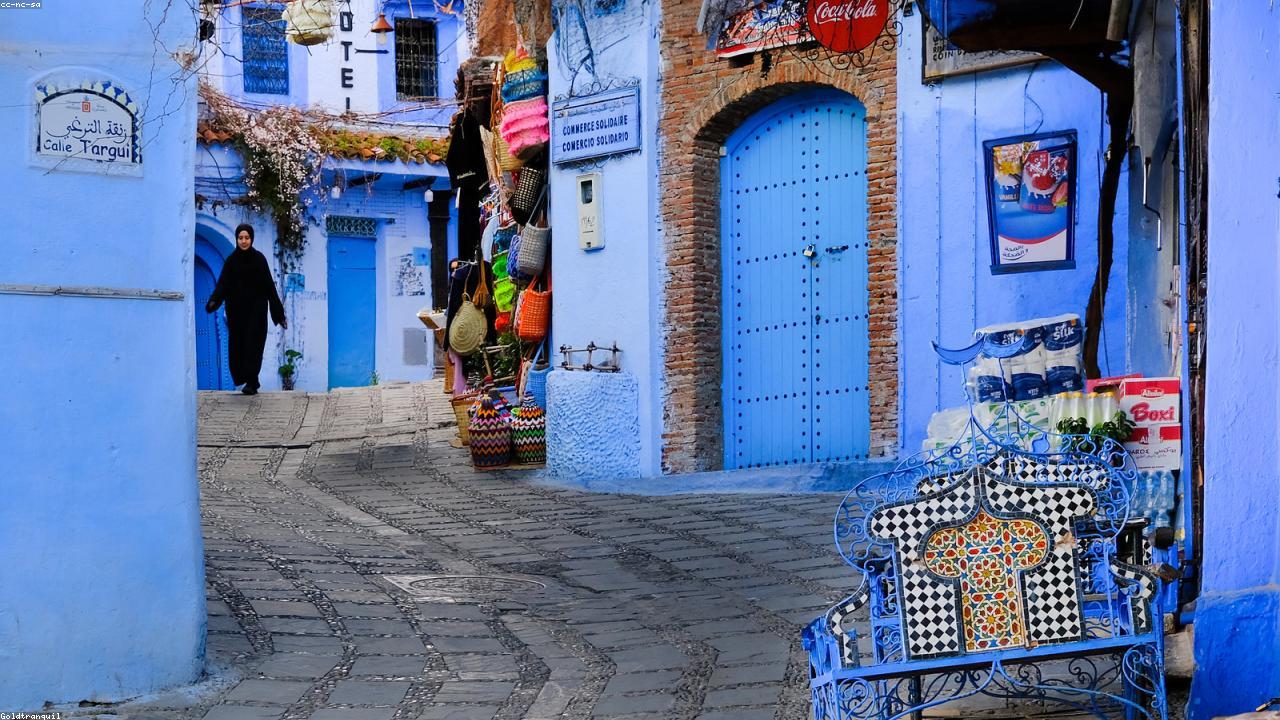
Photo: Ščenza
Chefchaouen, Morocco · Africa
The short list, pulled out of the long essay. No opening hours, because they change and I would only get them wrong — just what is worth your morning, roughly when to turn up, and where I have wasted time so you don’t have to.
By Ščenza
Last checked
Centre of the medinaBefore eight in the morning, or after eight at night
Everything in this town funnels into one square, with the fifteenth-century kasbah along one side and the Grand Mosque on another, its minaret octagonal rather than square — an unusual shape for Morocco, and the giveaway that the place was founded in 1471 by Andalusians who had just been pushed out of Spain. Between roughly ten and four the square belongs to the day buses from Tangier. Before and after, it belongs to old men, cats, and somebody methodically sweeping. Diocletian's Peristyle in Split runs the same two-shift arrangement, and I have made the same scheduling mistake in both places.
Plaza Uta el-HammamThe middle of the day, when the medina outside is at its worst
Small museum, modest holdings — Rif weaving, old photographs, some archaeology — inside the restored fifteenth-century fortress on the main square, with an Andalusian garden in the courtyard that is the only genuinely cool spot in the town centre at two in the afternoon. Climb the tower. From up there the medina is not the cobalt of the alley photographs but a roofscape of terracotta and satellite dishes with blue showing only in the gaps between, which is a considerably more honest portrait of the place.
Eastern edge of the medina, at the foot of the mountainMorning, and briefly — this is somebody's workplace
Where the mountain water arrives in the town: a stone spout, a run of washing slabs, and women doing laundry in cold water as they have for centuries, while a rotating audience of visitors photographs them doing it. Do not join that audience. Walk through, keep the camera down, take a mint tea on one of the small terraces above the stream, then carry on up the path towards the ruined mills, where within two minutes the noise stops and there is nobody working at all.
On the hill east of the medina, about half an hour up on footDawn, not sunset
Built in the 1920s during the Spanish protectorate and never really brought into use, it sits on a bare hill with the best view there is of the blue town below. Everybody goes at sunset, and the hilltop becomes a crowded terrace with drones over it. At dawn there were four of us and a dog, the light was coming onto the medina from the east instead of from behind it, and the walk up in the cool cost nothing. Same view, opposite hour, a tenth of the people. The path is steep but impossible to lose.
Talassemtane National Park, about half an hour's drive north-eastSpring or early autumn; summer weekends fill with Moroccan families
There are two walks from the same trailhead: upstream to a pair of waterfalls with pools that families swim in all summer, or the shorter and steeper climb to the Pont de Dieu, a natural rock arch standing over a gorge and looking structurally implausible right up until you are on top of it. The park was created in 2004 to protect the last of Morocco's fir forests. I did both walks on the same day in the wrong shoes and spent the following morning entirely horizontal on a roof terrace, which I now recommend as a plan in its own right.
The long version
Chefchaouen — universally and a little reductively known as 'the Blue City' — is a small mountain town in northern Morocco where the medina is washed in shades of cobalt, sky blue, and indigo. The blue is the postcard. The slower, kif-scented mountain life is the longer reward.
Read the full essay →