Caucasus
Yerevan, Armenia
Yerevan: the pink city under Ararat
May 30, 2023
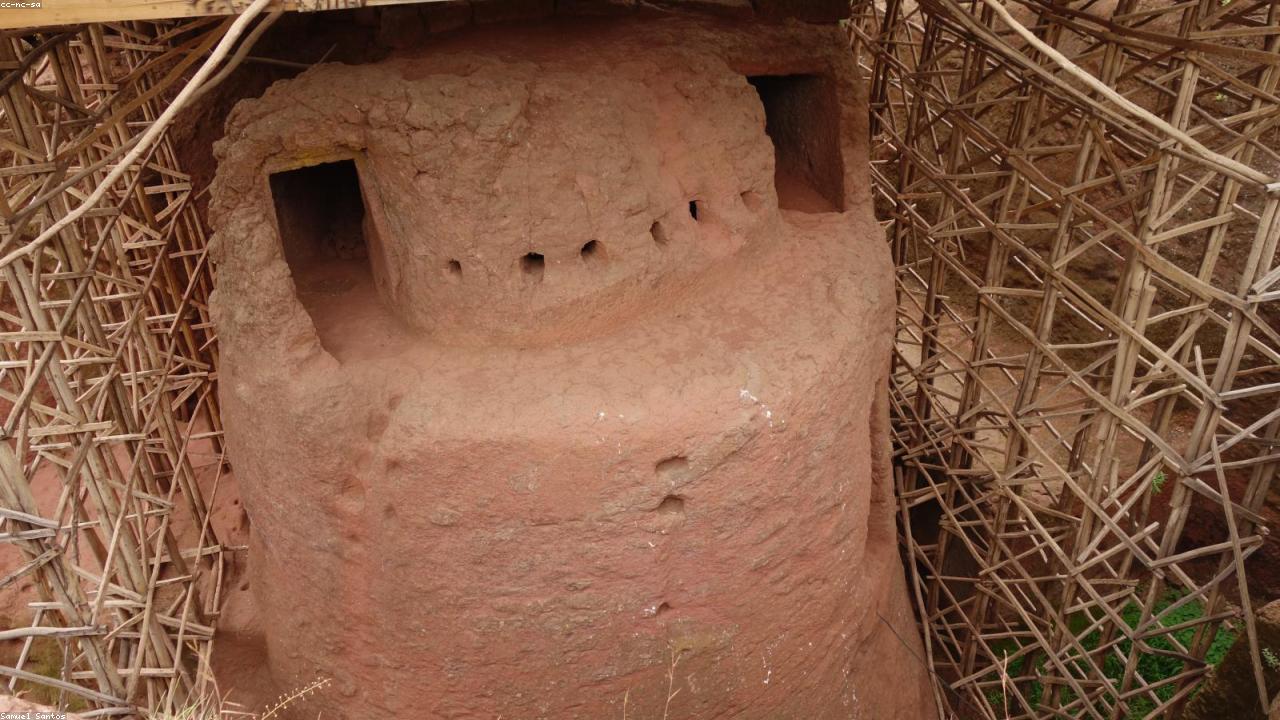
Photo: Ščenza
Lalibela, Ethiopia · Africa
The short list, pulled out of the long essay. No opening hours, because they change and I would only get them wrong — just what is worth your morning, roughly when to turn up, and where I have wasted time so you don’t have to.

By Ščenza
Last checked
The standalone church, west of the two clustersDawn, before the day's guided groups arrive
You arrive at ground level and the church is below you: a Greek cross cut down into red volcanic rock, deep enough that the first thing you ever see of it is the roof. Chant comes up out of the trench before you see a single person. I stood there in fog at a quarter to six with my hands pulled into my sleeves, entirely unprepared for how cold a highland morning is at 2,500 metres, and did not move for a long time.
Bete Medhane Alem, Bete Maryam and the smaller chapelsMorning, before the light gets hard
Bete Medhane Alem is thought to be the largest monolithic church in the world — one building, no joins, cut downward out of the bedrock with hammers and chisels. Without a guide you will see eleven interesting holes in the ground; with one you get the iconography, the logic of the trenches, and the etiquette for walking into a church where people are actually praying. Five of the churches sit under EU-funded steel canopies put up in 2008 and never taken down. They are ugly, and they are also why there is still rock left to look at.
Eastern group, on the way to Bete Gabriel-RufaelWhenever your guide takes you; carry nothing you would drop
The eleven churches are joined by trenches and passages hewn from the same rock, and one of them has no light in it at all — you go through with a hand on the wall, feeling for the turn. The dark is not a flaw in the design; it is the design. Pilgrims walk it as a passage through the underworld and come out the other side. I went through behind a Dutch couple, one of whom produced a phone torch and was asked, politely and with total finality, to put it away.
Cut into the Abuna Yoseph massif above town, around 3,100 mStart early; allow most of a morning, or about two hours by mule
A monastery carved into a cliff face six hundred metres above a town that already sits at 2,500, reached by a rocky path that does not flatter anyone who lives at sea level. You can take a mule for most of it. Everyone tells you there is no shame in that, which is how you know there is a little. A priest lives up there full-time. The view back down over the highland is the fee, and it is fair.
About 42 km north-east; roughly ninety minutes on a bad roadHalf a day, dry season only
This one is not carved out of the rock — it is built, in alternating layers of wood and pale stone, inside the mouth of a cave, and it is older than the Lalibela churches themselves. You walk the last stretch up through juniper woodland. Behind the building, back in the dark of the cave, are the remains of pilgrims who travelled here to die. The road out is genuinely rough and the four-wheel drive is not an upsell.
The long version
Lalibela's churches are not built. They are carved, downward, out of solid volcanic rock — eleven monolithic structures connected by underground tunnels, hewn over a century beginning in the 12th. They are also still in active liturgical use, 800 years on.
Read the full essay →