Photo: Ščenza
Lalibela, Ethiopia · Africa
Lalibela: the rock-hewn churches of Ethiopia's highlands
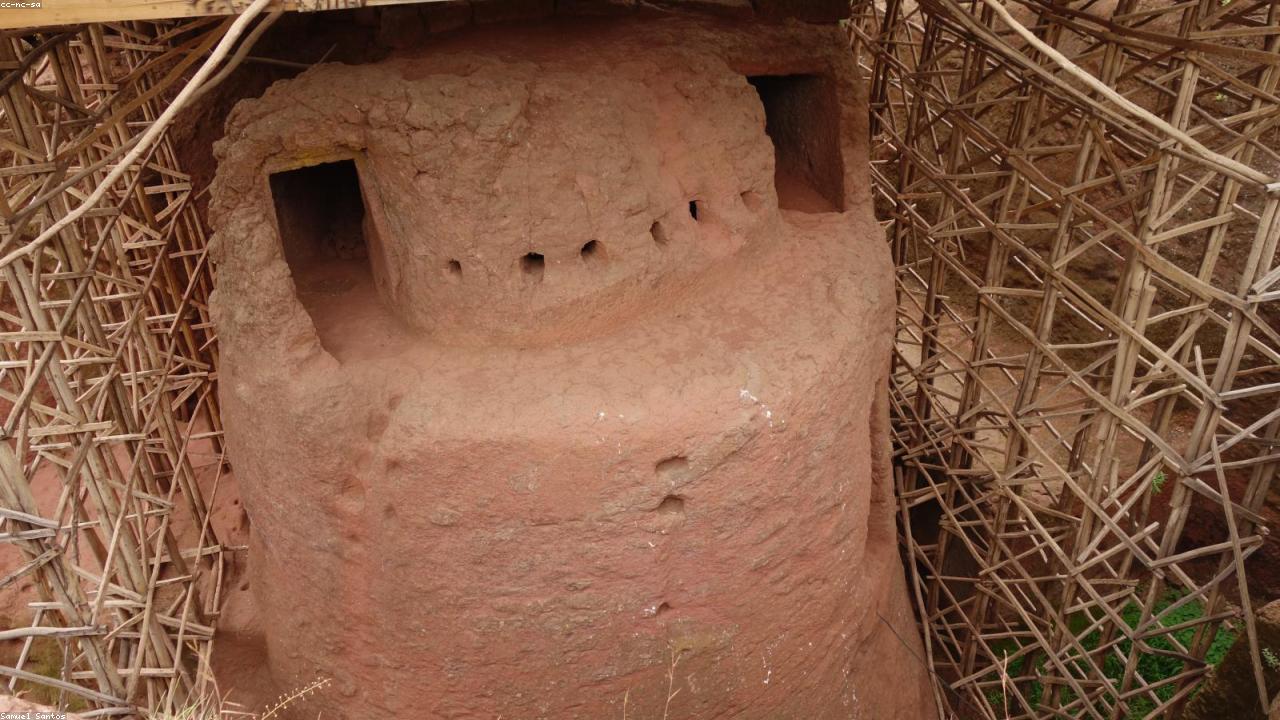
Lalibela's churches are not built. They are carved, downward, out of solid volcanic rock — eleven monolithic structures connected by underground tunnels, hewn over a century beginning in the 12th. They are also still in active liturgical use, 800 years on.

By Ščenza
· updated · 4 min read
It’s 5:45 a.m. at Bete Giyorgis — the Church of Saint George, the most photographed of the eleven rock-hewn churches of Lalibela — and a chanted Ge’ez liturgy is rising up out of the cross-shaped pit in the ground. The church is below me; from this vantage on the rim of the excavation, I am looking down at its cruciform roof. Priests in white robes are walking the surrounding processional galleries. The morning fog is just lifting off the highland. The temperature is, agreeably, about 11 degrees. This is the Lalibela morning.
Why I keep coming back
Lalibela is the second-most important pilgrimage site in Ethiopian Orthodox Christianity (after Aksum) and one of the most extraordinary architectural achievements anywhere. King Lalibela of the Zagwe dynasty, in the late 12th and early 13th centuries, commissioned the carving of eleven monolithic churches out of the volcanic tuff bedrock. The technique: dig a deep rectangular trench, then chisel the inner block down into a freestanding church, hollow out the interior, and excavate connecting tunnels. The result is a complex of below-ground basilicas, accessible by stepped passages, that has been in continuous liturgical use for eight centuries.
Ethiopia is also the only African nation that was never colonised (except for the brief Italian occupation of 1936–41), and the country’s Christian tradition is one of the oldest in the world — Ethiopian Orthodox Christianity dates to the 4th century AD.
Where to base yourself
Lalibela town itself — small, walkable, the churches a 5–10 minute walk from most accommodations.
Mountain View Hotel, Maribela Hotel, or Tukul Village for the mid-range options.
Mezena Lodge, Sora Lodge, or Hotel Mountain View for the upper-end options with the highland-valley views.
What to actually do
Visit the churches with a licensed guide. Two clusters — the northern group (Bete Medhane Alem, the largest; Bete Maryam; the smaller chapels) and the southern group — plus the standalone Bete Giyorgis. A guide is essential; the iconography, the priest culture, the underground tunnels between churches are not legible without one. About 1500 birr for a full-day guide.
Witness an early-morning service. The churches open at dawn for liturgy; visitors can stand respectfully at the entry. Dress modestly; shoes off.
Attend a festival if you can plan it. Ethiopian Christmas (Genna) on January 7 and Epiphany (Timkat) on January 19 are the major festivals; tens of thousands of pilgrims descend. The country’s January feast schedule offsets from the Gregorian by 7–13 days because the Ethiopian calendar is its own thing.
Trek to Asheton Maryam. A monastery on a cliffside above the town, an hour or two’s hike up. The view of the surrounding highland and the church itself, embedded in the rock face, are worth the climb.
Walk through the village. Lalibela town is small, traditionally constructed of round stone tukul houses with thatched roofs; agricultural, mostly subsistence; the texture of rural highland Ethiopia.
Eat a traditional injera meal. Injera — a large sourdough flatbread of teff grain — is the bottom-of-the-plate base for all Ethiopian meals; you tear pieces and use them to scoop the various wat (stew) dishes. The vegetarian Wednesday and Friday fasting meals (yetsom beyaynetu) are particularly good.
Where to eat
Food options in Lalibela are limited but the local Ethiopian cooking is excellent.
Ben Abeba — A distinctive multi-level architectural restaurant on a hillside; Scottish-Ethiopian fusion; the building itself is the show. Mountain View Hotel restaurant — Reliable mid-range; the kifto (Ethiopian raw beef tartare, like steak tartare with chili butter) is a specialty. Hotel Tukul Village restaurant — Ethiopian fasting meals (vegetarian) particularly good. Local injera houses in the town — small, cheap, the proper Ethiopian eating experience. Ask your guide. Coffee ceremony: every guesthouse will offer the full three-rounds coffee ceremony at some point during your stay; sit, drink the coffee, smell the frankincense; it’s a particular Ethiopian ritual.
When to come
October through March is the dry season — the highland is clear, the temperatures pleasant.
January 7 (Genna) and January 19 (Timkat) are the religious festivals; accommodation books a year ahead.
April through September is the rainy season; less reliable for travel.
Practical notes
- Visa: Ethiopian e-visa is the standard route for most Western passports.
- Money: Ethiopian birr; ATMs reliable in Lalibela; cash mostly.
- Getting there: Domestic flight from Addis Ababa (the only practical route). Ethiopian Airlines has multiple daily flights.
- Altitude: Lalibela is at 2500 m. Some travellers feel the altitude on arrival; take it slow on day one.
- Dress code at churches: Shoulders and knees covered; shoes off when entering.
- Tipping at the churches: The priests sometimes display the church’s most sacred crosses (a small per-display tip is appropriate); the singers (debteras) and the candle-bearers similarly.
- The 2020–2022 conflict in northern Ethiopia affected the Tigray region significantly. Lalibela is in the Amhara region; check current safety and access advisories before booking.
A final thought
Lalibela is one of the most extraordinary architectural and liturgical sites I have visited and one of the least promoted in the standard travel-magazine canon. The combination of the medieval rock-cut architecture, the continuous Ethiopian Orthodox liturgical use, and the highland setting at 2500 m makes the place genuinely without analogue.
The pilgrimage character of the site is not performed for visitors. The priests are doing what they have been doing for 800 years. The pilgrims walking on the surrounding hills, in white shamma cloths, are doing what their grandparents did. Visitors are tolerated but not catered to.
Go for three or four nights. Hire a licensed guide. Witness an early-morning service from a respectful distance. Trek to Asheton Maryam. Eat injera with the right hand. Sit for the coffee ceremony. The country is old. The churches are older. The highland air is thin and clear, and it has been clearing those churches’ chants for centuries.
If you only have a few days
5 ideal things to do in Lalibela
Bete Giyorgis from the rim at first light
The standalone church, west of the two clustersDawn, before the day's guided groups arrive
You arrive at ground level and the church is below you: a Greek cross cut down into red volcanic rock, deep enough that the first thing you ever see of it is the roof. Chant comes up out of the trench before you see a single person. I stood there in fog at a quarter to six with my hands pulled into my sleeves, entirely unprepared for how cold a highland morning is at 2,500 metres, and did not move for a long time.
The northern cluster with a licensed guide
Bete Medhane Alem, Bete Maryam and the smaller chapelsMorning, before the light gets hard
Bete Medhane Alem is thought to be the largest monolithic church in the world — one building, no joins, cut downward out of the bedrock with hammers and chisels. Without a guide you will see eleven interesting holes in the ground; with one you get the iconography, the logic of the trenches, and the etiquette for walking into a church where people are actually praying. Five of the churches sit under EU-funded steel canopies put up in 2008 and never taken down. They are ugly, and they are also why there is still rock left to look at.
The dark tunnel between the eastern churches
Eastern group, on the way to Bete Gabriel-RufaelWhenever your guide takes you; carry nothing you would drop
The eleven churches are joined by trenches and passages hewn from the same rock, and one of them has no light in it at all — you go through with a hand on the wall, feeling for the turn. The dark is not a flaw in the design; it is the design. Pilgrims walk it as a passage through the underworld and come out the other side. I went through behind a Dutch couple, one of whom produced a phone torch and was asked, politely and with total finality, to put it away.
Trek up to Asheton Maryam
Cut into the Abuna Yoseph massif above town, around 3,100 mStart early; allow most of a morning, or about two hours by mule
A monastery carved into a cliff face six hundred metres above a town that already sits at 2,500, reached by a rocky path that does not flatter anyone who lives at sea level. You can take a mule for most of it. Everyone tells you there is no shame in that, which is how you know there is a little. A priest lives up there full-time. The view back down over the highland is the fee, and it is fair.
Yemrehanna Kristos, the church inside a cave
About 42 km north-east; roughly ninety minutes on a bad roadHalf a day, dry season only
This one is not carved out of the rock — it is built, in alternating layers of wood and pale stone, inside the mouth of a cave, and it is older than the Lalibela churches themselves. You walk the last stretch up through juniper woodland. Behind the building, back in the dark of the cave, are the remains of pilgrims who travelled here to die. The road out is genuinely rough and the four-wheel drive is not an upsell.
From a Split boy’s notebook
The Split lens
What reminded me of home
Religious pilgrimage town with a continuous Christian-Orthodox tradition stretching back to the early centuries. The rock-hewn churches and the priests in white robes are structurally a stranger and older version of what Easter Week in our small villages on Hvar and Brač still looks like — torch-lit processions, the bells, the deeply held religious-cultural identity.
What Split could borrow
Lalibela's churches are still living liturgical spaces, not museums — the Mass continues; the visitors observe from a respectful distance. Our Diocletian's Mausoleum / Cathedral of Sveti Duje has slid toward becoming a museum-with-occasional-services. Re-prioritising the liturgical life over the visitor traffic would do for our cathedral what Lalibela has done for its churches.
Who can take you
Tour operators & guides to try
A short, opinionated starter list — just my humble opinion. Verify before booking.
Wild Frontierssmall groupwww.wildfrontierstravel.com →
Wild Frontiers' Ethiopia trips run Lalibela in their northern-circuit itinerary alongside Aksum, Gondar, and the Simien Mountains. Group size 8–12. Strong local guiding; the rock-hewn churches are explained with the proper Orthodox-liturgical context. Caveat: the country's post-2020 political situation has been volatile; itineraries occasionally re-route around Tigray. Verify current safety advisories at booking.
Steppes Traveltailoredwww.steppestravel.com →
Steppes Travel's Ethiopia program is the tailored-and-private alternative — same circuit potentially, but with private vehicles and guides, longer stays at Lalibela for the festival timing (Genna in January, Timkat in mid-January), and access to the higher-end accommodation (Mezena Lodge, Sora Lodge). Upper-tier pricing. Caveat: same current-affairs caveat as Wild Frontiers.