Asia
Beijing, China
Beijing: the imperial city behind the smog and the headlines
July 7, 2023
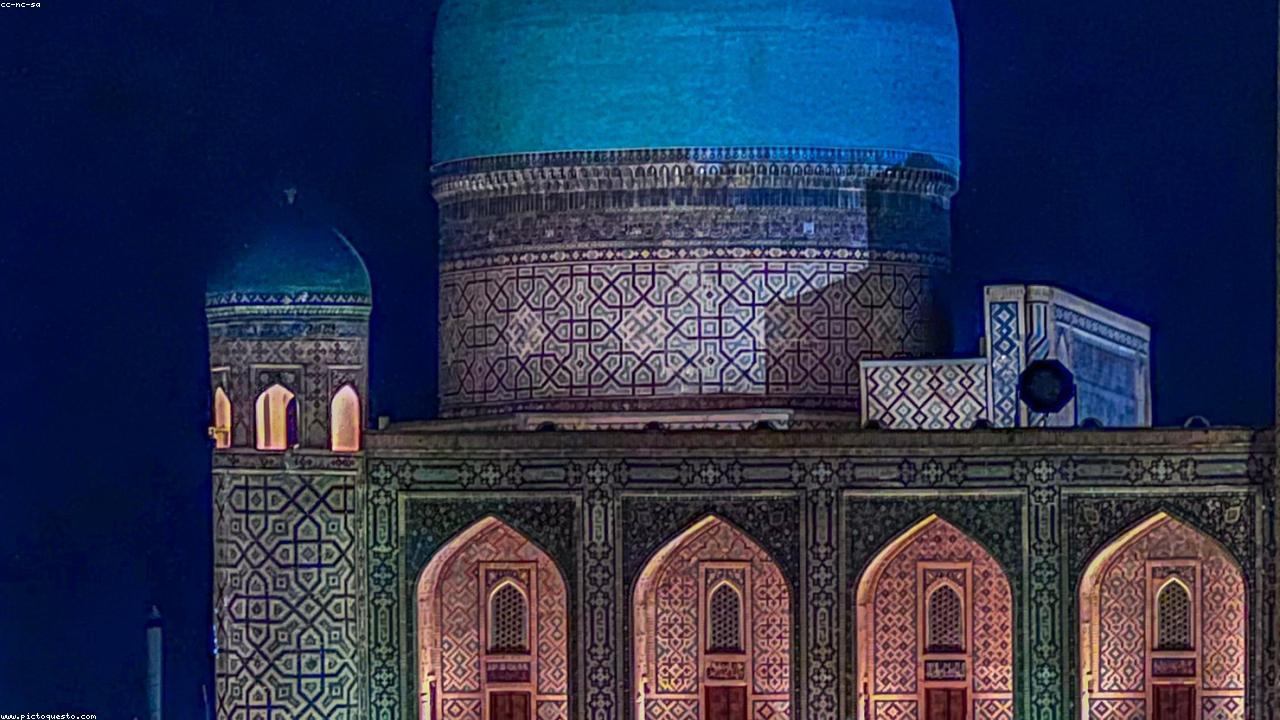
Photo: Ščenza
Samarkand, Uzbekistan · Central Asia
The short list, pulled out of the long essay. No opening hours, because they change and I would only get them wrong — just what is worth your morning, roughly when to turn up, and where I have wasted time so you don’t have to.
By Ščenza
Last checked
Central SamarkandDawn from the outside; the coaches land mid-morning
Three madrasas on three sides of one square: Ulugh Beg's from 1417 to 1420, the Sher-Dor of the 1630s with its tigers-and-rising-sun mosaic cheerfully ignoring the usual prohibition on living creatures, and the Tilya-Kori of the 1640s to 1660s, gilded inside to a degree that stops being architecture and becomes an argument. Come at dawn and watch the tile go from grey to that particular turquoise over about fifteen minutes. Bring your own tea and sit on the steps opposite. Later in the day it is a car park with a monument attached.
North-east, on the edge of the Afrasiyab moundEarly; the lane is one person wide in places
A narrow street of more than twenty mausoleums climbing a hillside, built and rebuilt between the eleventh century and the nineteenth and linked by small domed arches. The tilework gets denser and stranger the higher you go, until it stops resembling decoration and starts resembling obsession. Ulugh Beg's astronomer, Kazi Zade Rumi, lies under the double-domed tomb near the bottom — a very Samarkand ranking, in which the mathematician gets the good spot by the entrance. There is no overtaking on the stairs, so go before anyone else has had breakfast.
A ten-minute walk south of the RegistanAfter dark, when the dome is lit
The ribbed blue dome here is the ancestor of half the domes of Mughal India, including the famous one at Agra. Beneath a slab of dark green jade that had already served as a Chinese emperor's ceremonial stone and then as a Mongol khan's throne lies Timur, with two sons, two grandsons and his spiritual teacher. Soviet anthropologists opened the tomb on 20 June 1941 and rebuilt his face from the skull: about a hundred and seventy-two centimetres, and a heavy limp. Germany invaded two days later. Every guide in the city tells you the curse story and not one of them quite disowns it.
Between the Registan and the old townMorning, while the bread ovens are still going
Built after Timur's Indian campaign of 1399 at a hundred and sixty-seven metres by a hundred and nine, with a forty-metre dome, and bricks were dropping out of it within a few years — an overreach so complete it becomes almost likeable. An earthquake in 1897 took the portal arch; Soviet reconstruction started in 1974 and is still being funded. A vast marble Quran stand from Timur's own time sits in the courtyard. Then walk out the back into the produce market for bread the size of a bicycle wheel and dried apricots you will regret rationing.
North-east, on the road out past AfrasiyabCombine with Shah-i-Zinda; half an hour is enough
What survives is a trench. The underground portion of a sextant with a forty-metre radius, marble-lined, sunk into the hillside because building the instrument above ground would have needed a tower nobody could keep upright. The star tables produced here in the 1420s were not bettered for two centuries. Ulugh Beg was assassinated in 1449, the observatory was demolished, and the site stayed lost until the archaeologist Vyatkin dug it out in 1908. The museum takes twenty minutes; the arc itself takes five and is the part that stays with you.
About 80 km south of SamarkandA full day; the pass road is half the point
Timur was born near here and built a summer palace, the Ak-Saray, from 1380 with craftsmen deported from Khwarezm. What remains is two colossal gate towers with the arch between them long gone, still mosaiced in blue and gold, still ridiculous in scale. Be told in advance: UNESCO put the historic centre on its in-danger list in 2016 after the medieval fabric around the monuments was cleared for parks and parking, so what you get is great objects standing in a strangely swept setting. The drive over the pass is genuinely worth the day on its own.
The long version
Samarkand is the great Timurid capital, with the most extraordinary 14th- and 15th-century Islamic architecture in Central Asia. Uzbekistan has, since 2018, dramatically liberalised tourist access; the country is now one of the most rewarding regions in the world to visit.
Read the full essay →