Asia
Kyoto, Japan
Kyoto in the early hours: the old capital before the day-trippers
August 23, 2024
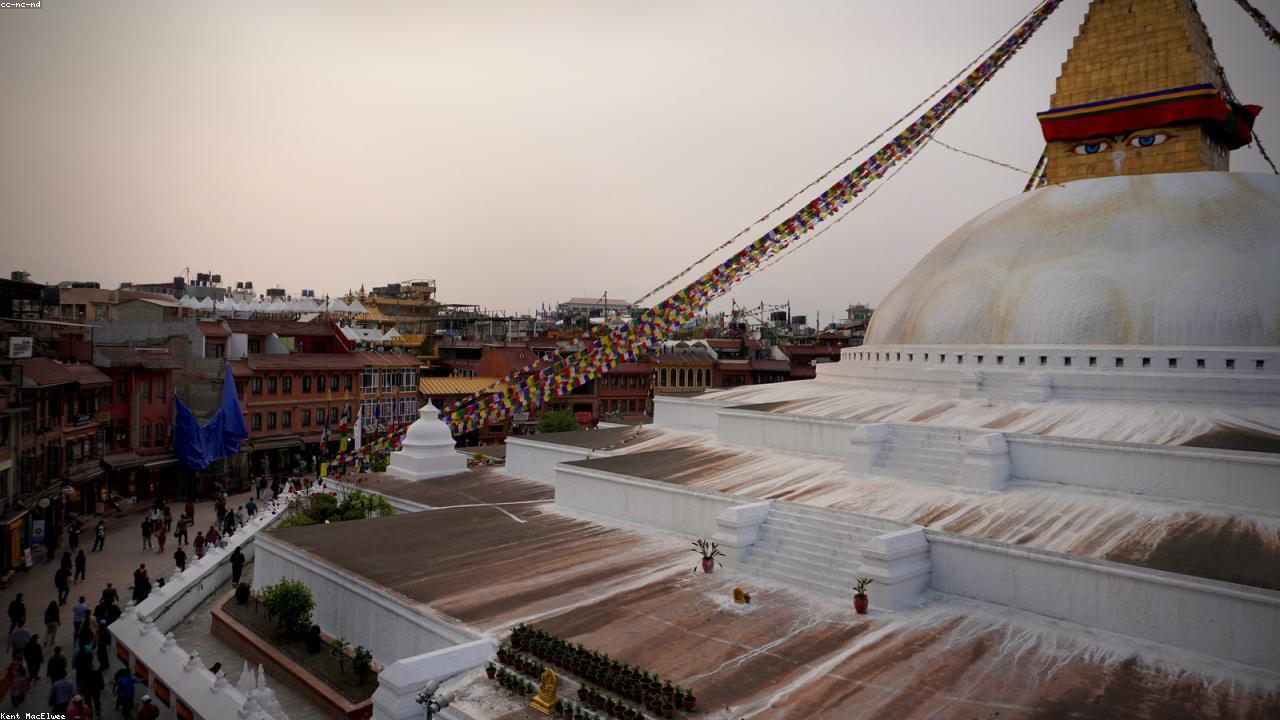
Photo: Ščenza
Kathmandu, Nepal · Asia
The short list, pulled out of the long essay. No opening hours, because they change and I would only get them wrong — just what is worth your morning, roughly when to turn up, and where I have wasted time so you don’t have to.

By Ščenza
Last checked
North-eastern Kathmandu, a few kilometres from ThamelFirst light, any morning
Thirty-six metres of white dome, the largest stupa in Nepal, and at dawn a slow clockwise river of people walking around it: Tibetan families, monks, shopkeepers, and one or two tourists visibly working out which way round to go. Clockwise. Always clockwise. The spire cracked in the 2015 earthquake and was rebuilt on private donations and thirty kilos of gold, reopening in 2016 — the first of the valley's World Heritage sites to come back. Juniper smoke, prayer wheels turning under a hundred hands, and no queue at all, because it is barely light.
Lalitpur, across the Bagmati from central KathmanduLate afternoon, when the temple plinths fill up
The museum inside the old royal palace explains Newar bronze casting well enough that you walk back out into the square and finally see what you have been looking at all week. Outside: the Krishna Mandir of 1667 with its twenty-one gilt pinnacles, the Bhimsen temple of 1680, and Sundari Chowk with its sunken Tusha Hiti water tank. The Hari Shankar temple collapsed entirely in 2015 and was fully rebuilt by 2023. Sit on the steps in the last hour of light and watch a UNESCO site being used, quite properly, as a living room.
About 13 km east of central KathmanduStay over; the day buses leave in the late afternoon
Bhaktapur is where the medieval Newar city survives best, and the argument for staying the night is pure arithmetic: everyone else is on a bus back to Thamel by evening, and then the 55-Window Palace of 1708, the Golden Gate of the 1750s and the whole brick-and-timber grid belong to the people who live there and to you. There is still a square where potters lay clay out to dry in the sun. Of ninety-nine original courtyards perhaps fifteen remain, and the 1934 earthquake did more of that damage than 2015 — which nobody mentions on the day tours.
Hilltop west of the cityLate afternoon, as the valley haze turns gold
Pratap Malla built these stairs in the seventeenth century and they go up in one unbroken line, steep enough that most people stop pretending at about two-thirds. Macaques own the hill and will take anything not zipped shut; I lost a bag of oranges in under four seconds, and the operation was so professionally executed I could not summon any real annoyance. At the top: the stupa, re-gilded in 2010 with twenty kilos of gold, painted eyes facing all four directions, and the whole valley smoking gently below you.
On the Bagmati, out towards the airportLate afternoon into the evening ritual
Non-Hindus cannot enter the main courtyard, so you cross the river and watch from the terraces opposite, which is honestly the better vantage point anyway. Below you, cremations proceed on the ghats in full view — families, wood, the river doing its work — and none of this is staged for anyone's benefit. Watch quietly, keep the camera down, and if that feels like more than you want, it is entirely reasonable not to come at all. The complex runs to 246 hectares and something over five hundred smaller shrines, so allow longer than you planned.
Old Kathmandu, north-east of Hanuman DhokaMorning, when the vegetable sellers hold the square
Six streets converge at Asan and the square they make has been trading since it sat on the road between India and Tibet. The Annapurna Ajima temple presides over it, the goddess represented by a heaped grain measure — the most practical piece of theology I have run into anywhere. Walk up from Indra Chowk through the textile and bead sellers and let the crowd move you along. There is nothing to tick off: just brass, spices, motorbikes threading through gaps that do not exist, and a smell that changes completely every fifteen metres.
Kaiser Mahal, at the edge of ThamelMidday, when Thamel is at its least bearable
A walled neo-classical garden built in 1920 for a Rana field marshal, left to collapse for four decades, then restored between 2000 and 2007 with Austrian funding. Pavilions, a pond, an amphitheatre, and the actual product on sale: silence, ten metres from one of the loudest streets in South Asia. I have gone in twice purely to stop being sold trekking equipment, sat under a pergola for an hour reading nothing, and walked straight back out into it.
The long version
Kathmandu is two cities — the dusty, traffic-choked, modern capital, and the medieval Newari city of pagoda temples, hidden courtyards, and 1500-year-old shrines. The second city is the one to come for.
Read the full essay →