Photo: Ščenza
Varanasi, India · Asia
Varanasi at dawn on the Ganges: India's oldest continuously inhabited city
Varanasi is not for everyone, and it does not pretend to be. The city is dense, intense, ancient, and dedicated to a kind of religious practice that does not soften itself for visitors. The morning river, at dawn, is the experience that justifies the journey.

By Ščenza
· updated · 5 min read
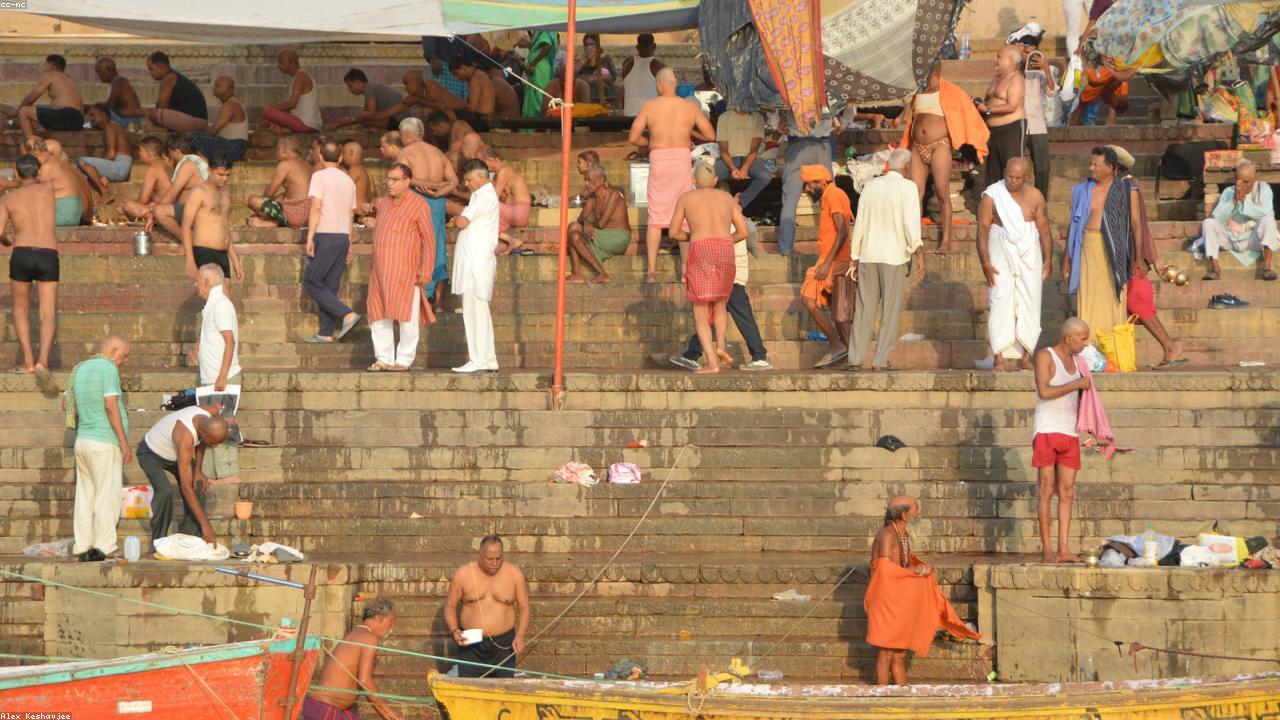
It’s 5:14 a.m. on the Ganges and I’m in a flat-bottomed wooden rowboat being pushed slowly past the bathing ghats of Varanasi. A boy of about twelve is rowing; he was rowing yesterday and the day before, and his father before him, and his grandfather before that. The mist is coming up off the river. On the ghats, pilgrims are stripping to bathe. A sadhu — an ascetic, ash-smeared, dreadlocked, naked except for a saffron cloth — is sitting cross-legged on a stone step, watching the river. Somewhere upriver, smoke rises from the cremation ghat. The city, which has been continuously inhabited for at least three thousand years, is doing what it has been doing for three thousand years.
Why I keep coming back
Varanasi (Kashi, Banaras) is one of the seven holy cities of Hinduism and arguably the most important. The Ganges flows north here, against its general direction, and the bathing of one’s body in the river at this stretch is considered to purify lifetimes of karma. The cremation at the Manikarnika and Harishchandra ghats — open-air, on wooden pyres, in full view of the river and the public — is the death-rite that Hindus across India hope for. The city has been the centre of Hindu philosophy, Sanskrit study, and classical Indian music for centuries.
It is, for the Western visitor, an experience without analogue. The proximity to death is the unsoftened feature. The cremations happen continuously, 24 hours a day, on pyres twenty metres from where pilgrims are bathing.
Where to base yourself
Near the ghats (Assi Ghat at the southern end is the calmer option; the central area around Dashashwamedh and Manikarnika is more intense). The narrow lanes behind the ghats are where the heritage guesthouses are.
What to actually do
Take a boat at dawn. A rowboat with a local boatman, hired from the ghats, around 500–800 rupees an hour. Start at 5 a.m. The boatman will row from the southern Assi Ghat past the entire 6.5-km riverfront of bathing ghats; the light is the experience. Allow two hours.
Walk the ghats in the early morning. All 84 ghats (named bathing terraces) line the riverfront for 6.5 km. The walk is the entire trip. Morning is mandatory — by midday the heat and the people make it harder.
Witness an aarti. The fire ceremony at Dashashwamedh Ghat at sunset; an elaborate, choreographed offering of fire to the Ganges, performed by Brahmin priests with brass lamps the size of footballs. Crowded, theatrical, free. Arrive at 5:30 p.m. for a seat on the steps or on a tied-up boat just offshore.
Visit the burning ghats respectfully. Manikarnika and Harishchandra. Photography is generally forbidden and locally enforced — you may be approached, sometimes aggressively, by the families and Doms (the lower-caste cremation specialists). Do not photograph. Observe quietly from a distance. Donations are sometimes solicited; small notes are sufficient.
Day-trip to Sarnath. 10 km north; the place where the Buddha gave his first sermon after his enlightenment. The Dhamekha Stupa from the 5th century, the small Sarnath museum with its famous Lion Capital. Half a day.
Hear classical Indian music. Varanasi is the home of the Banaras Gharana of Hindustani classical music. Evening concerts at the Sankat Mochan Temple during the spring festival or at the Tulsi Ghat at irregular intervals are not always easy to find but are extraordinary when they happen.
Where to eat
The food is vegetarian (the city is deeply observant), heavily spiced, and starch-rich. The street food is some of the best in north India.
Kachori sabzi at any of the morning stalls in the lanes — puffed pastries with potato curry, the local breakfast. Lassi at Blue Lassi — Banana, mango, almond — thick, served in clay cups. Chai at any street stall — Varanasi makes some of the best masala chai in India; the small kullad clay cups (smashed after use) are the local tradition. Banaras Restaurant at Hotel Surya — Reliable mid-range north Indian. Brown Bread Bakery (Bengali Tola lane) — A long-running expat-friendly café-bakery for when you want something familiar. Pizzeria Vaatika Café (Assi Ghat) — Travelling-cliché Italian, but the rooftop view is the value.
When to come
November through February. Pleasant temperatures, the river clear-ish.
Avoid April through September — extreme heat (45°C+) and monsoon flooding.
Dev Deepawali (the full moon two weeks after Diwali in November) is the city’s most spectacular festival — every ghat lit with thousands of oil lamps, the river floating with diyas. Accommodation books a year ahead.
Practical notes
- Visa: E-visa for most Western passports.
- Money: Cash is essential here. ATMs in the older centre are unreliable; carry small notes.
- Transport: From the airport, a pre-paid taxi to the ghats is the safest move. Tuk-tuks within the city; agree the fare before. The lanes behind the ghats are too narrow for cars.
- Health: Bottled water only; avoid raw vegetables and fruit unless you peel them; pack rehydration salts.
- The hassle: Real. The persistent touts, the unwanted boat ride offers, the ‘guide’ who attaches himself to you. Politeness and firmness are the strategy.
- The water of the Ganges: Holy. Also genuinely polluted. Do not bathe in it. Do not, despite local encouragement, drink it.
A final thought
Varanasi is, of all the cities I have written about, the one most resistant to a tidy travel-writer’s summary. The experience is unfiltered: religious life proceeds at full intensity, death is visible and continuous, the sensory load is enormous and at times overwhelming. Western visitors are sometimes startled in ways that leave a permanent mark.
What the city offers, if you can receive it, is the reminder of mortality as a present and unsoftened fact, performed continuously in a public landscape that has been doing this since before recorded history. The cremation fires never go out. The river keeps running. The boats are rowed by the same families. The bathers go in at dawn. The mist comes up.
Go for three or four nights, minimum. Take the dawn boat. Walk the ghats slowly. Don’t try to make sense of it on the first morning. Eat at the small vegetarian places. Sleep with the river noise. The city is older than your assumptions. Let it be.
If you only have a few days
6 ideal things to do in Varanasi
A rowboat from Assi Ghat at first light
Assi Ghat, the southern end of the riverfrontPush off around five; allow two hours on the water
Flat-bottomed wooden boat, one oarsman, six and a half kilometres of ghats sliding past on your right while the mist comes off the water and the bathers go in. Settle the hour and the fare on the bank rather than mid-river. The light between five and seven is the entire reason people come to this city, and it does not last long. My boatman mentioned that his father and grandfather had rowed the same stretch, with no particular emphasis, the way you would mention which bus you take to work.
Walk the ghats from Assi to Manikarnika
The full 6.5 km riverfront, on footEarly morning; the stone is punishing by mid-morning
Eighty-four named stone terraces along the river, and the walk between them is the trip. You pass laundry, cricket, goats, wrestling pits, sadhus, and eventually the cremation ground at Manikarnika, where the pyres burn continuously and have done for centuries. Put the camera away entirely there — this is enforced, and correctly so. Stand well back, keep quiet, and decline the man offering to walk you to a 'viewing terrace' for a donation. I did this first in sandals and arrived at Dashashwamedh with a blister and a much-revised sense of the day ahead.
The Ganga Aarti at Dashashwamedh Ghat
Central ghats, below Kashi VishwanathEvery evening at dusk; Tuesdays and festival days are the biggest
Brahmin priests on raised platforms swing brass lamps the size of footballs in choreographed unison for roughly forty-five minutes, free, with the crowd stacked up the steps behind them and more people watching from boats tied up offshore. You can take the steps or pay a boatman for a seat on the water, which is the better view and the worse sound. I have done both and I would take the steps, and I would get there early enough to feel faintly ridiculous about how early I was.
Subah-e-Banaras at Assi Ghat
Assi Ghat, southern endDaily, the two hours before sunrise
A free morning programme the state started in 2014 — Vedic chanting, a fire ritual, yoga, and then Banaras-gharana classical music played to the river as the light comes up. It runs about two hours and it genuinely is for whoever turns up. Sit at the back on the steps and do not get in the way of the people doing the yoga. I arrived expecting a production staged for visitors and found mostly local people who plainly do this every morning, plus one flautist I have thought about at odd moments ever since.
Sarnath
8 km northeast; half a day including the driveMorning, back in the city for lunch
Here the Buddha gave his first sermon after his enlightenment, and the Dhamek Stupa that marks the spot is thirty-nine metres of brick and carved stone. The archaeological museum next to it holds the Ashokan lion capital from around 250 BCE — the one reproduced on every Indian banknote and passport. Modern temples built by Thailand, Japan, Tibet, Myanmar and half a dozen other traditions ring the site. After two days on the ghats the silence out here is close to medically necessary.
Ramnagar Fort across the river
14 km, on the east bank of the GangesLate afternoon; October if you want the Ramlila
The Maharaja of Benares still lives in part of it, so you see only a section — but that section is the Saraswati Bhawan, a museum of vintage American cars, lotus-shaped palanquins, weapons from three continents, and an astronomical clock built in 1852 that tracks the sun, the moon and the constellations. Nothing is well labelled. Half the cases resemble somebody's attic, and I mean that as praise. The month-long Ramnagar Ramlila runs across the town in October with the Maharaja arriving on an elephant; if your dates are close, move your dates.
From a Split boy’s notebook
The Split lens
What reminded me of home
Sacred river-city with a dawn ritual that draws thousands without trying. The Varanasi ghats at 5:30 a.m. are an Indian version of what our Riva morning could be — fishermen, the muezzin-equivalent of our church bells, the slow first hour of the day with the locals' coffee and a swimming dip at Bačvice. We don't celebrate the dawn enough.
What Split could borrow
Varanasi's daily Ganga Aarti at sunset is theatrical, free, and the city's signature performance. We have the Peristyle — arguably the most beautiful natural amphitheatre in the Adriatic — and we use it for occasional concerts. A nightly summer ritual at Peristyle, performed by locals rather than imported acts, would become a signature Split evening.
Who can take you
Tour operators & guides to try
A short, opinionated starter list — just my humble opinion. Verify before booking.
Greaves Indiatailoredwww.greavesindia.com →
Greaves India's Varanasi component within a tailored north-India trip uses local Brahmin-trained guides who can explain the ghats' liturgical practice properly. The dawn boat ride is arranged at the right hour. Mid-to-upper-tier accommodation. Caveat: Varanasi is the kind of place where the right guide makes an enormous difference; if your budget allows a private guide for a single day, this is the day to spend it.
Intrepid Travelsmall groupwww.intrepidtravel.com →
Intrepid's Varanasi-as-part-of-a-longer-trip approach is competent — a 2-night stop, the dawn boat, an evening Ganga Aarti, a Sarnath day trip. Group size 12–16. Caveat: the city is intense, and the small-group format means you experience it together rather than alone, which is partly good (the shared processing helps) and partly limiting (you don't get the slow individual hours that the ghats reward). Build in a free morning.